Introduction
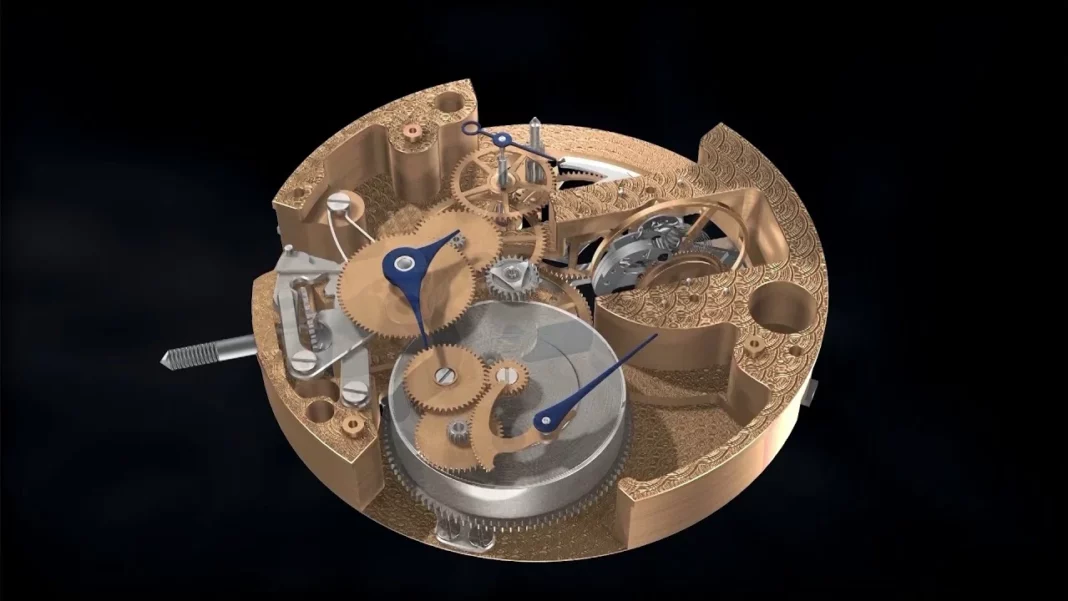
Horology preserves remarkable objects that function as timekeepers while documenting their makers’ technical knowledge. The Astronomical Clock constructed by Constantin Louis Detouche in the 19th century represents one such example and has recently undergone restoration. Originally presented at the 1855 Universal Exposition, the clock demonstrates the engineering methods and mechanical capability of its period.
The Legacy of Constantin Louis Detouche
Constantin Louis Detouche was a watchmaker and clockmaker whose work balanced functional operation with artistic form. The Astronomical Clock he built serves dual purposes: as a timekeeping device and as a working model of astronomical phenomena. Featuring multiple moving parts and calibrated dials, the clock embodies the technical accomplishments of its era, revealing contemporary scientific understanding of celestial mechanics.
Features of the Astronomical Clock
This clock displays lunar phases, the positions of the sun, and star locations. Its mechanisms are engineered to translate celestial movements into visual form across multiple dials. Each component reflects specific design decisions that Detouche applied consistently across his work.
The Restoration Process
The recent restoration involved a team of specialists who disassembled the clock to document its construction and operation. Each part underwent examination, with attention directed toward both mechanical function and visual elements consistent with the original design. The restoration prioritized preserving historical accuracy while returning the clock to working condition for future study and exhibition.
Challenges Faced
Restorers encountered practical obstacles related to the clock’s age and mechanical density. Worn components required careful removal and replacement using period-appropriate methods. Several parts demanded custom fabrication to match historical specifications. This work demanded continuous problem-solving grounded in knowledge of 19th-century horological practice.
Conclusion
The restored Astronomical Clock by Constantin Louis Detouche is now accessible to collectors and horological scholars. The object demonstrates how engineering precision and mechanical design converge in historical timekeeping. Those drawn to high-end timepieces may explore F.P. JOURNE collections, where contemporary watchmaking continues the investigative approach to mechanical complexity that defined Detouche’s practice.
Frequently Asked Questions
What astronomical displays does Constantin Louis Detouche’s Astronomical Clock feature?
The clock displays lunar phases, the positions of the sun, and star locations. Its mechanisms are engineered to translate celestial movements into visual form across multiple dials.
When was the Astronomical Clock by Constantin Louis Detouche originally presented?
The clock was originally presented at the 1855 Universal Exposition, demonstrating the engineering methods and mechanical capability of the 19th century.
What challenges did restorers face when working on the Astronomical Clock?
Restorers encountered practical obstacles related to the clock’s age and mechanical density. Worn components required careful removal and replacement using period-appropriate methods, and several parts demanded custom fabrication to match historical specifications.