
The Read
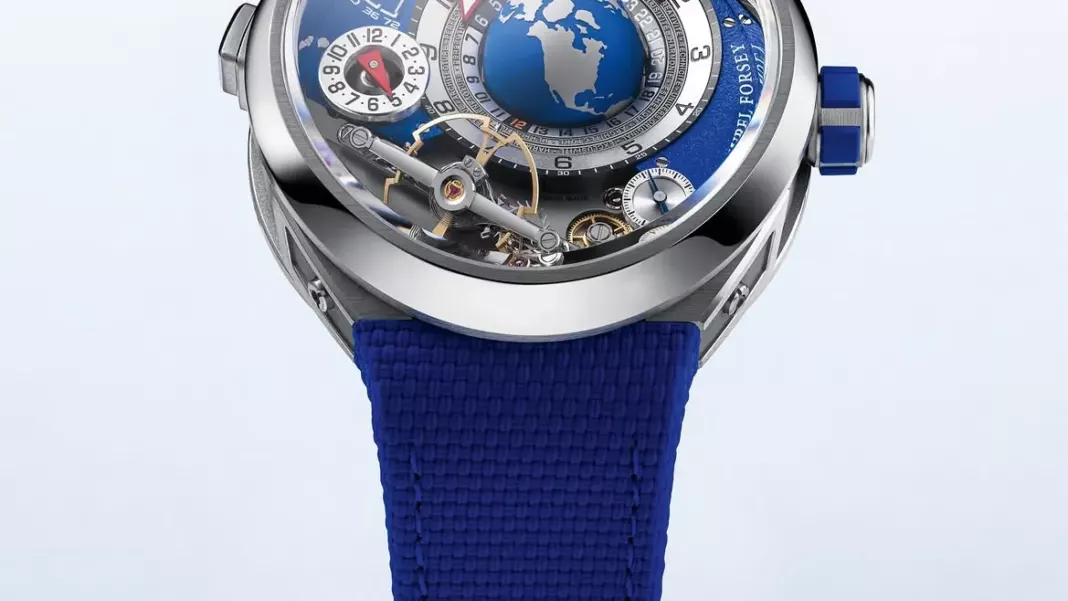
- 42.9mm curved titanium Convexe case, limited to 22 pieces: a production number set by the atelier’s hand-finishing capacity, not by commercial strategy.
- The GMT concept, first introduced in 2011, has been completely re-engineered here — 73 more components than its predecessor, totalling 496 across the calibre.
- A 30-degree inclined balance wheel at 6 o’clock replaces the tourbillon’s rotating cage, delivering equivalent chronometric correction with less mechanical mass.
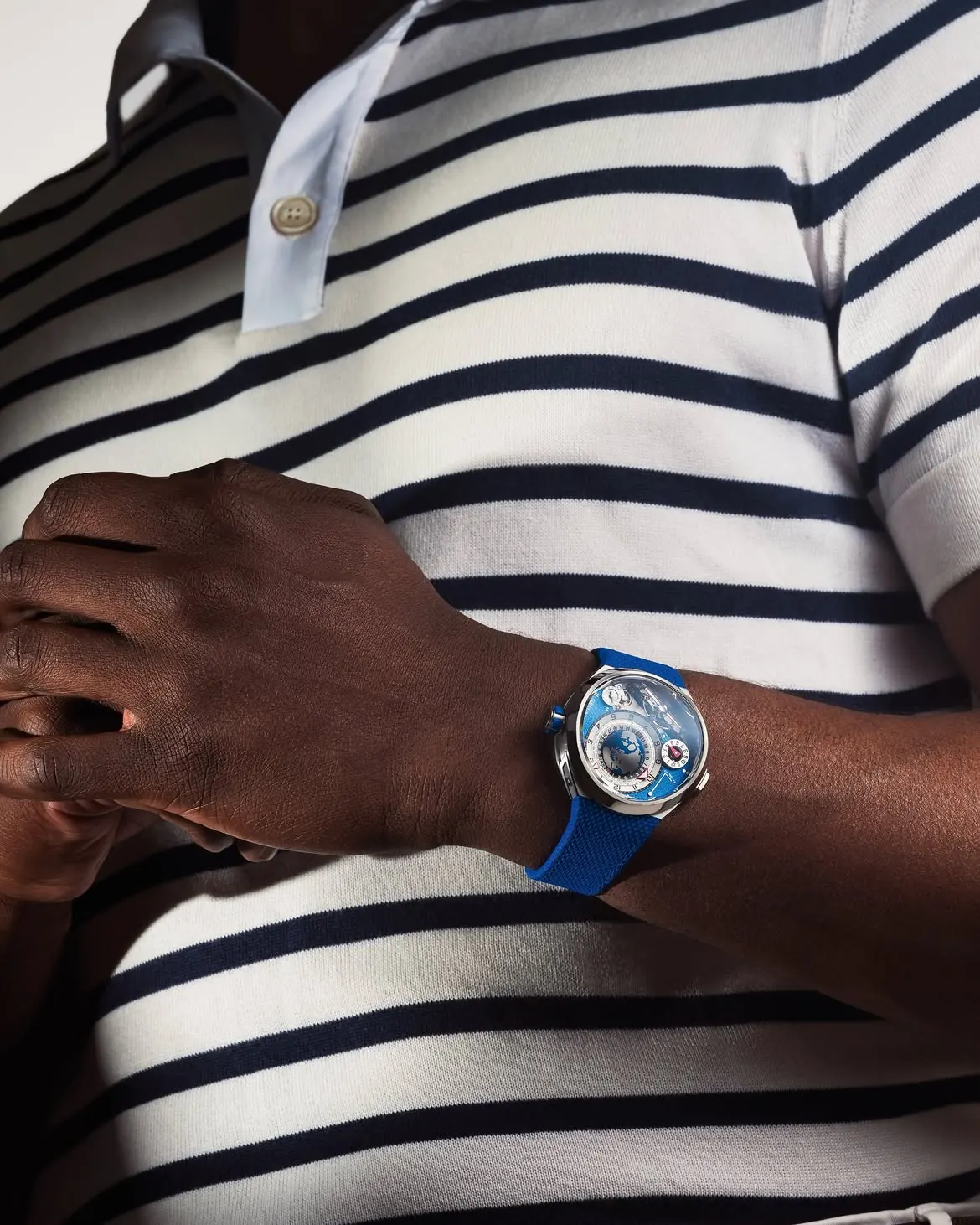
- The edition’s defining gesture: the blue of the globe’s oceans radiates outward across the dial, the hand-sewn rubber strap, and the crown inserts — one continuous colour across every surface.
The Complication at Its Centre
A titanium globe at the dial’s centre rotates once every 24 hours, its oceans in blue, its continents in relief, its motion precisely synchronised with the planet it represents. The dial around it is not flat but architectural — a multi-level amphitheatre that descends toward the globe, with hours and minutes on the outermost ring, a GMT subdial at 9 o’clock, small seconds at 5 o’clock, and a power reserve indicator at 11 o’clock. The 24-hour chapter ring encircling the globe uses black segments for night and white for day, so the watch conveys, at a glance, which cities are in darkness.
As Greubel Forsey framed the concept: “The Earth sets the colour.” The phrase is precise: the blue originates in the oceans on the globe, then extends across the dial surfaces, the hand-sewn rubber strap, and the titanium crown inserts. No previous GMT version has applied this chromatic logic so completely.
496 Components, 30 Degrees of Inclination
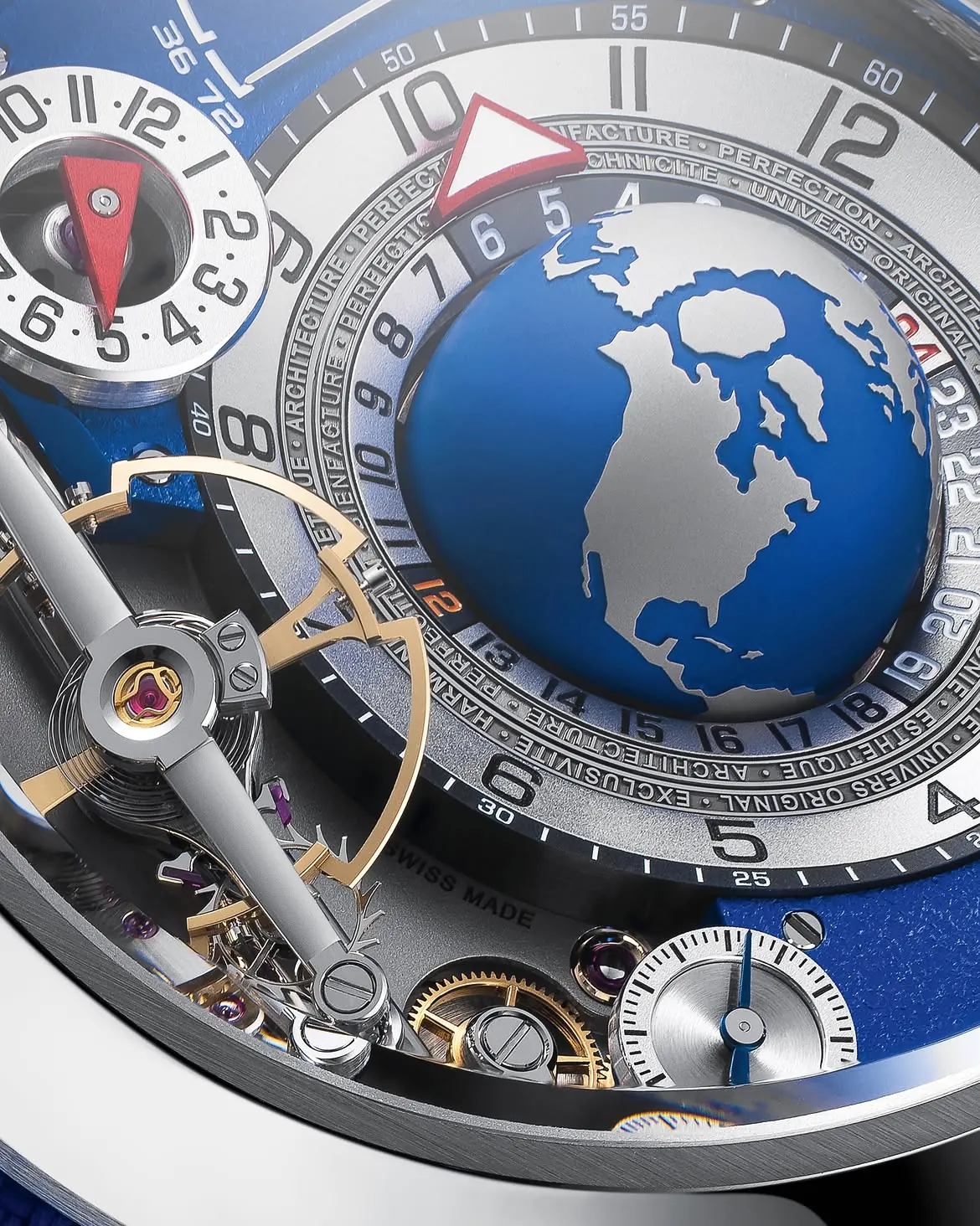
The hand-wound calibre comprises 496 components in 72 jewels — 73 more than its predecessor — the result of a complete re-engineering to accommodate new displays and improved chronometric output. Two series-coupled fast-rotating barrels deliver 72 hours of power reserve. The balance, beating at 21,600 vph, carries six gold mean-time screws on a variable-inertia design and sits tilted 30 degrees from horizontal beneath a flat black-polished steel bridge on polished pillars.
Tilting the balance keeps the escapement clear of the extreme flat and vertical positions where gravitational error accumulates most. It is Greubel Forsey’s proprietary answer to the tourbillon, and it appears on this calibre without the visual weight of a rotating cage — leaving the globe and the amphitheatre dial to dominate the front of the watch. Independent coverage including Revolution Watch’s report from Dubai Watch Week confirms the movement’s architecture was examined in person by collectors at the event; for broader context on where the independents present their work, see Fondation Haute Horlogerie.
La Chaux-de-Fonds on the Caseback
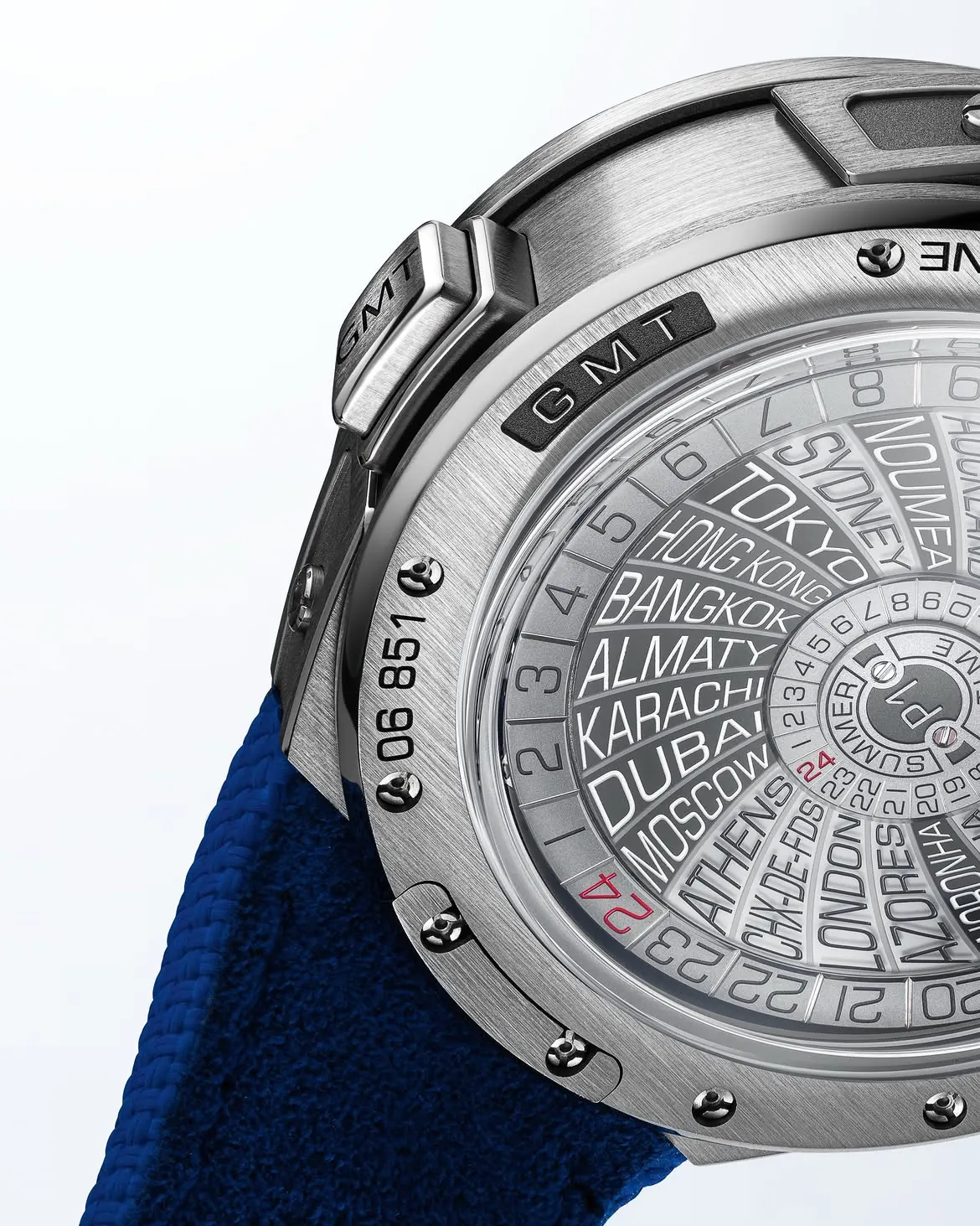
Through the sapphire caseback, a disc engraved with 24 reference cities provides the coordinates for universal time and daylight saving. La Chaux-de-Fonds, the UNESCO World Heritage city where Greubel Forsey‘s atelier operates, takes the UTC+1 position occupied elsewhere by Paris. It is a quiet statement of geographic identity — one that places the manufacture’s home on every watch produced. The 42.9mm Convexe case (reduced from the previous generation for improved wearability) is rated to 50 metres water resistance and follows the wrist contour via its curved caseback.
For collectors following the independents across the fair season, the watch was also shown at Watches and Wonders. Twenty-two pieces will be produced. Each component finished by hand.
Specifications
| Movement | Hand-wound in-house, 496 components, 72 jewels, 21,600 vph (3 Hz) |
| Power Reserve | 72 hours (two series-coupled fast-rotating barrels) |
| Case Size | 42.9mm × 15.1mm (17.6mm incl. crystals) |
| Case Material | Titanium, Convexe curved design; domed sapphire crystal front and back |
| Water Resistance | 50 metres |
| Edition | 22 pieces |
Stay ahead of the latest releases. Subscribe to our newsletter for editor-curated coverage of luxury timepieces across the GCC.
Frequently Asked Questions
What movement does the Greubel Forsey GMT Balancier Convexe use?
The GMT Balancier Convexe houses a hand-wound in-house calibre comprising 496 components running in 72 jewels. Power is supplied by two series-coupled fast-rotating barrels delivering a 72-hour power reserve, with the balance oscillating at 21,600 vph (3 Hz).
How many pieces of the Greubel Forsey GMT Balancier Convexe are being produced?
The edition is limited to 22 pieces, a figure that reflects the hand-finishing capacity of Greubel Forsey's atelier in La Chaux-de-Fonds rather than a marketing decision.
What makes the inclined balance wheel different from a tourbillon?
Greubel Forsey tilts the balance wheel 30 degrees from horizontal, keeping the escapement away from the extreme flat and vertical positions that cause the greatest timekeeping errors. This delivers chronometric benefits comparable to a tourbillon without the mechanical complexity of a rotating cage.
Is the Greubel Forsey GMT Balancier Convexe available in Dubai or the Gulf?
The GMT Balancier Convexe was featured at Dubai Watch Week in November 2025, confirming the watch's presence in the GCC market. Interested collectors should contact Greubel Forsey directly via greubelforsey.com for current availability.
What case size is the Greubel Forsey GMT Balancier Convexe?
The case measures 42.9mm in diameter and 15.1mm in height (17.6mm including the crystals), machined in titanium with the Convexe curved silhouette that follows the natural contour of the wrist.