
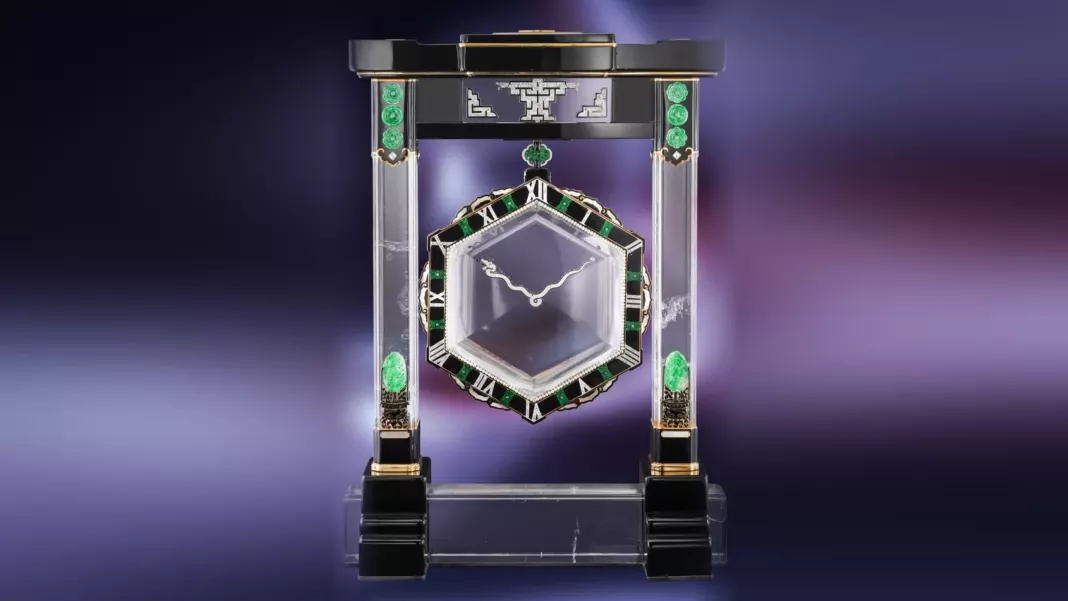
Six Portico Mystery Clocks left the Cartier workshops between 1923 and 1925. One alone carries a hexagonal dial, and it returns to auction in Geneva on 7 and 8 November, 30 years after its last public sale.
A Quick Orientation
- Cartier Portico Mystery Clock No. 4, made in 1924, is Lot 220 of The Geneva Watch Auction: XXIV, presented by Phillips in Association with Bacs & Russo.
- It is the only Portico with a six-sided dial, and one of the two largest and most elaborate clocks of the series.
- Formerly the property of Alain Cartier, it reputedly once belonged to the Maharajah of Nawanagar.
- The public preview runs from 4 to 7 November at the Hotel President, Geneva, with an estimate from CHF 1,800,000.
A Temple Gate in Rock Crystal
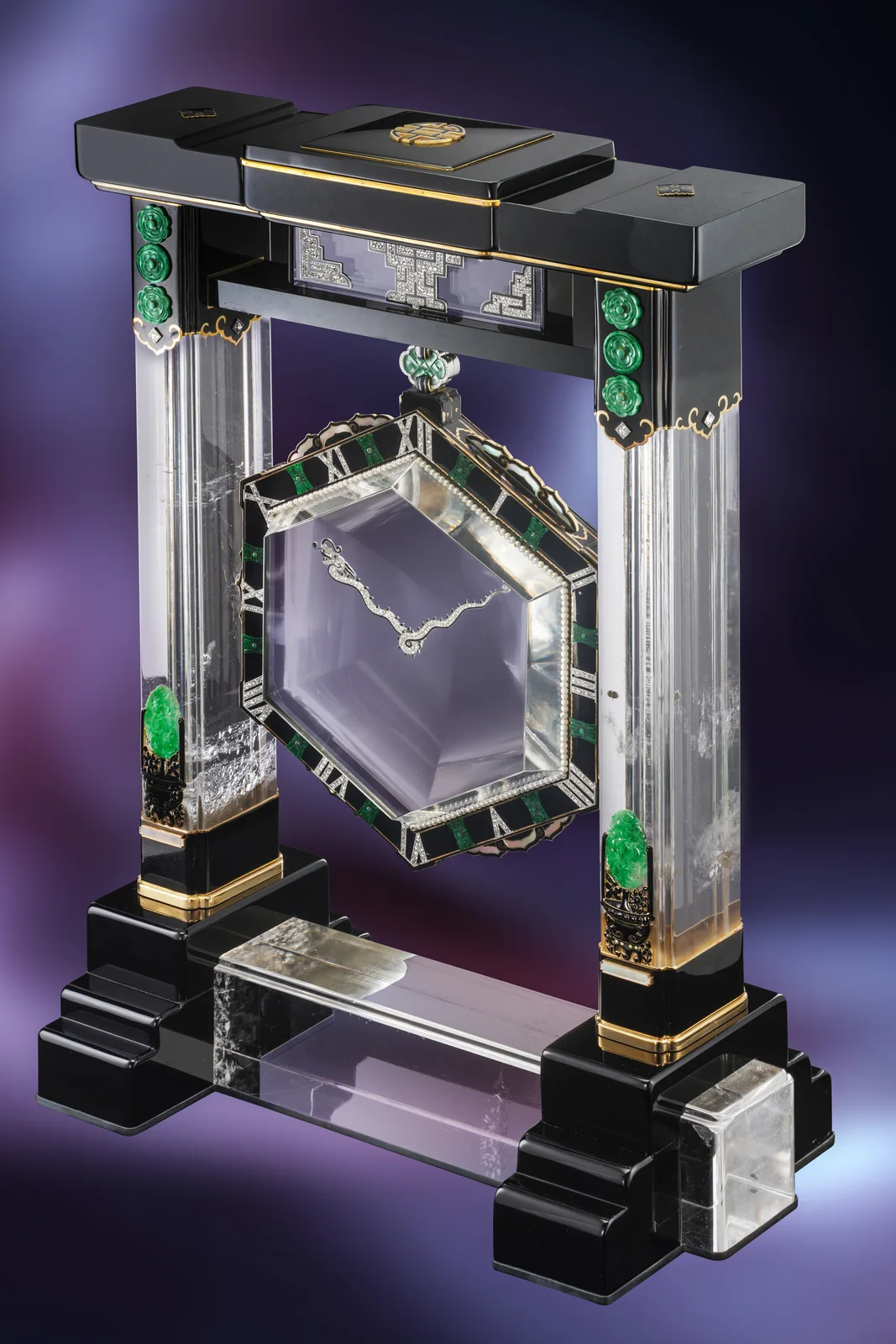
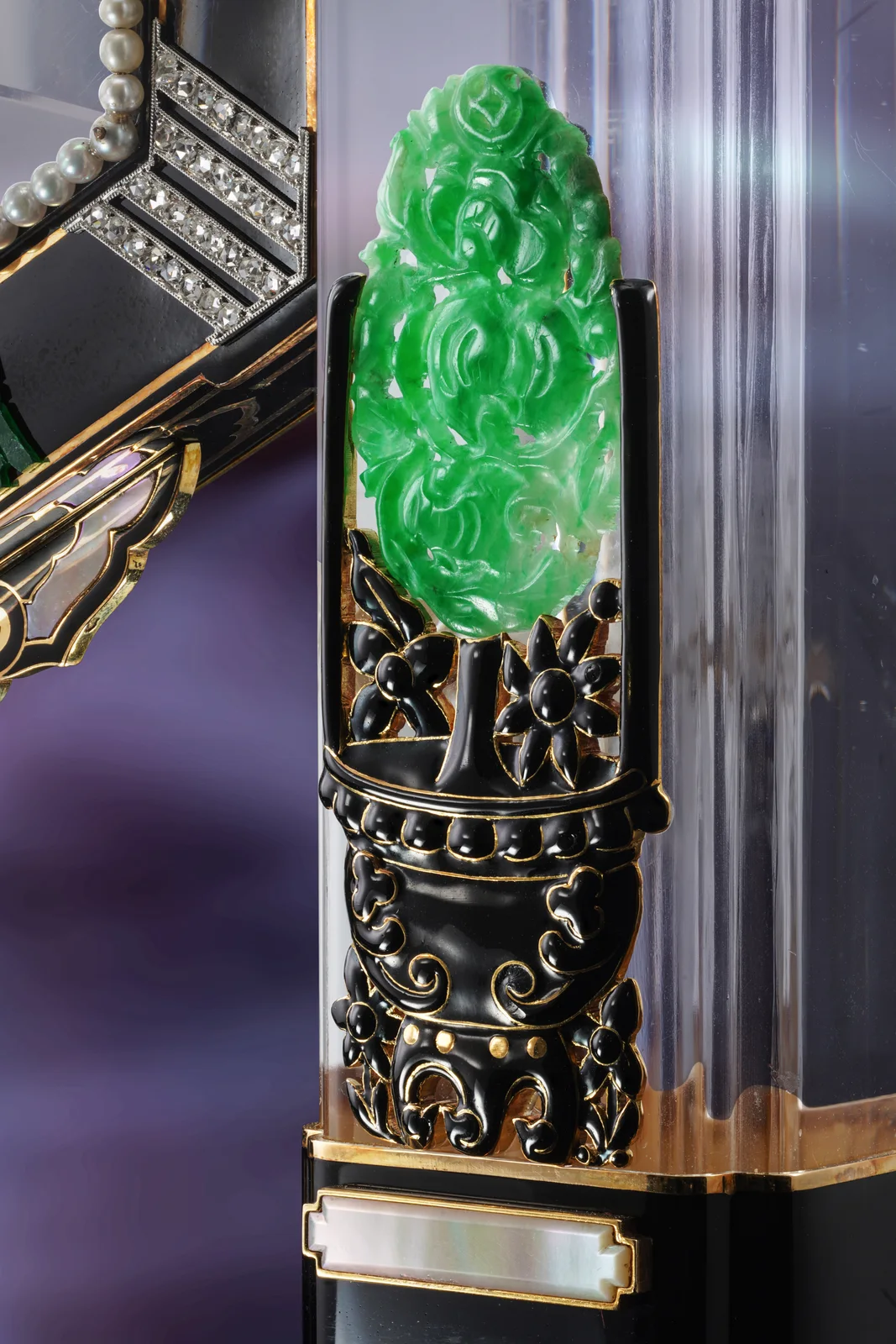
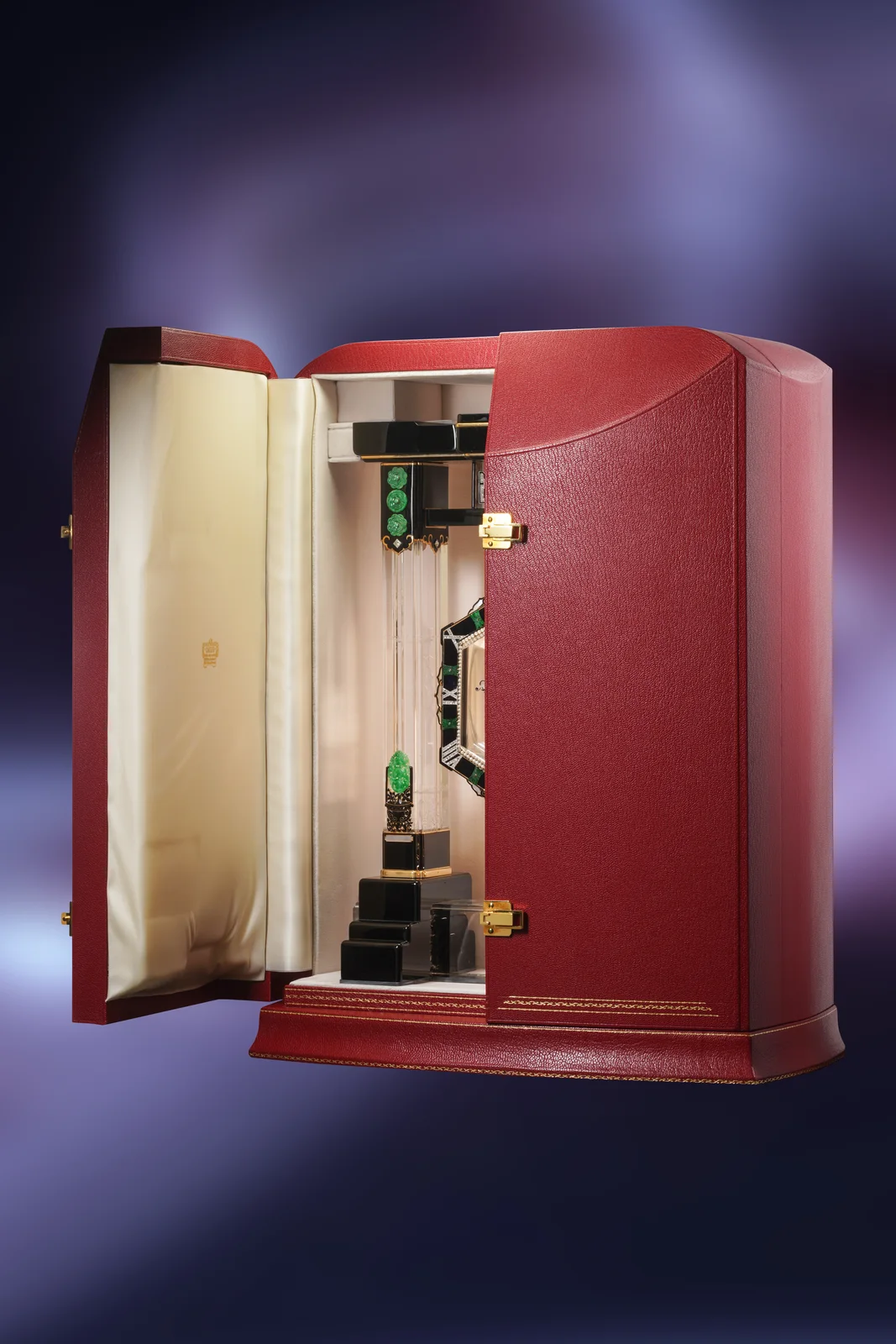
Portico No. 4 stands 38.5 cm high and weighs 10.6 kg. Its form recalls an Asian temple gate: two square rock-crystal columns carry a flat arch, and from that arch the carved rock-crystal dial hangs like a gong. The structure brings together yellow gold, platinum, enamel, onyx, jade, mother-of-pearl, seed pearls and diamonds.
Two jade trees rise from the bases of the columns, which carry black enamel decoration. Above them, a rock-crystal and enamel screen with jade decoration completes the arch. The manually wound movement, by the European Watch & Clock Company, rests within that arch, entirely out of sight.
Six Sides, and a Dragon Telling the Time
The other five Porticos have 12-sided dials. The six sides of No. 4 create larger facets and more room for ornament: a bezel of onyx and jade with diamond-set Roman numerals, an inner row of seed pearls, and hands pavé-set with rose-cut diamonds in the form of a dragon.
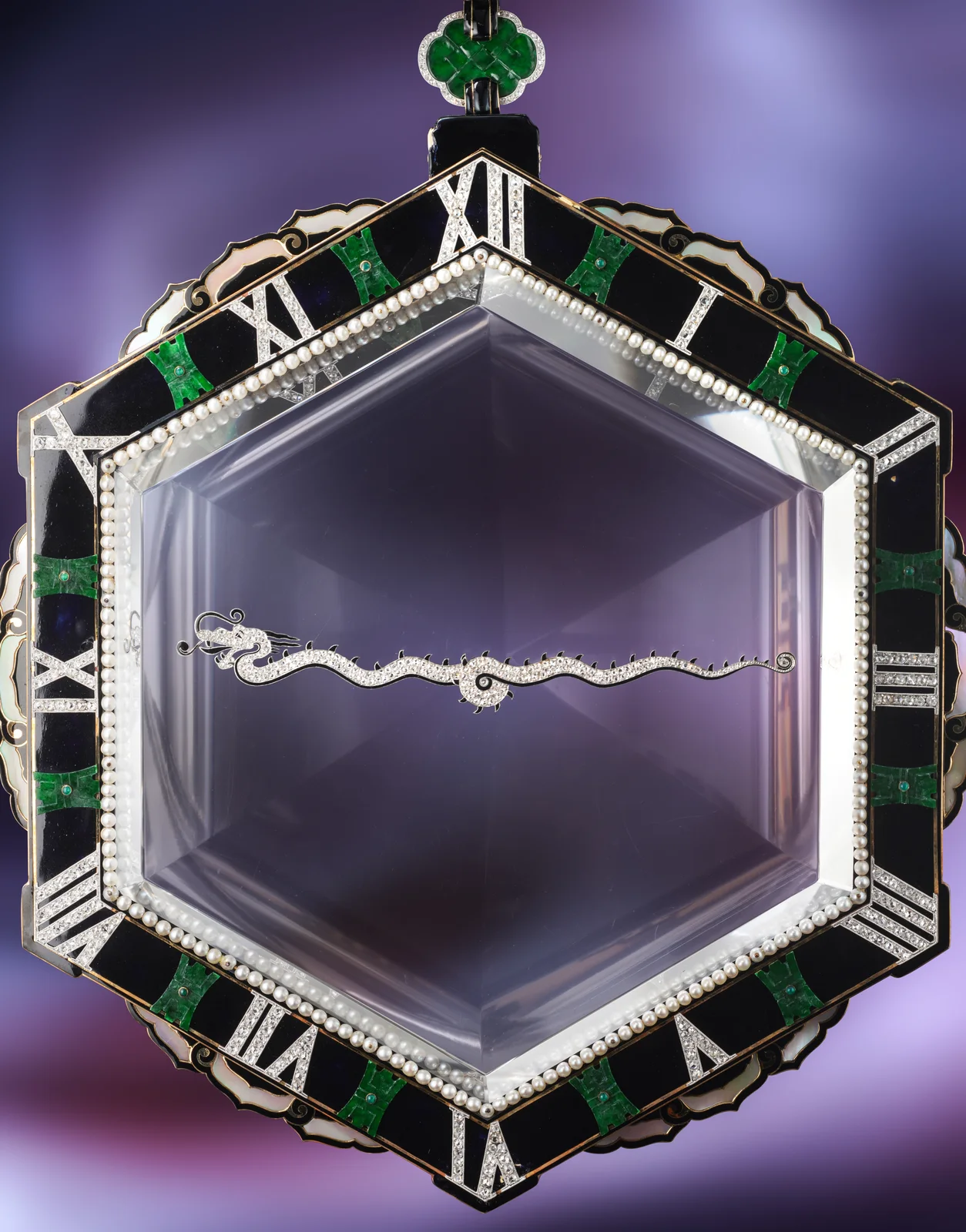
Eric Nussbaum, first director of the Cartier Collection, admired this clock in particular. At the time of its 1996 sale he described it as “the largest, most expressive, and most Art Deco of the family of six.”
The Illusion Behind the Mystery Clock
Cartier introduced its first Mystery Clock, the Model A, in 1912 with the clockmaker Maurice Couët. The hands seem to float because they are attached to transparent discs, driven around their circumference by a concealed movement, a principle with precedents in the illusion clocks of the French clockmaker and magician Jean-Eugène Robert-Houdin.
Between 1923 and 1925, Cartier and Couët gave the idea a new architecture. In the six Porticos, the movement moved from the base to the structure above the dial. These clocks belong to a period when Asian art nourished Cartier’s creativity: Louis Cartier had sent the salesman Jules Glaenzer to the Far East, and he returned with curiosities, gemstones and objects that shaped the Maison’s decorative work throughout the 1920s.
A Provenance Within the Family
No. 4 formerly belonged to Alain Cartier, grandson of Louis Cartier and a fifth-generation member of the family. It reputedly once belonged to the Maharajah of Nawanagar, ruler of the princely state in western India. Its last public appearance was at The Magical Art of Cartier in Geneva, on 19 November 1996. The complete series of six has been shown together on one known occasion: at the Salon International de la Haute Horlogerie in 1991, in an exhibition organised by Cartier.
The clock is accompanied by a Cartier Certificate of Authenticity dated 14 January 2002, its key and its presentation box.
Portico No. 3 Set the Reference
Phillips sold Portico No. 3, also made in 1924, at The Geneva Watch Auction: XXI in May 2025 for CHF 3,932,000. Nos. 3 and 4 are the only two Porticos with square columns. Aurel Bacs, Senior Consultant at Phillips Watches, places No. 4 at the summit of its field: “Portico No. 4 is in a league of its own.”
Viewing the Clock in Geneva
The clock is on view during the preview from 4 to 7 November 2026 at the Hotel President, Quai Wilson 47, Geneva, and offered during the sale of 7 and 8 November. Full lot details appear on the Phillips catalogue page. The wider sale is presented in our guide to The Geneva Watch Auction: XXIV.
Frequently Asked Questions
What makes Cartier Portico Mystery Clock No. 4 unique?
Of the six Portico Mystery Clocks Cartier created between 1923 and 1925, No. 4 is the only one with a hexagonal dial; the other five have 12-sided dials. It is also one of the two largest in the series, alongside No. 3.
When and where is Portico No. 4 offered?
Phillips in Association with Bacs & Russo offers it as Lot 220 of The Geneva Watch Auction: XXIV, held on 7 and 8 November 2026 at the Hotel President, Quai Wilson 47, Geneva. The public preview runs from 4 to 7 November.
What is the estimate for Portico No. 4?
Phillips estimates the clock from CHF 1,800,000, excluding buyer’s premium. Its sister clock, No. 3, sold at Phillips in Geneva in May 2025 for CHF 3,932,000.
Who owned Cartier Portico No. 4?
It formerly belonged to Alain Cartier, grandson of Louis Cartier, and reputedly once belonged to the Maharajah of Nawanagar. It last appeared at auction on 19 November 1996, at The Magical Art of Cartier in Geneva.
How does a Cartier Mystery Clock work?
The hands appear to float because they are attached to transparent discs, driven around their circumference by a concealed movement. In the Portico series, the movement sits in the arch above the suspended dial rather than in the base.