
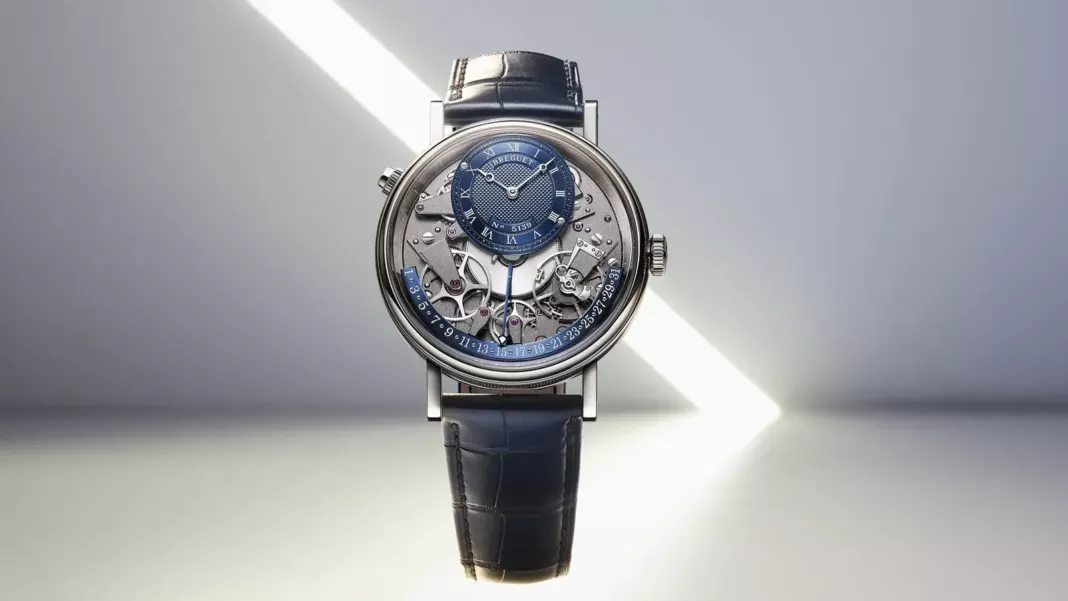
Key Highlights
- The Breguet Tradition collection, launched in 2005, places movement architecture on the dial side, a direct reference to Abraham-Louis Breguet’s souscription and tact watches of the late 18th century.
- The shock absorber, invented by A.-L. Breguet around 1790 and presented officially in 1806, is a visual and technical signature across all Tradition references except the Tourbillon 7047.
- The collection has grown from the original Tradition 7027 to encompass GMT, retrograde seconds, chronograph, and tourbillon complications over two decades.
- Two new 2025 references — the Tradition Seconde Rétrograde 7035 (7035BH/H2/9V6) and Tradition Seconde Rétrograde 7097 (7097BR/GM/9WU) — extend the line’s current chapter.
- Breguet CEO Gregory Kissling has described the Tradition as “the icon of the House of Breguet.”
A Considered Look
Few collections in contemporary haute horlogerie can point to a single structural idea as their defining principle and sustain it across twenty years without revision. The Breguet Tradition does precisely that. The movement and the dial occupy the same face: the barrel, gear train, and balance wheel are arranged symmetrically about a central plate, all visible to the eye that falls naturally on the front of the watch. Nothing is hidden behind a caseback.
The construction is not a design choice layered onto an existing movement. It is the movement’s architecture. This distinction matters to collectors who have handled the reference closely; the visual weight of the mechanics is the watch, not a window into it.

Heritage & Lineage
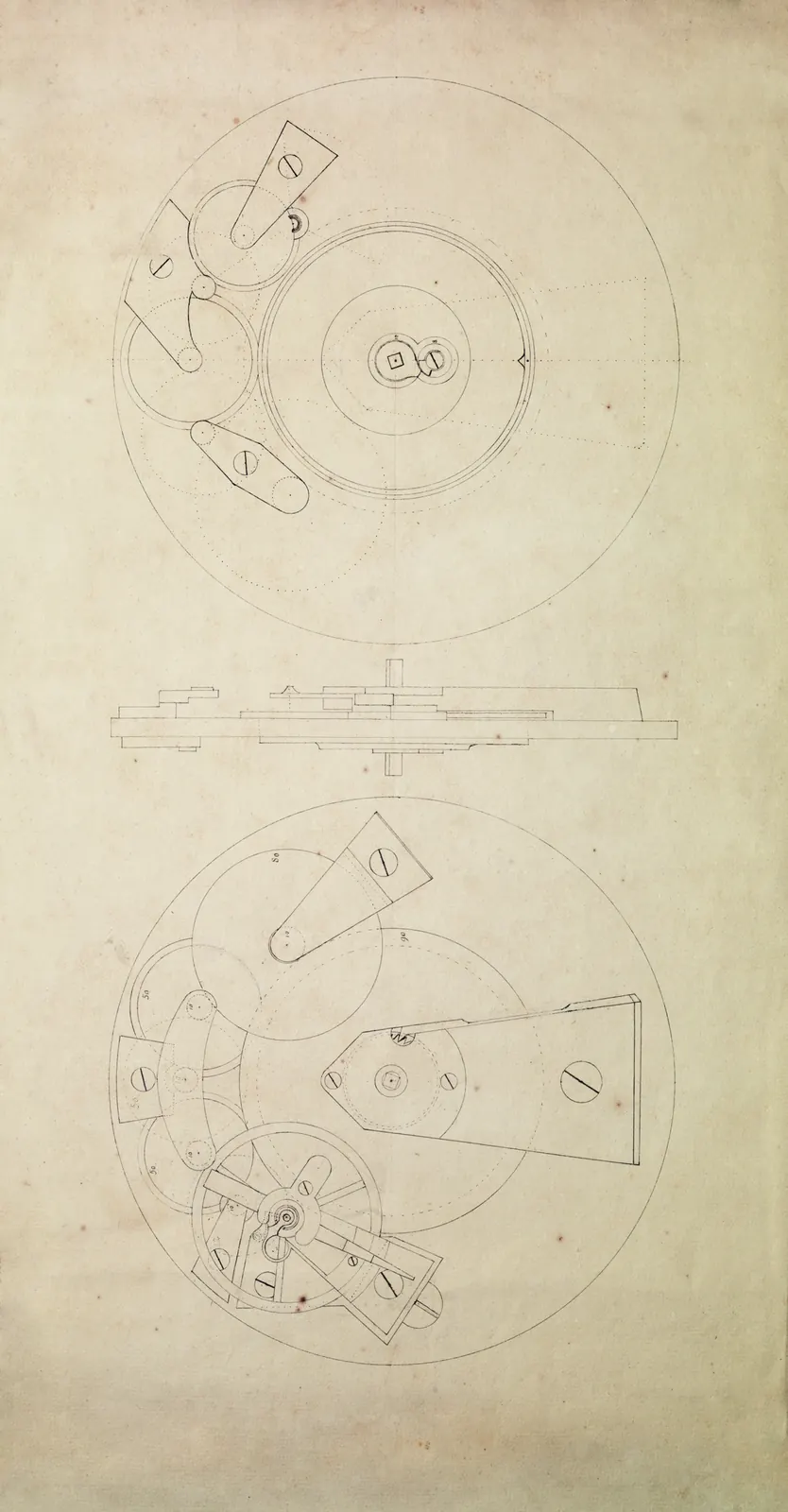
The origin is specific. In the aftermath of the French Revolution, Abraham-Louis Breguet developed the souscription watch as a deliberately simplified, accessible creation. Nearly 700 examples were sold, mainly between 1798 and 1805. From this calibre emerged the tact watch, which added time reading by touch via a movable outer hand and placed the mechanics and display on a single face. This layout lay dormant for two centuries.
When Nicolas G. Hayek drove its revival in 2005, the result was not a reproduction. Emmanuel Breguet, Head of Patrimony at the House, has described the goal plainly: to create a deeply contemporary watch while giving the impression of observing an ancient movement. For the record, Watches and Wonders and the Fondation Haute Horlogerie have both cited the Tradition’s architectural premise as a reference point in contemporary fine watchmaking education.
Movement & Materials
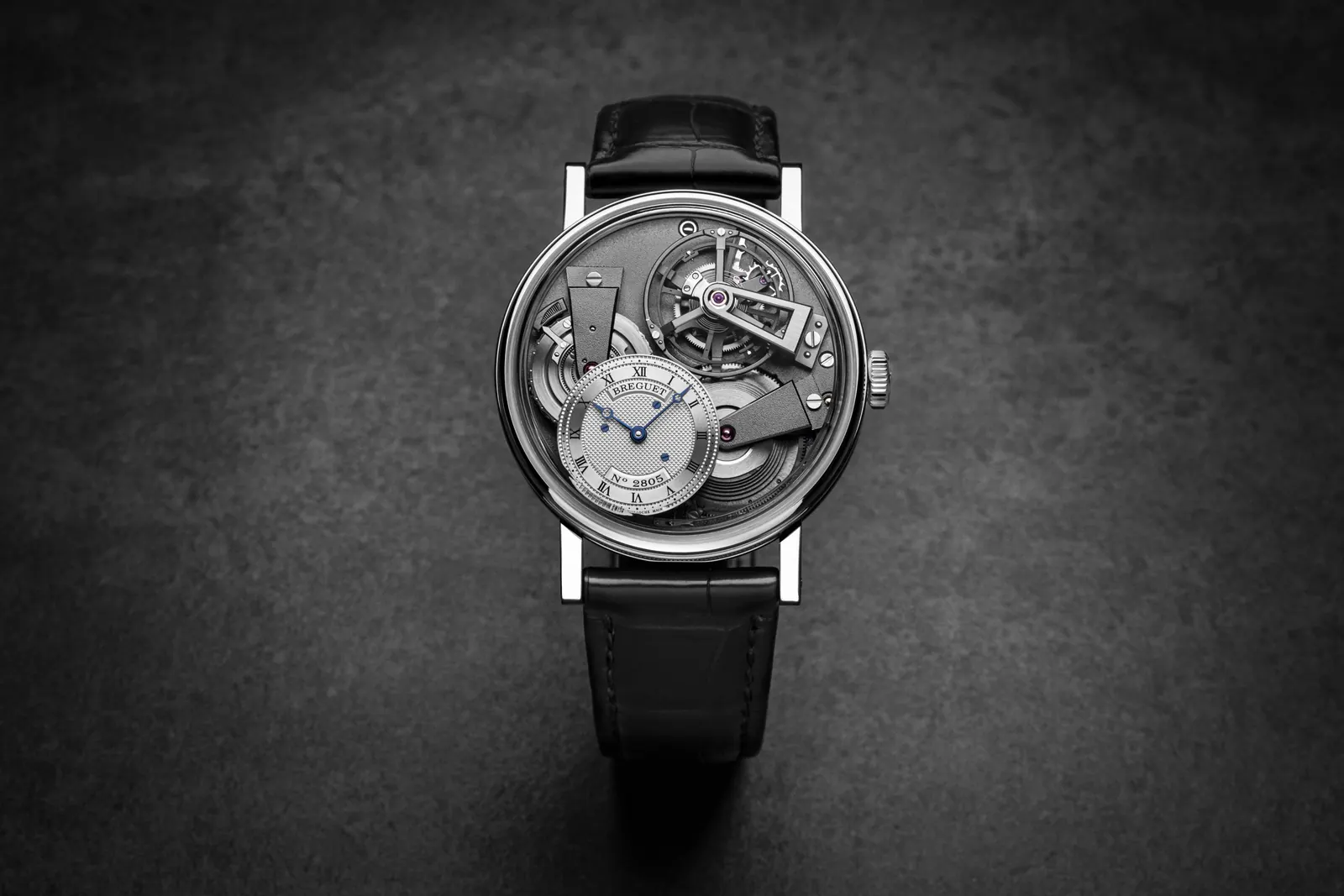
The shock absorber warrants specific attention. Breguet devised it around 1790 to address the acute vulnerability of balance pivots in the event of a fall. He shaped the pivots into cones and seated them in matching cups held by thin spring blades, creating an elastic suspension that absorbed impact without disrupting the regulating organ. The mechanism was presented officially at the 1806 National Exhibition. Within the Tradition collection, it functions as both a working component and an immediately legible historical reference, present across all references save the Tourbillon 7047, where the layout was reconfigured to display the tourbillon without constraint.
The Tourbillon 7047 represents a deliberate departure. The central barrel arrangement is set aside so that the tourbillon, the complication most closely associated with the Breguet name since its invention, can occupy the dial face without compromise. The underlying principle of total mechanical visibility remains constant; only the hierarchy of components changes.
The Collection in Context
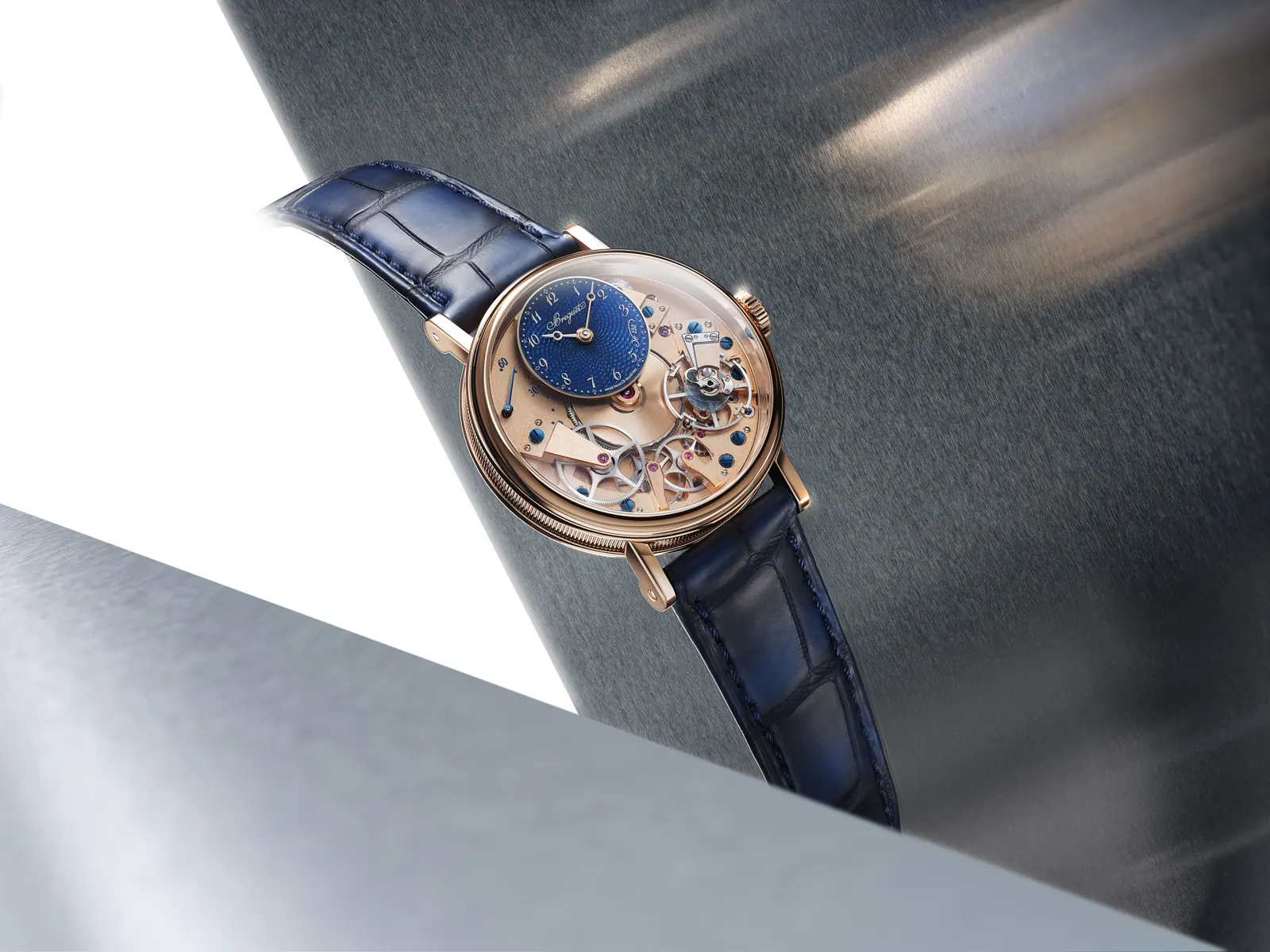
Over twenty years, the Tradition line has expanded from the original 7027 into GMT (7067), retrograde seconds (7097 and 7035), chronograph (7077), and retrograde calendar (7597) variants. The most recent additions, both dated 2025, are the Tradition Seconde Rétrograde 7035 in reference 7035BH/H2/9V6 and the Tradition Seconde Rétrograde 7097 in reference 7097BR/GM/9WU. Each new reference enters a catalogue that now spans two decades of continuous development without a fundamental reconfiguration of the founding idea.
Gregory Kissling, CEO of Breguet, draws a clear distinction between the Tradition and the Classique: the latter perpetuates Breguet’s aesthetic codes, while the Tradition expresses heritage through the architecture of the mechanism itself. For collectors in the GCC market, where both historical depth and visible mechanical craft carry weight, this distinction is meaningful. The Tradition does not require explanation; the movement explains itself.
Stay ahead of the latest releases. Subscribe to our newsletter for editor-curated coverage of luxury timepieces across the GCC.
Frequently Asked Questions
When was the Breguet Tradition collection first introduced?
The Tradition collection was introduced in 2005, with the first model being the Tradition 7027. It was conceived under the impetus of Nicolas G. Hayek as a contemporary interpretation of Abraham-Louis Breguet's souscription and tact watches.
What makes the Breguet Tradition different from the Classique line?
Where the Classique line expresses Breguet's heritage through its aesthetic codes — guilloché dials, Breguet hands, fluted cases — the Tradition expresses it through the architecture of the movement itself, placing the mechanics and the time display on the same dial-side face.
What is the shock absorber featured in Breguet Tradition watches?
The shock absorber is a device invented by Abraham-Louis Breguet around 1790 to protect the fragile balance pivots from damage caused by impacts. It shapes the pivots into cones housed in spring-held cups, and was officially presented in its final form at the 1806 National Exhibition. It appears across nearly all Tradition references, with the Tourbillon 7047 being the sole exception.
Does the Tradition Tourbillon 7047 follow the same architecture as other Tradition references?
The Tradition Tourbillon 7047 deliberately departs from the central barrel configuration used in other Tradition models. This was a conscious decision to allow the tourbillon — one of Breguet's signature complications — to be displayed without the constraints of the standard layout, while remaining faithful to the collection's principle of revealing the movement on the visible side.
Which are the most recent Breguet Tradition references?
Among the most recent additions to the collection are the Tradition Seconde Rétrograde 7035 (reference 7035BH/H2/9V6) and the Tradition Seconde Rétrograde 7097 (reference 7097BR/GM/9WU), both released in 2025.