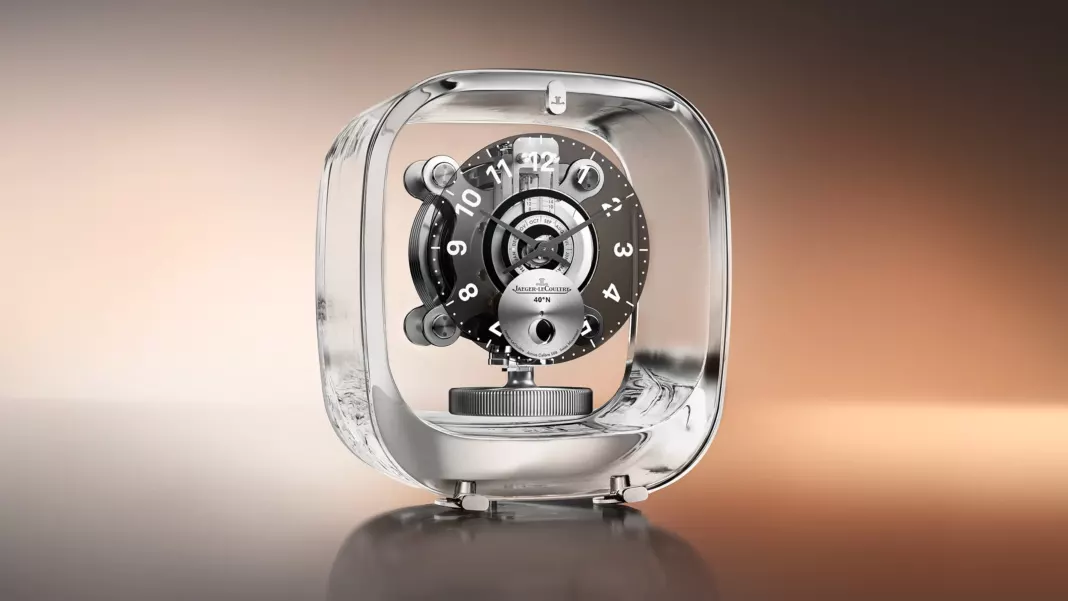
Key Highlights
- Unveiled at Milan Design Week, April 2026; a sequel to Marc Newson’s 2016 Atmos 568
- Mouth-blown Baccarat crystal cabinet: a single solid piece reduced to just 13 mm in places
- New complications: sunrise/sunset indications and Equation of Time, calibrated to three latitudes (30°, 40°, 50°)
- Moon phase accuracy of one day’s discrepancy in 4,087 years
- Strictly limited to 50 pieces per year across three references
A Clock That Breathes
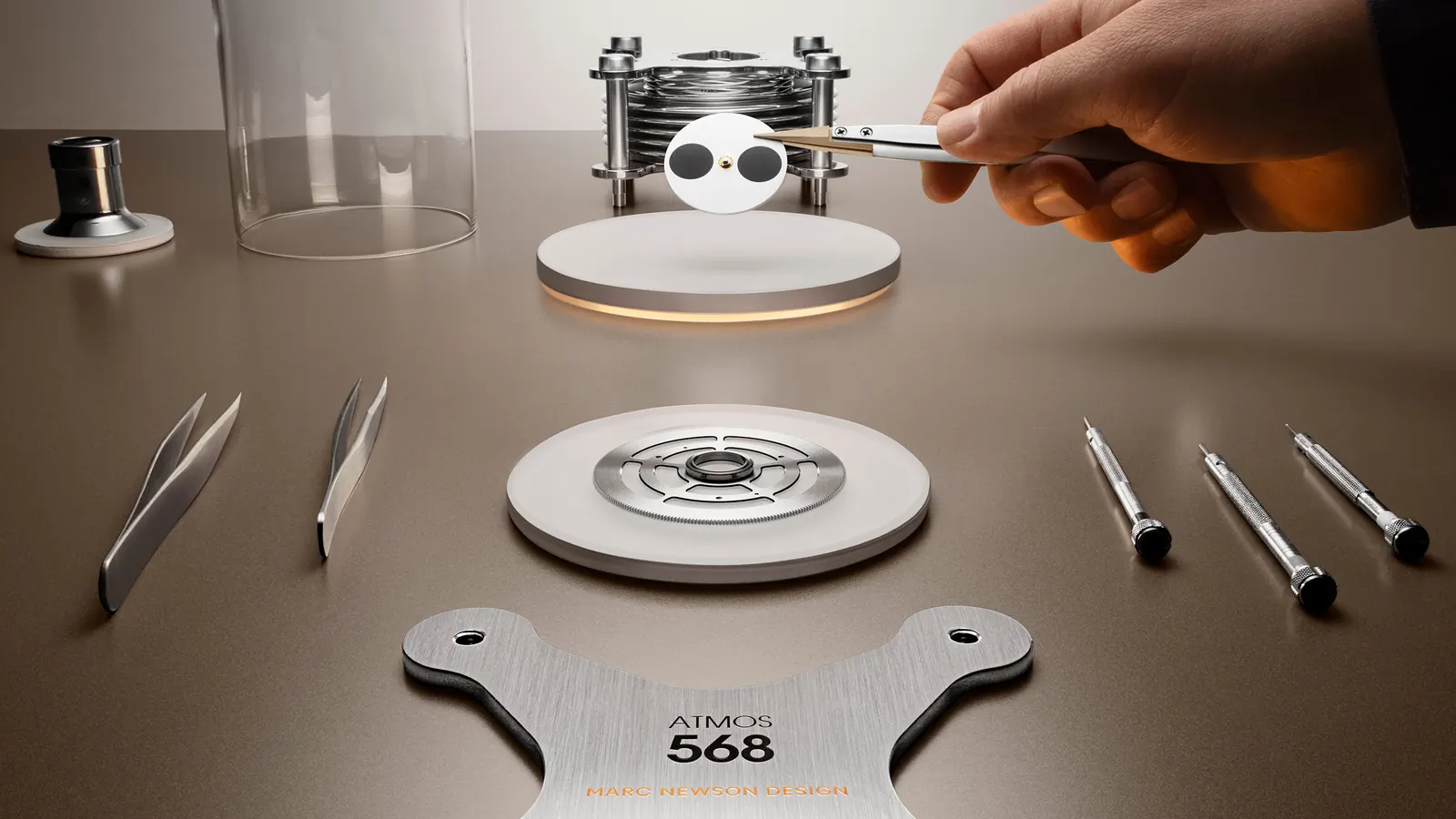
The Atmos has occupied a singular position in horology since its mechanism was first invented in 1928 by Swiss engineer Jean-Léon Reutter. Requiring no manual winding and no external power source, it draws energy from imperceptible variations in ambient temperature. A sealed, gas-filled capsule contracts and expands with temperature changes, winding a drive spring that sets the balance wheel oscillating once per minute. A single degree Celsius of fluctuation provides roughly two days of autonomy, allowing the clock to run indefinitely in principle.
This self-sustaining architecture has always made the Atmos more than a timekeeping instrument. Its mechanical identity has also made it a natural canvas for artistic collaboration. Since the 1970s, Jaeger-LeCoultre has invited leading designers and master craftspeople to reimagine the object while preserving its essential character. The 2026 edition continues that tradition at its most ambitious. For those following the brand’s creative direction alongside Watches and Wonders and the Fondation Haute Horlogerie, this release signals a new high-water mark in design-led horology.
Marc Newson and the Long Dialogue
Australian-born industrial designer Marc Newson first encountered the Atmos in his early teens, and that formative impression has shaped a collaboration with Jaeger-LeCoultre spanning nearly two decades. Beginning with Calibre 561 in 2008, the partnership produced Calibre 566 in 2010 and the first Calibre 568 in 2016. Each iteration refined Newson’s approach: introducing precise design interventions that respect the mechanical integrity of the object rather than overwriting it. His practice, characterised by fluid lines, material experimentation, and rigorous attention to detail, finds a natural counterpart in a manufacture with more than 190 years of accumulated expertise and over 1,400 calibres to its name.
The 2026 interpretation builds on the 2016 edition with a new colour palette and the addition of two substantial complications. Newson’s stated ambition is longevity: objects designed to endure in both function and form. That principle is entirely consistent with a clock whose displays, once set, will remain accurate for over four millennia without intervention.
The Crystal Cabinet and the Complications
Baccarat Crystal: A Four-Year Feat
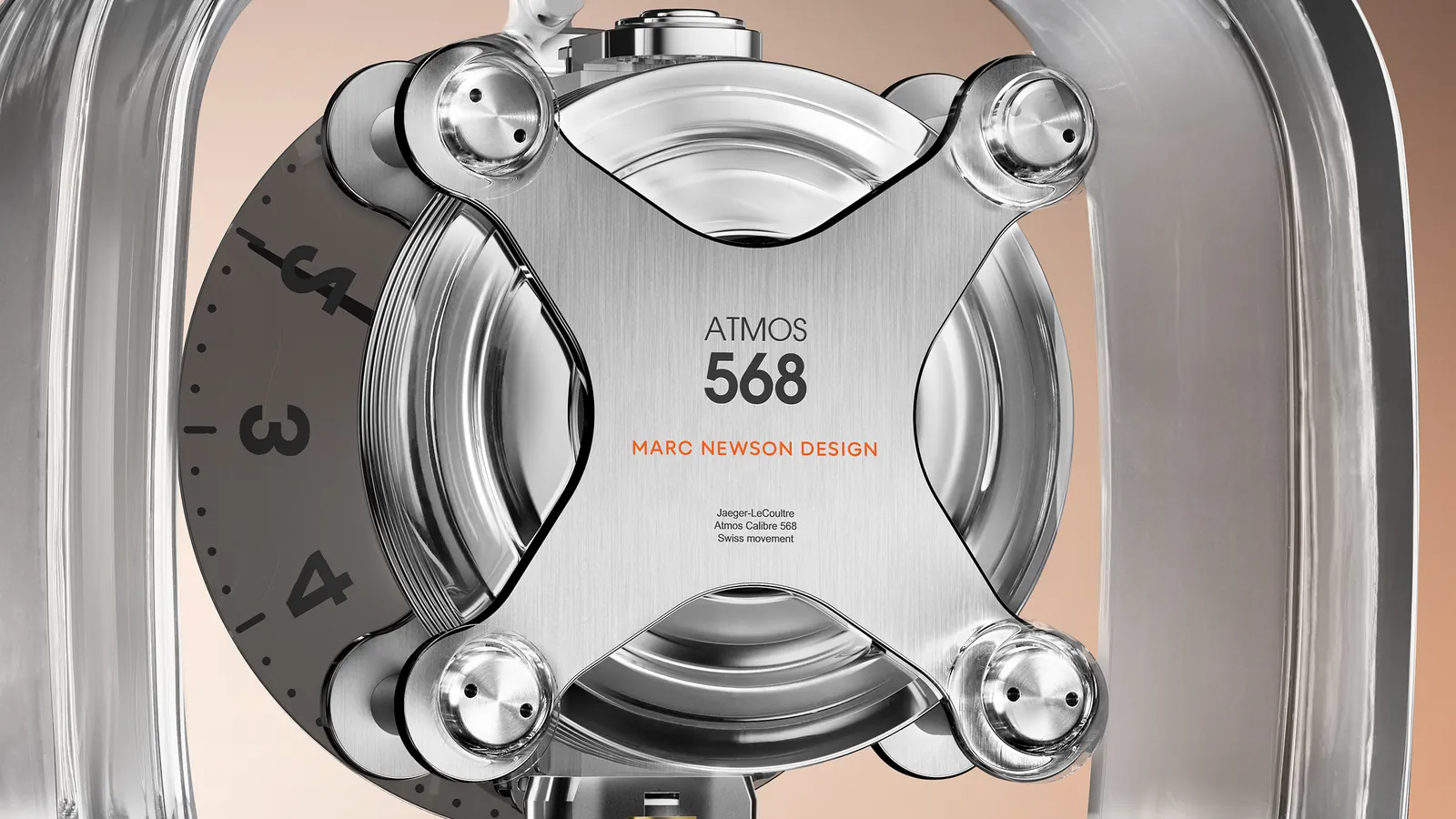
The cabinet required nearly four years of research and development in collaboration with Baccarat, the French crystal house founded in 1764. The result is a mouth-blown, hand-crafted enclosure formed as a single solid piece, save for a removable glass panel providing access to the movement, with walls reduced to as little as 13 mm. Its shape, a square with softly rounded corners, evokes a slowly melting ice cube; the absolute transparency and apparent fragility belie the structural strength required to carry the movement. Four attachment points, rather than the traditional three, secure the mechanism and create visual symmetry visible from the rear of the clock.
New Complications, Precise to Millennia
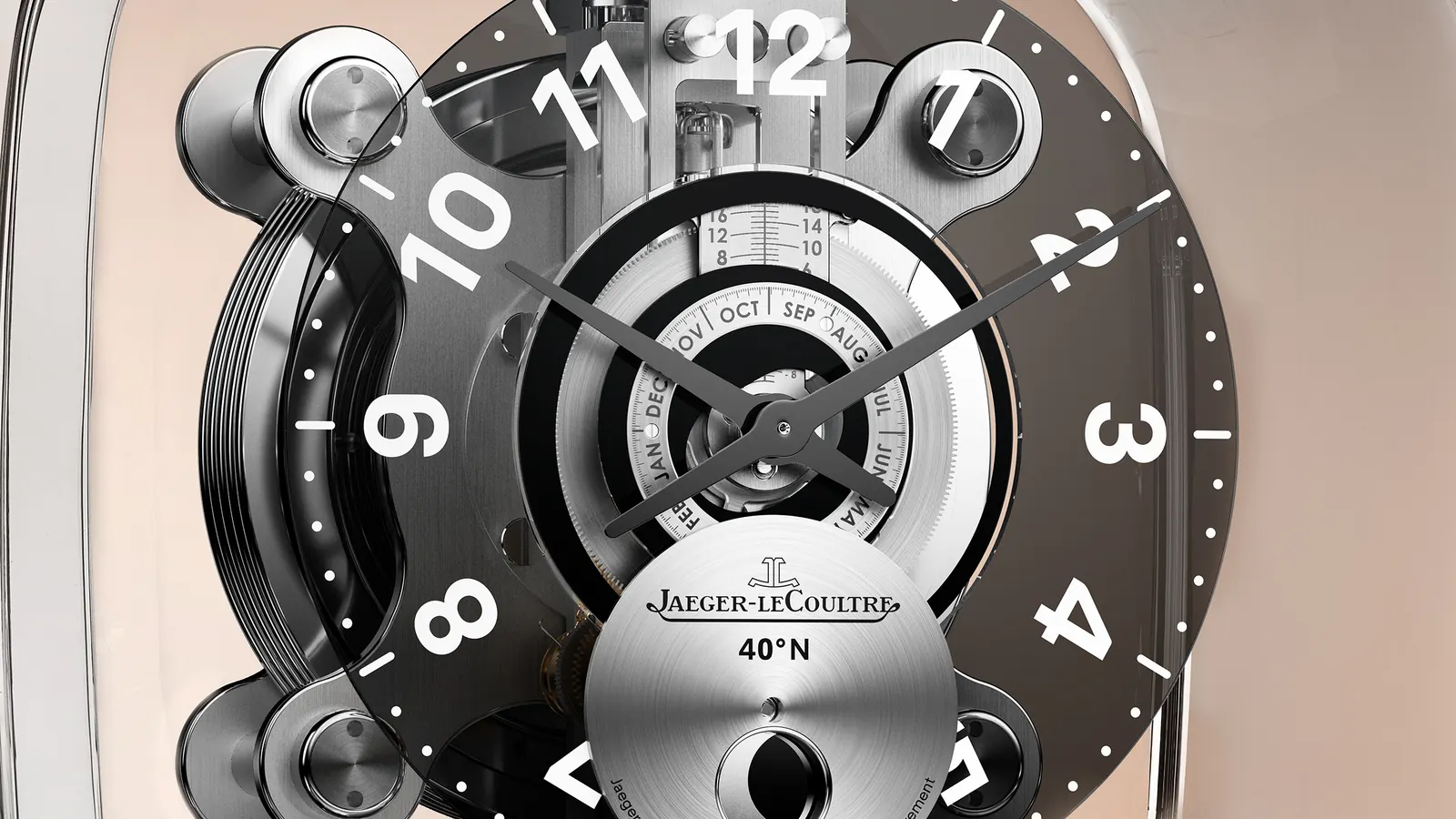
Calibre 568’s dial is legible by design: Arabic numerals printed in white on a black-tinted sapphire crystal disc, ringed by a minute track, with months marked in French on an inner circle. A concentric sapphire disc between the months and hours carries the sunrise and sunset indications, each marked by a small arrow at the disc’s edge. The Equation of Time is displayed as an ellipse surrounding the hand arbour, shifting to reveal the correct plus or minus minutes against a scale.
The collection comprises three references, each calibrated to a specific latitude: 30°, 40°, and 50°. Sunrise, sunset, and Equation of Time data are precisely tailored to the designated latitude of each piece. The moon phase display, positioned at 6 o’clock on a smoothly finished disc, achieves an accuracy of one day’s discrepancy across 4,087 years. The only required correction is the bi-annual adjustment for Daylight Saving Time where applicable. Visit the official Jaeger-LeCoultre website for the full technical specifications and boutique information.
Why It Matters
The Atmos Designer 568 by Marc Newson is not a watch, yet it belongs entirely to the world of haute horlogerie. It is an objet d’art that measures time with precision surpassing most mechanical movements, housed in a material that took four years to master, and produced in a quantity of 50 pieces per year. For Middle East collectors, for whom space, light, and long-term investment value converge in a single object, this clock represents a compelling proposition: one that requires nothing of its owner except a room with normal temperature variation, and rewards that patience for centuries.
Discover more about the watches and objects shaping the Middle East market. Join our mailing list for ongoing reviews, releases, and collector insights.
Frequently Asked Questions
How does the Jaeger-LeCoultre Atmos clock power itself without winding or electricity?
The Atmos draws energy from imperceptible variations in ambient temperature through a sealed, gas-filled capsule that contracts and expands like bellows, winding a drive spring that sets the balance wheel oscillating once per minute. A single degree Celsius of fluctuation provides roughly two days of autonomy, allowing the clock to run indefinitely in principle.
What new complications does the 2026 Atmos Designer 568 by Marc Newson feature?
The 2026 edition introduces sunrise/sunset indications and Equation of Time, both calibrated to three latitudes (30°, 40°, 50°), along with a moon phase display accurate to one day’s discrepancy in 4,087 years.
What material is the Atmos Designer 568 cabinet made from and how long did it take to develop?
The cabinet is crafted from mouth-blown Baccarat crystal, formed as a single solid piece with walls reduced to as little as 13 mm, and required nearly four years of research and development in collaboration with the French crystal house founded in 1764.