In Brief
- Cartier’s La Panthère is a trilogy of fragrances — Eau de Parfum (2014), Parfum (2020), and Elixir — each composed by in-house perfumer Mathilde Laurent around a chypre-feline structure built on gardenia, musk, and the creative legacy of Jeanne Toussaint, Cartier‘s legendary Artistic Director known within the House as “La Panthère”.
- The original Eau de Parfum introduced a feline floral chypre category, with top notes of dried fruits, rhubarb, and bergamot giving way to gardenia, rose, and ylang-ylang over an oakmoss-leather base.
- The Parfum (2020) adds osmanthus alongside majestic gardenia, producing a warmer, more concentrated effect that Cartier places “between floral light and animal depth”.
- The Elixir, the most recent and most tenacious, introduces jasmine, iris, and amber to create what Cartier describes as the sensation of surrendering to wild musk and velvety jasmine.
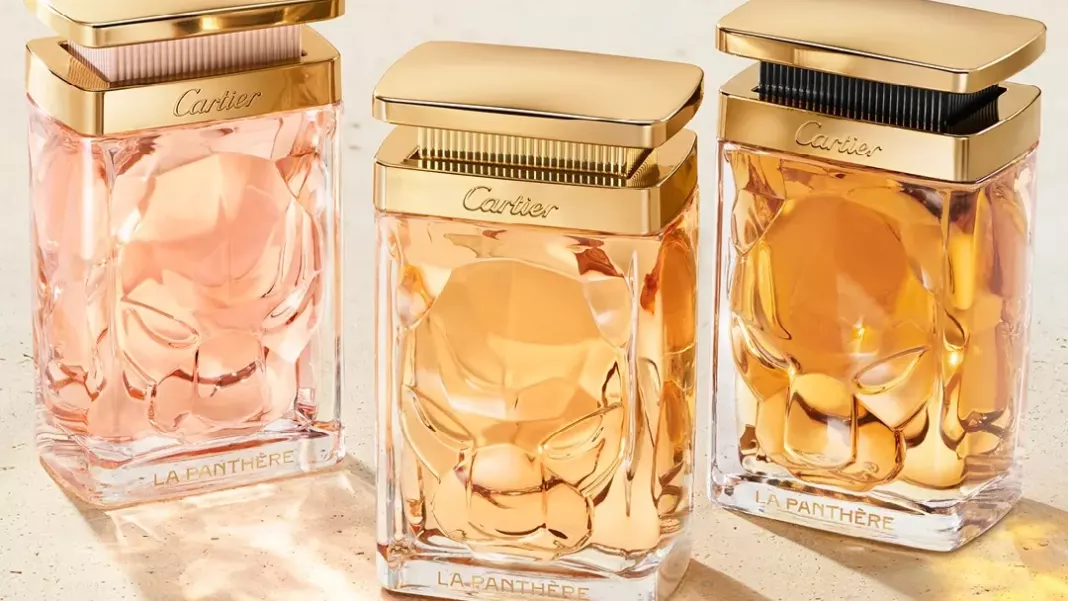
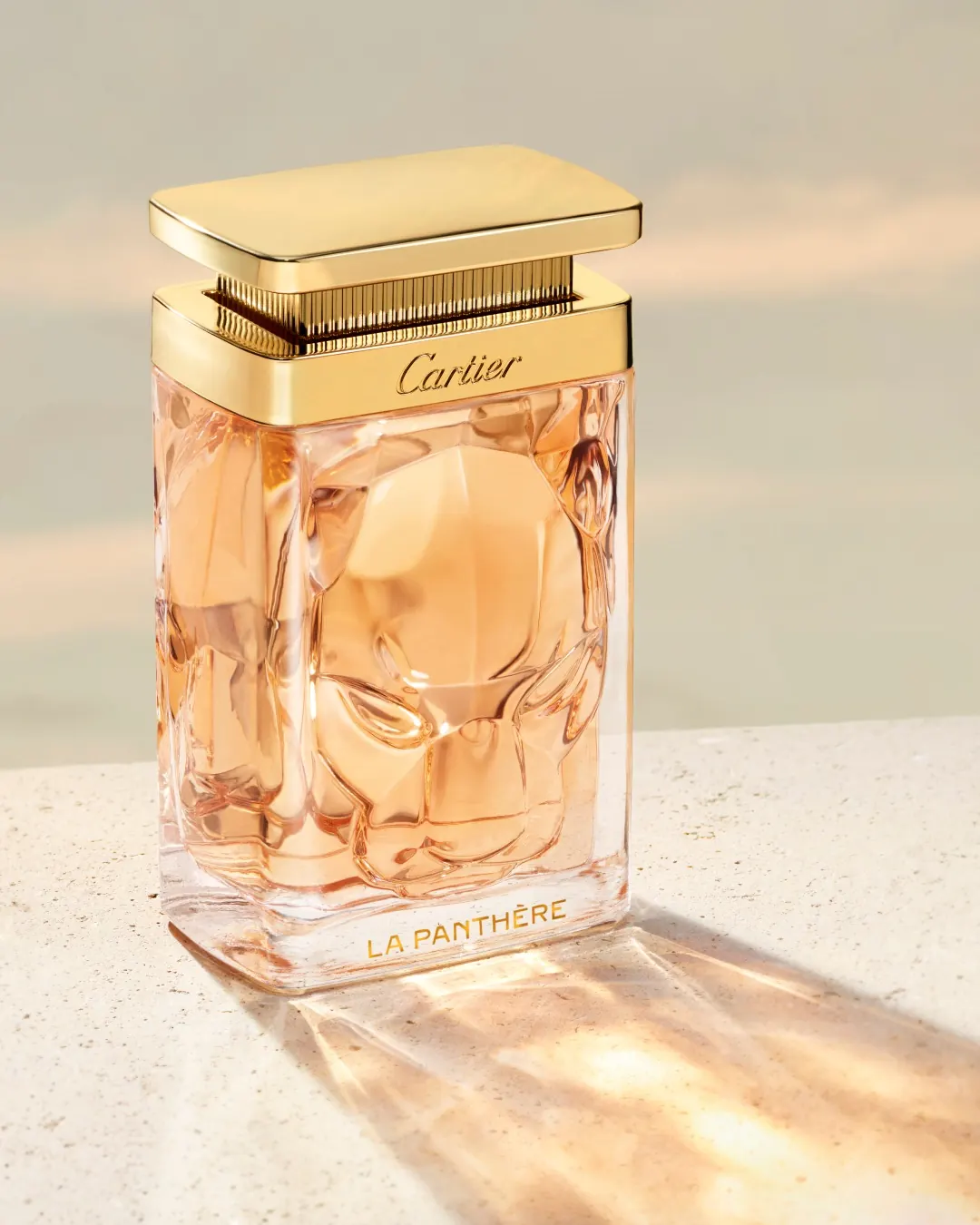
- All three share the same iconic faceted glass bottle with a sculpted panther face, now offered in refillable format across Cartier boutiques worldwide and at cartier.com.
Design & Bottle
The faceted glass bottle is as deliberate a design object as any jewel in Cartier’s archive.
Its surface is cut so that the panther’s face emerges from the glass as though carved from a gemstone, with geometric planes that shift between transparency and reflection depending on the angle of light. The effect is precisely that of a faceted diamond or emerald: a single object that multiplies light rather than simply reflecting it. A polished metal cap extends the sculptural quality into the hand.
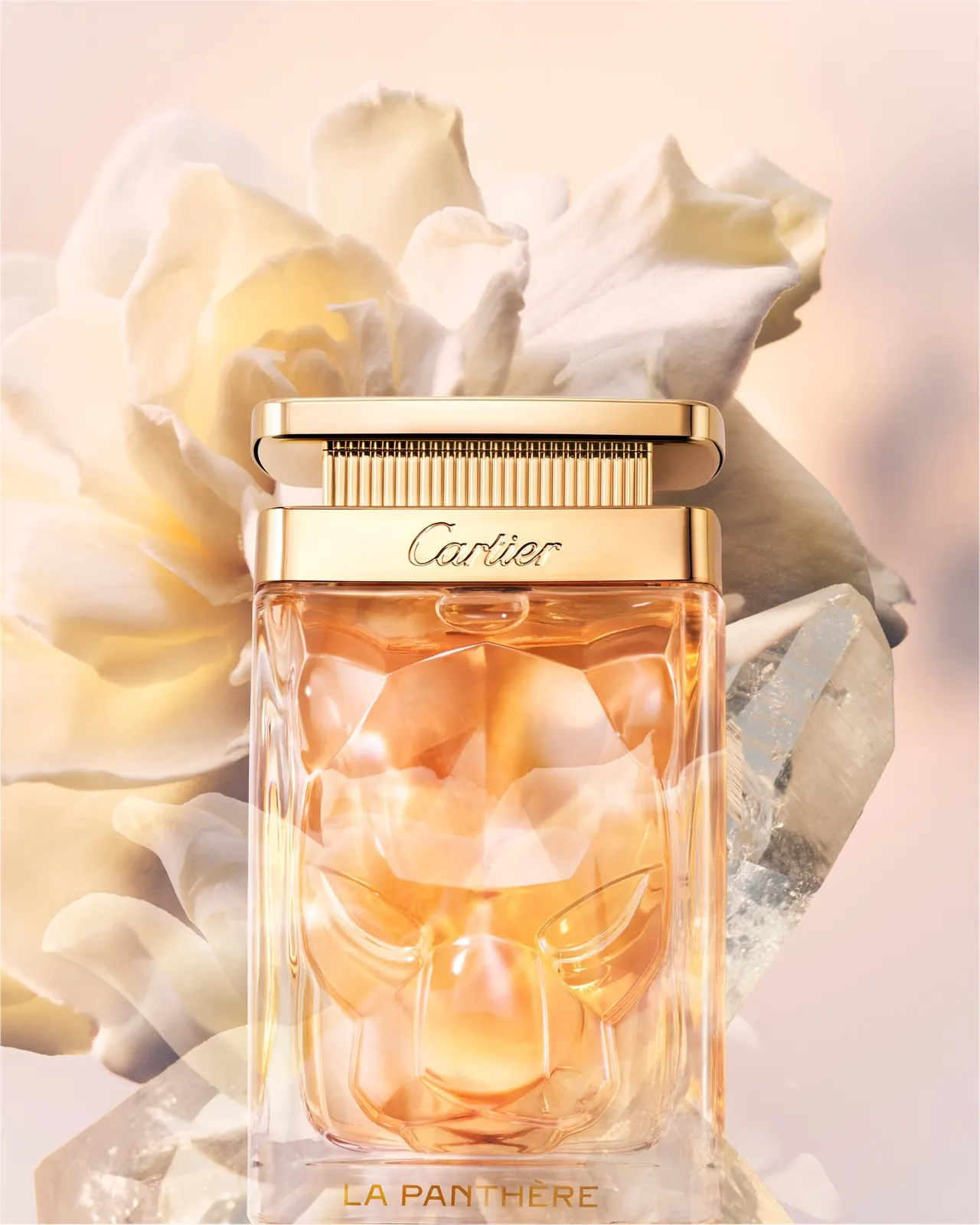
All three fragrances now come in refillable format, a practical commitment that also preserves the bottle’s role as a permanent object: one designed to be displayed, returned to, and kept.
The Three Compositions
Each of the three La Panthère fragrances occupies a distinct position within the same olfactory architecture.
The Eau de Parfum (2014) opens with dried fruits, rhubarb, and bergamot before moving into a gardenia-dominant heart alongside rose, ylang-ylang, and orange blossom. The base — oakmoss, musk, leather, and patchouli — gives the composition its feline signature: earthy, animalic, and controlled. Laurent describes the gardenia as the inevitable starting point, the flower Jeanne Toussaint herself favoured. The result is a fragrance that reads as poised rather than passive.
The Parfum (2020) takes that architecture and concentrates it. Osmanthus, with its distinctive apricot warmth, joins the majestic gardenia at the heart. The musk is warmer, the base richer, and the overall presence more insistent — a version of the panther felt at close range rather than observed from a distance.
The Elixir pushes furthest. Jasmine, iris, and amber are added to the original structure, producing what Cartier calls “the sensation of curling up in the soft, intoxicating feline fur and surrendering to the warmth of wild musk combined with velvety jasmine.” Where the Eau de Parfum is poised and the Parfum is intense, the Elixir lingers — on fabric, on skin, in memory.
Heritage & Lineage
The panther entered Cartier’s vocabulary in 1914 as a spotted motif on an onyx and diamond wristwatch, but it was Jeanne Toussaint who transformed it into something irreplaceable.
Toussaint served as Cartier’s Artistic Director from the 1930s through the 1970s, shaping the Maison’s aesthetic identity with a fierceness that earned her the House nickname “La Panthère”. In 1948, she created what remains one of the most celebrated jewels of the twentieth century: a three-dimensional panther perched atop a 116.74-carat cabochon emerald, commissioned by the Duke of Windsor for the Duchess. That brooch — at once sculpture, jewel, and symbol — established the feline as the single most powerful emblem in Cartier’s creative vocabulary. For Middle East collectors familiar with the Cartier Haryana necklace and the broader high jewellery archive, the panther thread runs continuously through the Maison’s most significant pieces.
Laurent’s phrase for the project captures its ambition exactly: “Every woman has a feline aspect and every flower has a hidden animal essence.” The La Panthère trio is the olfactory extension of that proposition — the panther expressed not in onyx, diamond, or emerald, but in gardenia, musk, and amber. Where a Panthère bracelet is seen, a La Panthère fragrance is felt.
For those building a personal fragrance wardrobe with the same attention given to jewellery from houses such as Van Cleef & Arpels, the trio offers three distinct entry points into a single, coherent olfactory identity — one that has been a century in the making.
Stay ahead of the latest releases. Subscribe to our newsletter for editor-curated coverage of luxury timepieces across the Middle East.
Frequently Asked Questions
Who created the Cartier La Panthère fragrances?
All three La Panthère fragrances — the Eau de Parfum, the Parfum, and the Elixir — were composed by Mathilde Laurent, Cartier's in-house perfumer, who first created the family in 2014.
For 2026, the Cartier LOVE bracelet gains an annual colour capsule of six new models.
What is the difference between La Panthère Eau de Parfum, Parfum, and Elixir?
The Eau de Parfum (2014) is a feline floral chypre built on gardenia, oakmoss, and leather. The Parfum (2020) deepens that structure with osmanthus and warmer musk for greater intensity. The Elixir adds jasmine, iris, and amber, producing the most animalic and tenacious of the three.
Are the Cartier La Panthère bottles refillable?
All three fragrances in the La Panthère trio are presented in refillable format, sharing the same faceted glass bottle with a sculpted panther face, as part of Cartier's environmental responsibility programme.
Where can I buy Cartier La Panthère perfume in the Middle East?
The La Panthère trio is available at cartier.com and at Cartier boutiques worldwide, including locations across the Gulf region.
What inspired the panther symbol in Cartier's fragrance collection?
The panther first appeared on a Cartier wristwatch in 1914 and was made iconic by Jeanne Toussaint, the Maison's Artistic Director, who was known within the House as 'La Panthère'. Her 1948 brooch featuring a panther atop a 116.74-carat cabochon emerald established the feline as Cartier's defining creative emblem.