What You Need to Know
- Boucheron’s Plume de Paon is a Haute Joaillerie collection founded in 1883, in which every piece — necklace, earrings, ring, and medallion — is assembled from multiple independently articulated diamond-pavé segments that physically move like the barbs of a real peacock feather.
- The collection’s proprietary articulation method, combining concealed hinges and openworking, is exclusive to Boucheron’s Place Vendôme workshops.
- A rose-cut diamond anchors the centre of each piece, representing the eye of the peacock feather, chosen for its soft, distributed light rather than brilliant-cut fire.
- The most recent pieces introduce titanium alongside white and pink gold, reducing weight and amplifying the collection’s defining quality of movement.
The 1883 Commission That Set the Standard
Frédéric Boucheron first realised the peacock feather in jewelled form in 1883, working alongside atelier director Paul Legrand. That same year, Grand Duke Alexei of Russia commissioned what became the collection’s founding reference: an emerald and diamond peacock feather necklace known as the “question mark.” The name described its construction. The piece wrapped around the wearer’s neck in a single unfastened curve, its tip resting at the collarbone without any mechanical closure — a design with no precedent in 19th-century jewellery.
The freedom that construction offered was the point. Boucheron had formulated a principle the Maison has followed for over 140 years: the piece must move like a feather. Earlier works — feather hair jewellery and brooches from the 1860s — had anticipated the idea, but the 1883 necklace fixed it as a design doctrine.
The Technique Behind the Movement
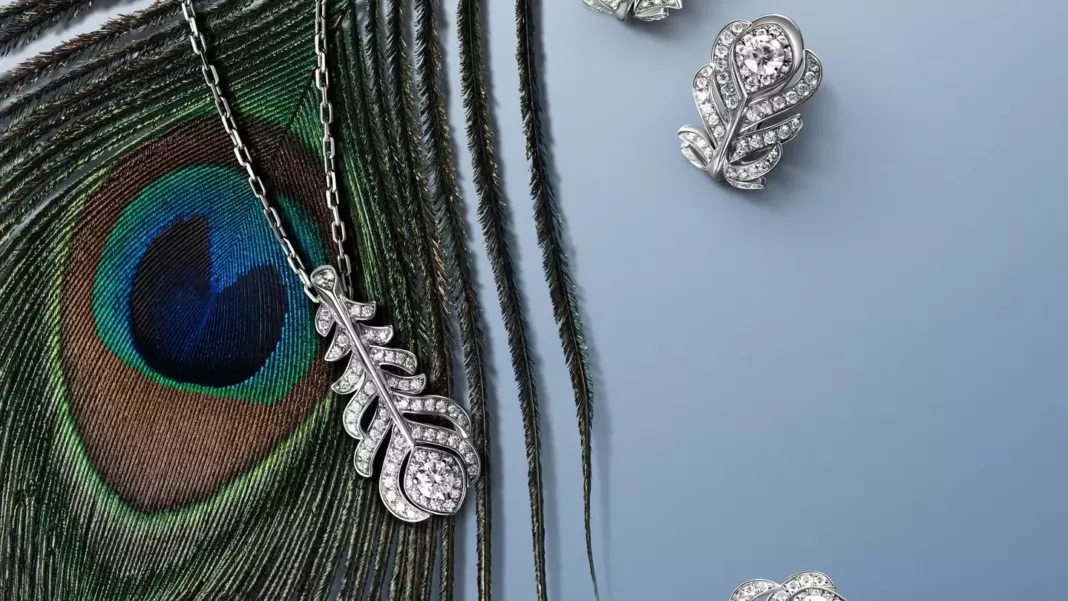
The technical foundation of the Plume de Paon is articulation. Boucheron’s artisans, known within the Maison as the Hands of Light, build each piece from multiple independently moving segments joined by concealed hinges. The individual strands of diamond pavé separate and reform with every movement of the wearer’s body, precisely as the barbs of a real feather behave. As Boucheron has stated: “The creation moves with its wearer, like a feather ruffling in the gentle breeze.”
Openworking refines the effect further. Metal is removed from beneath the stones, leaving only the minimum structure necessary to hold each diamond. The piece becomes lighter and permits light to pass through the stones from both sides, intensifying brilliance. In the most recent pieces, titanium — three times lighter than gold — joins white and pink gold as a structural material, taking the collection’s characteristic weightlessness to its furthest point.
Diamond Counts and the Rose-Cut Eye
The rose-cut diamond at the centre of each Plume de Paon piece is a deliberate technical choice. Its flat back and domed faceted top produce a soft, diffused shimmer that sits in visual harmony with the surrounding pavé rather than competing with it. A modern brilliant cut in the same position would overpower the surrounding stones with concentrated fire.
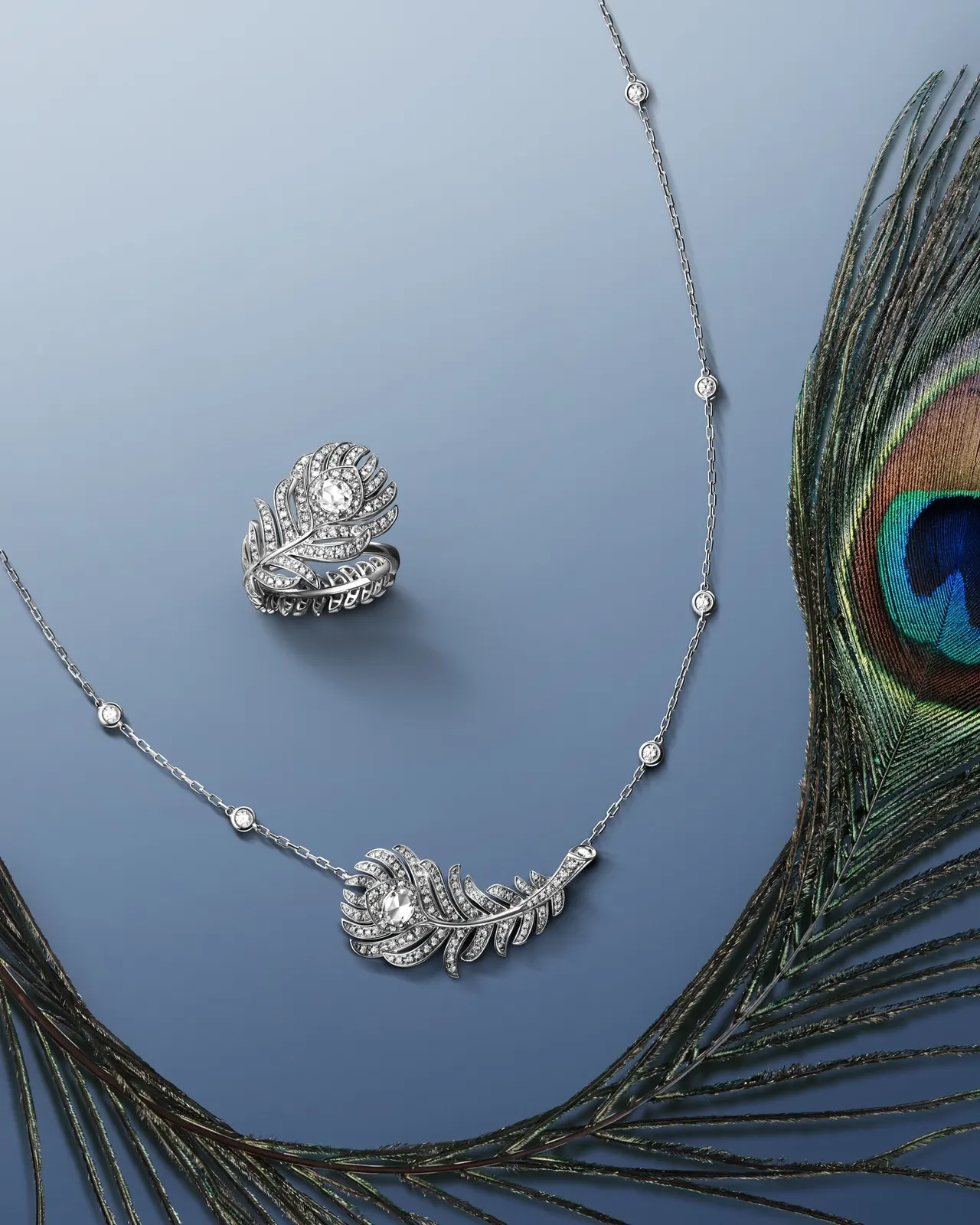
The necklace places a single 0.50-carat rose-cut diamond alongside 563 round diamonds totalling 4.47 carats. The pendant earrings carry two rose-cut diamonds of 1.35 carats accompanied by 782 round diamonds of 4.45 carats. The proportion mirrors the visual structure of the peacock feather itself: one luminous centre, hundreds of bright companions. For collectors considering pieces at this tier from Paris — whether Boucheron, Van Cleef & Arpels, or Bulgari — this level of stone-count transparency is a useful reference point.
The Collection Today
The contemporary range spans five categories, each applying the same structural logic. The flagship necklace drapes around the neck in the spirit of the original question mark and moves with the wearer. The pendant earrings are self-contained articulated feathers that sway with every turn of the head. The white gold ring is fully diamond-paved with openwork construction that makes full coverage read as almost weightless. A small ring in pink gold with a rose-cut centre offers a warmer interpretation. The medallion — among the most unusual pieces — encloses the feather motif within a disc of rock crystal surrounded by cultured pearls and diamonds; the crystal acts as a magnifying window, amplifying the feather’s internal detail.
Every piece is made entirely by hand in the Boucheron workshops at 26 Place Vendôme, Paris, under the creative direction of Claire Choisne. Boucheron, founded in 1858 and part of the Kering group, became the first jeweller to open on Place Vendôme in 1893. The Plume de Paon collection is among the clearest expressions of what that address has come to represent in Haute Joaillerie.
Stay ahead of the latest releases. Subscribe to our newsletter for editor-curated coverage of luxury timepieces across the Middle East.
Frequently Asked Questions
What makes the Boucheron Plume de Paon collection technically different from other feather motifs in jewellery?
Boucheron assembles each Plume de Paon piece from multiple independently moving segments joined by concealed hinges, allowing the diamond-pavé strands to separate and reform with the wearer's movement — precisely as the barbs of a real peacock feather behave. This proprietary articulation method is exclusive to Boucheron's own workshops.
What is the rose-cut diamond's role in the Plume de Paon?
The rose-cut diamond sits at the centre of each piece to represent the 'eye' of the peacock feather. Its flat back and domed faceted top produce a soft, diffused shimmer that sits in visual harmony with the surrounding pavé, rather than overpowering it with the concentrated fire of a modern brilliant cut.
How many diamonds are set in the Plume de Paon necklace?
The Plume de Paon necklace features a single rose-cut diamond of 0.50 carats alongside 563 round diamonds totalling 4.47 carats, all set in white gold.
Where is the Boucheron Plume de Paon collection made?
Every piece in the collection is crafted entirely by hand in Boucheron's Place Vendôme workshops in Paris by artisans the Maison calls the Hands of Light.
When did Boucheron first create the Plume de Paon design?
Frédéric Boucheron and atelier director Paul Legrand first realised the peacock feather in jewelled form in 1883, the same year Grand Duke Alexei of Russia commissioned the celebrated 'question mark' emerald and diamond feather necklace.