
Collector Notes
- Étoilée was conceived in the 1990s by Andrea Buccellati, the Maison’s third-generation creative director, and has remained continuously in production since.
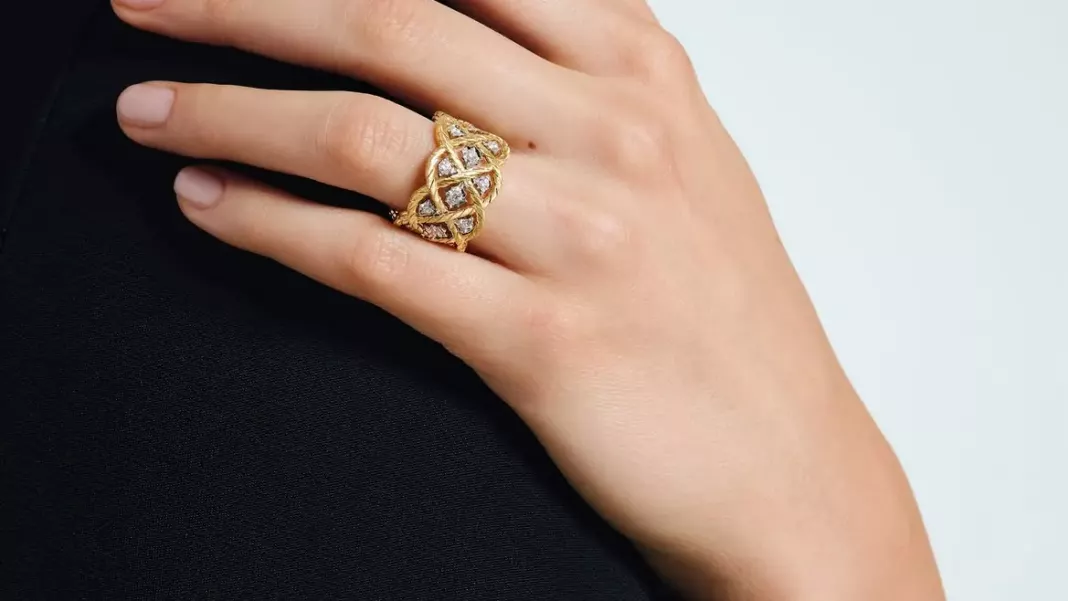
- Four hand-wrought gold chains interlace to form a rhomboidal grid; each rhombus contains a tiny white gold lily set with diamonds, giving the collection its French name: “starry.”
- The defining technique is filo ritorto (twisted thread): gold extruded to a hair-fine filament, twisted, woven into chains, and pressed into bespoke moulds to hold the exact geometry.
- Materials are consistent across all silhouettes: yellow gold for the chain structure, white gold for the lilies, diamonds at each flower’s centre.
- Retail prices on Buccellati.com begin at approximately $6,000, rising to $18,500 and above for more elaborate pieces.
- Buccellati was acquired by Richemont in 2019; the atelier’s hand-finishing philosophy has remained unchanged across all collections.
Origins in the Atelier’s Vocabulary
Buccellati has operated, since Mario Buccellati founded the house in Milan in 1919, on a single conviction: that gold should behave like fabric. The very Maison logo draws from the polylobate openings of Venetian palaces, and the signature technique that Mario perfected, the tulle or honeycombing method in which sheets of gold are hand-pierced into fabric-like nets, established a design language built entirely on textile metaphors. Étoilée sits within that tradition as naturally as a stitch within a weave.
Andrea Buccellati, working from that inheritance in the 1990s, set out to explore interwoven structure at its most geometric. The concept was architectural from the outset: four chains producing a repeating grid of rhomboidal voids. What made the design distinctive was the counterpoint placed inside that grid, a small lily, soft and floral, that the severe geometry frames rather than suppresses. That dialogue between the structural and the delicate defines the collection to this day, distinguishing Étoilée from sister lines such as Ramage, Hawaii, Rombi, and Macri, each of which draws on the same technical foundations but resolves them differently.

The Making: Filo Ritorto in Practice
The production of a single Étoilée piece begins with gold wire drawn through a specialised tool until it reaches filament gauge. That filament is then twisted back upon itself, the filo ritorto technique, to give the thread both visual depth and directional texture. The twisted threads are woven into the four chains that form the Étoilée structure, and the chains are then pressed into bespoke moulds to reproduce the exact rhomboidal geometry the design requires. It is, in the Maison’s own framing, textile engineering performed in solid gold.
The diamond-set lilies that occupy each rhombus are worked separately in white gold and set by craftspeople who specialise in that stage alone. Buccellati’s atelier operates on a principle of focused specialisation: each hand works on one stage of the process, and the techniques, filo ritorto, tulle, modellato, openwork engraving, take years to learn. The Maison’s description of the finished result as recalling “precious weaving yarns” is not marketing licence; it reflects what the object physically does in light, catching and releasing it the way a woven surface does rather than the way polished metal does.
The Collection in Full: Silhouettes and Pricing
Étoilée is among Buccellati’s most complete Icona collections, offered across every major jewellery category. Rings range from slender stackable bands to bolder cocktail pieces; bracelets include the signature cuff and the open-link form that most directly exposes the four-chain weave. Necklaces and pendants allow the rhomboidal pattern to unfold in continuous lengths, while earrings are available from compact studs to longer drops. Across every silhouette, the material logic remains fixed: yellow gold for the chain structure, white gold for the lilies, diamonds illuminating each centre.
For collectors and GCC clients exploring the collection at Buccellati.com, entry-level pieces begin at approximately $6,000, with more elaborate creations priced at $18,500 and beyond. That range places Étoilée in directional conversation with the high jewellery offerings of houses such as Van Cleef & Arpels and Bulgari, though the Buccellati piece is singular in its textile premise. The collection’s continuous production since the 1990s is itself an argument: no piece survives in a house catalogue for three decades on the strength of novelty alone.
Gianmaria Buccellati once reduced the Maison’s entire creative philosophy to a sentence: “I make a design so that a craftsperson can make it; it is the heart of the creation.” Étoilée is the fullest expression of that principle within the Icona range. Andrea Buccellati designed it with precise knowledge of what the atelier’s hands could produce; the atelier’s hands have been producing it, with accumulated refinement, ever since. With the fourth generation now represented by Lucrezia Buccellati, and the Maison operating within Richemont’s portfolio since 2019, the continuity that makes Étoilée possible shows no sign of interruption.
Stay ahead of the latest releases. Subscribe to our newsletter for editor-curated coverage of luxury timepieces across the GCC.
Frequently Asked Questions
What is the Buccellati Étoilée collection?
Étoilée is one of Buccellati's Icona collections, conceived in the 1990s by Andrea Buccellati. It is built from four hand-wrought gold chains interlaced to form rhomboidal spaces, each containing a tiny diamond-set lily in white gold. The collection spans rings, bracelets, necklaces, pendants, and earrings.
What technique is used to make Étoilée jewellery?
The collection relies on filo ritorto, meaning twisted thread, one of the Maison's most demanding goldworking techniques. Gold is extruded into a hair-fine filament, twisted back upon itself, and then woven into chains that are pressed into bespoke moulds to achieve the precise rhomboidal geometry of the pattern.
How much does Buccellati Étoilée jewellery cost?
Current retail prices on Buccellati.com begin at approximately $6,000 for smaller pieces and extend through $18,500 and above for the more elaborate creations.
Who designed the Étoilée collection?
Étoilée was conceived by Andrea Buccellati, the third-generation creative head of the family Maison. Andrea's daughter Lucrezia now represents the fourth generation of the house, which was founded in Milan in 1919 by Mario Buccellati.
Where can I buy Buccellati Étoilée jewellery?
Étoilée is available across Buccellati boutiques worldwide and at buccellati.com, where the Maison's Most Loved selection brings together the pieces that resonate most with clients globally.