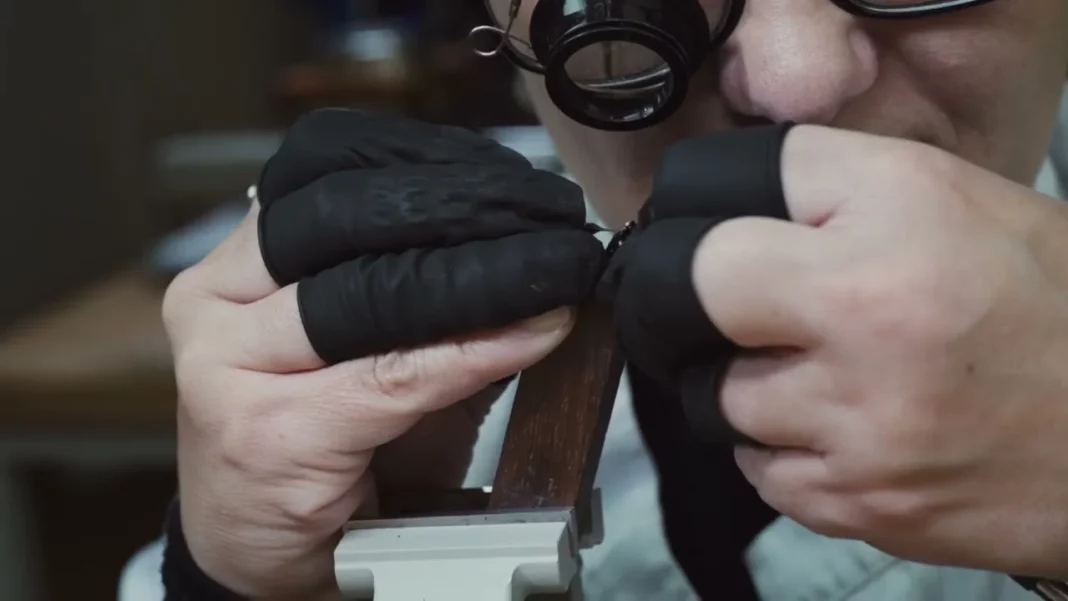
Hand-Finishing at LAURENT FERRIER
The Classic Origin from LAURENT FERRIER demonstrates how hand-finishing separates exceptional timepieces from industrial production. Its escapement bridge undergoes finishing work that transforms a functional regulator into a visible expression of the manufacture’s standards. The bridge sits beneath the dial, visible through the caseback, where every surface reflects hours of focused work.
Understanding the Escapement Bridge
The escapement bridge anchors the balance wheel and escapement to the movement plate. On the Classic Origin, this component receives the same finishing treatment as components visible on the dial—polished flats, beveled edges, and hand-engraved surfaces. LAURENT FERRIER’s approach refuses the separation between “seen” and “unseen” parts.
Hand-Finishing Techniques
LAURENT FERRIER’s watchmakers apply traditional finishing by hand: polishing flat surfaces with abrasive papers in sequence from coarse to fine grits, beveling edges with a file and stone at precise angles, and hand-engraving decorative patterns where the design calls for them. Each operation removes material deliberately; the process cannot be rushed without visible flaws.
The Significance of Hand-Finishing
Finishing serves dual purposes. The polished and beveled surfaces reduce friction between parts, lowering wear over decades of operation. The process also enforces dimensional accuracy—a watchmaker finishing by hand cannot hide tolerances that manual filing exposes. The curves and angles of the escapement bridge become legible evidence of the craftsman’s standards.
Why Choose LAURENT FERRIER?
A LAURENT FERRIER watch represents a commitment to single-watchmaker accountability. The Classic Origin, built by one craftsman from movement assembly through case finishing, carries the weight of that individual’s reputation. The hand-finished escapement bridge is not a luxury flourish but the natural result of how the manufacture operates.
For those interested in exploring the full range of LAURENT FERRIER collections, click here to explore LAURENT FERRIER collections. Discover how each piece tells a story of dedication, passion, and the pursuit of perfection.
Frequently Asked Questions
What is the escapement bridge and why is it important in the LAURENT FERRIER Classic Origin?
The escapement bridge anchors the balance wheel and escapement to the movement plate. On the Classic Origin, finishing this component to the same standard as visible dial components reflects the manufacture’s principle that all parts merit equal attention, regardless of visibility.
How does hand-finishing improve the performance of the LAURENT FERRIER Classic Origin?
Polished and beveled surfaces reduce friction between parts, lowering wear over decades. Hand-finishing also enforces dimensional accuracy—the manual process exposes tolerances that cannot be masked, ensuring each completed movement meets consistent mechanical standards.
What traditional techniques does LAURENT FERRIER use to hand-finish the escapement bridge?
LAURENT FERRIER’s watchmakers polish flat surfaces using progressive abrasive grits, bevel edges with files and stones at precise angles, and apply hand-engraved patterns where the design specifies them. Each technique requires manual control and cannot be automated without compromising results.