What Sets It Apart
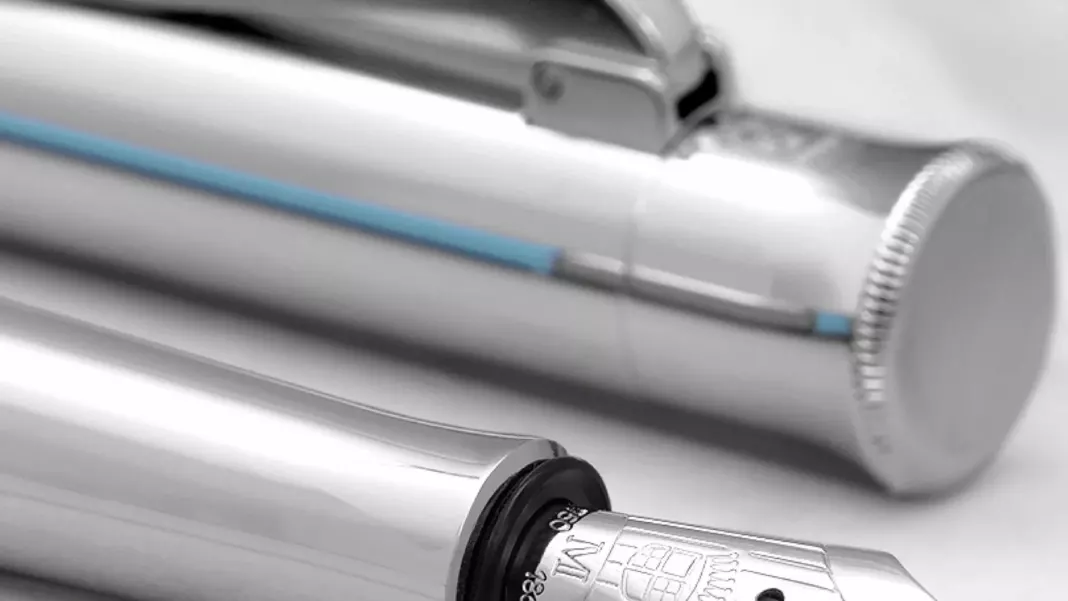
- The Graf von Faber-Castell Guilloche collection is a family of writing instruments whose precious resin barrels are individually engraved with a guilloché pattern, a technique originally reserved for fine watch dials, Fabergé Imperial Easter eggs, and precious silverwork, producing a surface no mass-production process can replicate.
- Each pen passes through more than one hundred manufacturing steps, the majority by hand; no two barrels carry an identical pattern.
- The fountain pen version is fitted with a handmade 18-karat gold nib, rhodium-plated with an iridium point, run in by hand before leaving the atelier.
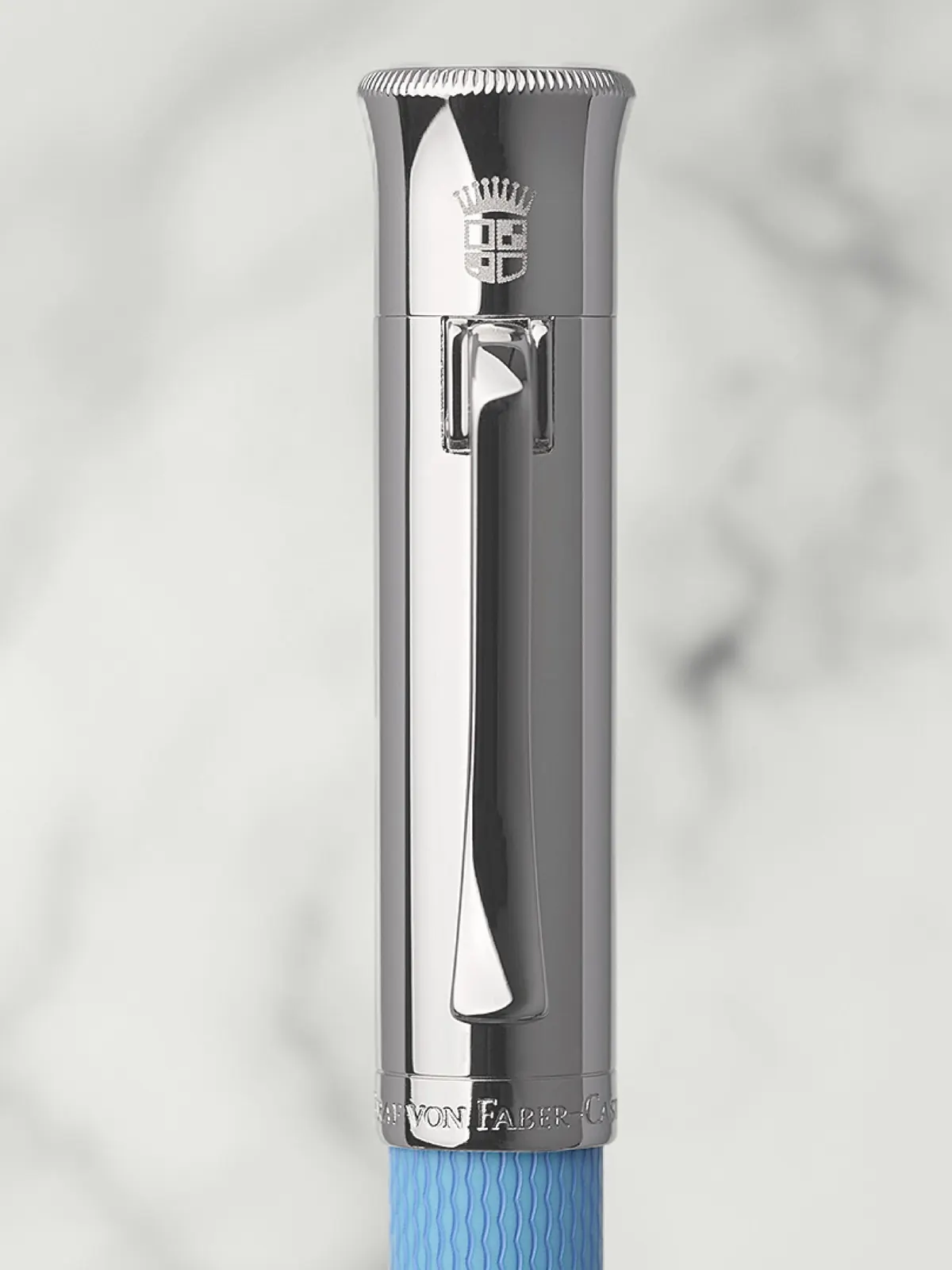
- The most recently featured colourway, Gulf Blue, amplifies the guilloché geometry through a deep, saturated lacquer that channels light across the barrel in three dimensions.
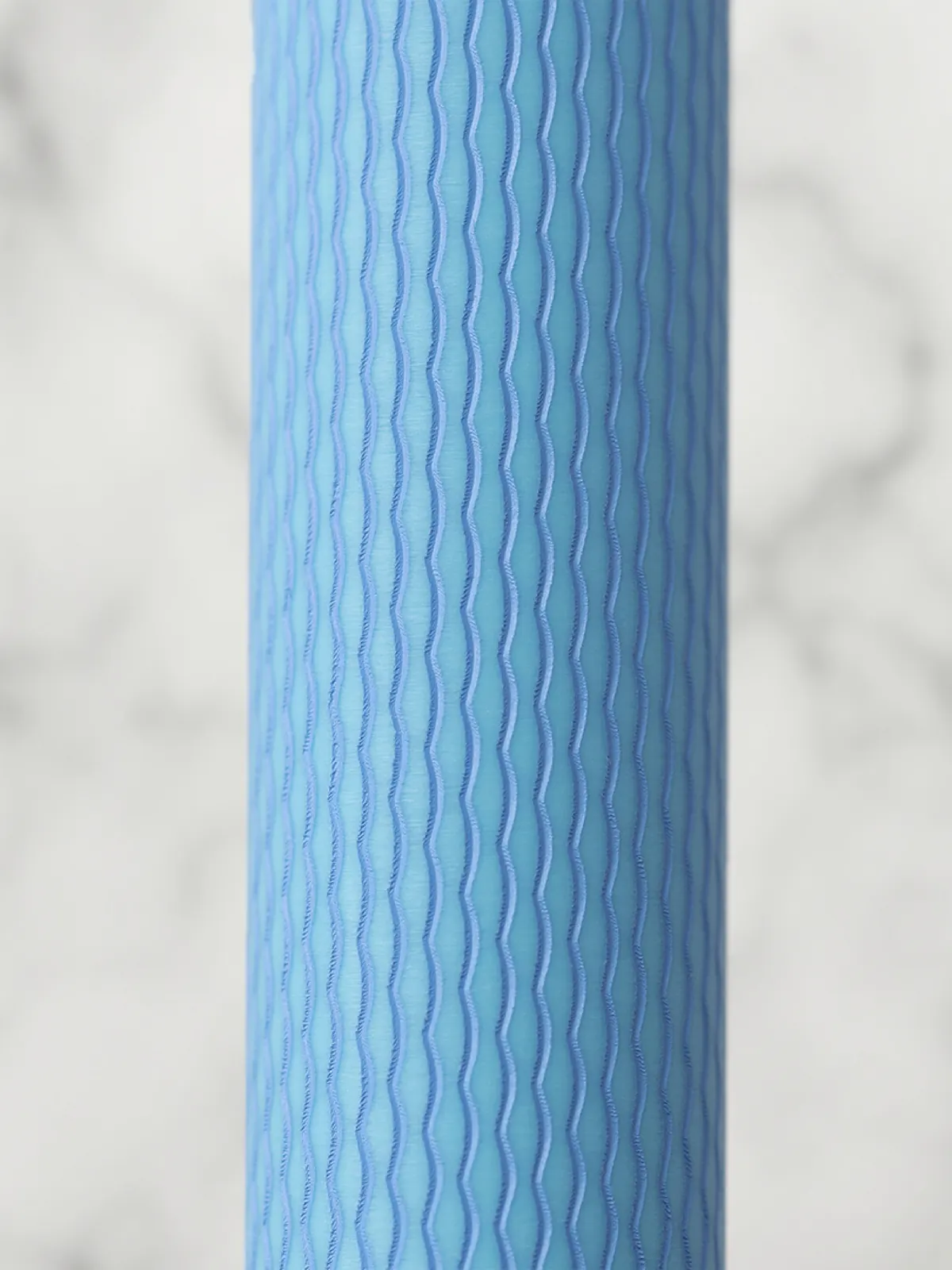
Guilloché sits at a precise intersection of geometry and light. The technique, whose name derives from the French for “engraved pattern,” involves cutting fine, interlocking lines into a surface at rigorously controlled intervals and depths. When the engraved surface is lacquered, those lines produce a subtle moiré effect: the pattern appears to shift and move as the object turns in the hand, structured yet seemingly alive. It is a discipline long associated with fine watch dials and the enamelled cases of Fabergé eggs. Graf von Faber-Castell applies it, line by line, to a barrel of precious resin.
The Engraving and What Follows
The Guilloche collection is produced in two pattern variations. The grain guilloché delivers a regular, dotted texture; the herringbone design produces an angular, woven geometry. Both exist to create optical complexity once lacquered, but they read differently on the barrel. The grain pattern diffuses light across a broader surface. The herringbone concentrates it into directional channels. Graf von Faber-Castell offers the herringbone variant in the Cisele version, where the pattern appears on rhodium-finished metal rather than resin.
After engraving, the barrel enters a lacquering and polishing sequence that accounts for much of those hundred-plus production steps. Each lacquer layer is applied, dried, and assessed individually before the next coat follows. The barrel is then polished repeatedly until the lacquer sits in exact registration with the engraved lines beneath, creating the depth and lustre that distinguish the finished piece from a surface-decorated instrument. The assembly phase adds rhodium-plated metal pieces, a spring-loaded solid-metal clip, and — for the fountain pen — the handmade 18-karat gold nib with its iridium point, individually run in by hand to guarantee smooth ink flow from the first stroke.
Colour as Material
Gulf Blue is the collection’s most recently featured colourway, a deep, saturated blue whose richness depends directly on the guilloché pattern beneath the lacquer. The engraved lines catch and channel light across the barrel’s surface, giving the colour a three-dimensional depth that a plain lacquered barrel cannot achieve. The effect shifts with the angle of view; the pattern is always present, always slightly different. Among the Piaget-adjacent vocabulary of guilloché on watch dials, this relationship between colour and engraved surface is well understood. On a writing instrument, it remains rare.
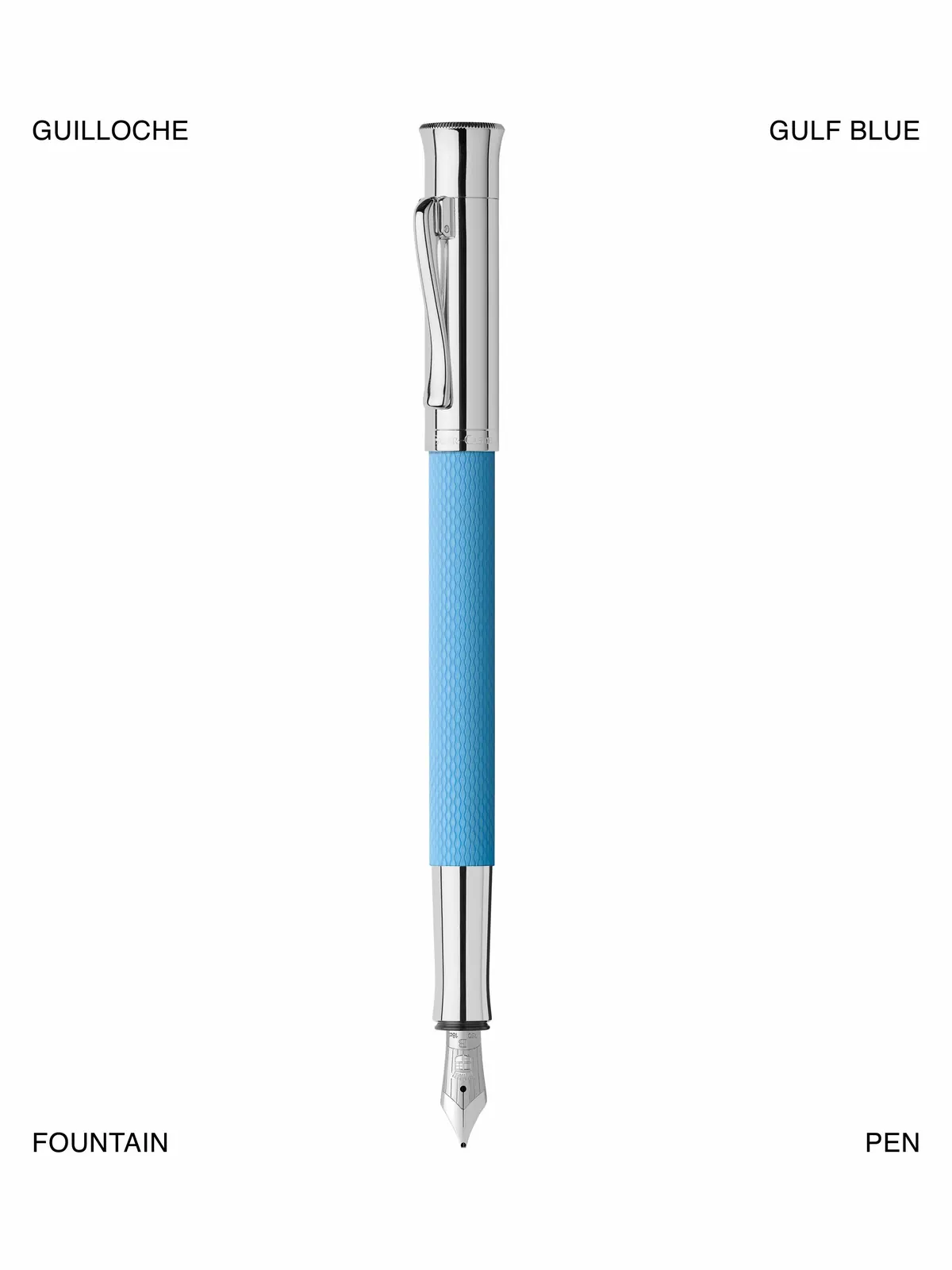
The broader palette runs from Black and the Black Edition (the latter with black PVD fittings rather than rhodium), through Indigo, Cognac, Coral, Olive Green, and India Red. Darker shades reveal the guilloché primarily through texture and light behaviour; lighter shades such as Gulf Blue and Coral allow the geometry to read from a distance as well as up close. The rhodium cap and fittings provide the same cool, mirror-like counterpoint across every colourway, the contrast between smooth metallic surface and textured, coloured barrel forming the collection’s visual identity. As the Maison states, the result is “both contemporary and unmistakably Graf von Faber-Castell.”
A House with 260 Years of Fine-Writing Expertise
Faber-Castell was established in 1761 in Germany, making it one of the oldest industrial companies in the world. The Graf von Faber-Castell line, named after the noble family that has led the house since the 18th century, represents its luxury tier: writing instruments conceived as objects of lasting quality, finished to the standards of fine jewellery. The Guilloche collection places that history in direct contact with a craft vocabulary normally confined to watchmaking and silverwork. The hundred-plus steps, the individually engraved barrels, the handmade gold nib — each is a decision against convenience and in favour of an object that, as the Maison describes it, “reveals its character at first glance.”
The collection is available across four formats: fountain pen, ballpoint pen, rollerball, and propelling pencil. Each is presented in a chamois-coloured gift box with a wood-lined interior. Further information is available at Graf von Faber-Castell.
For more on the writing instruments and luxury objects shaping collector taste across the Middle East, subscribe to our weekly editorial briefing.
Frequently Asked Questions
What technique does the Graf von Faber-Castell Guilloche collection use on its barrels?
Each barrel is individually engraved with a guilloché pattern, a line-by-line process originally developed for fine watch dials, Fabergé eggs, and precious silverwork. The barrel is then hand-lacquered in multiple layers and repeatedly polished to produce the collection's characteristic depth and lustre.
How many manufacturing steps does a Graf von Faber-Castell Guilloche pen require?
Creating a single Guilloche writing instrument involves more than one hundred manufacturing steps, the majority carried out by hand. Because each barrel is engraved individually, no two Guilloche pens carry precisely the same pattern.
What nib does the Graf von Faber-Castell Guilloche fountain pen use?
The Guilloche fountain pen is fitted with a handmade 18-karat gold nib, rhodium-plated with an iridium point, individually run in by hand to ensure smooth ink flow from the first stroke. The pen operates on a cartridge or converter system.
What colours are available in the Graf von Faber-Castell Guilloche collection?
The collection is offered in Black, Black Edition (with black PVD fittings), Indigo, Cognac, Coral, Olive Green, India Red, Cisele, and Gulf Blue. Each colour interacts differently with the guilloché engraving — darker shades reveal the pattern through texture and light behaviour, while lighter colours allow the geometry to read more visually from a distance.
Is the Graf von Faber-Castell Guilloche available as more than a fountain pen?
The Guilloche collection is available in four writing instrument formats: fountain pen, ballpoint pen, rollerball, and propelling pencil. All formats share the same individually engraved precious resin barrel and rhodium-plated fittings.