The Core Details
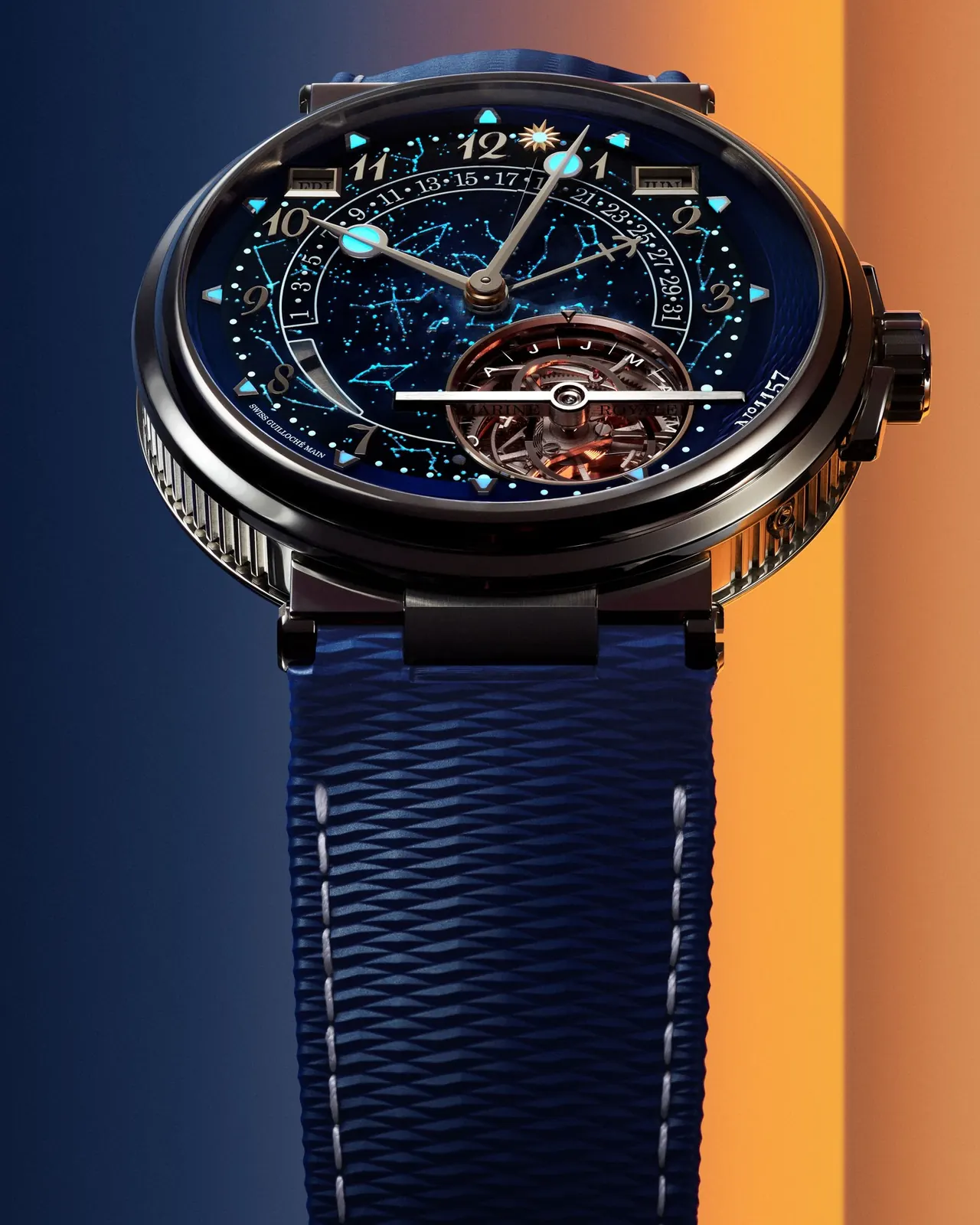
- Caliber 581 DPE houses three of watchmaking’s most demanding complications — a one-minute tourbillon, a running equation of time, and a perpetual calendar — within a 43.9mm platinum case measuring just 11.8mm tall.
- The Équation Marchante display uses a second, independent minute hand tipped with a faceted golden sun to show true solar time in real time, not as an offset value.
- 563 components, 57 jewels, 28,800 vph frequency, and a minimum 80-hour power reserve from a single mainspring barrel.
- The perpetual calendar requires no manual correction until 2100, displaying day, date, month, and leap year across the dial.
On just four days each year — April 16, June 14, September 1, and December 25 — mean solar time and true solar time are identical. On every other day, the two diverge by as much as 16 minutes. Capturing and displaying that divergence continuously, in real time, on a wristwatch, is an achievement very few manufactures have attempted. Breguet is among the few; the 5887 is its clearest argument.
Case, Setting and Finishing
950 platinum accounts for both the case and the peripheral oscillating rotor — a deliberate pairing that keeps weight consistent and preserves the collection’s material identity. At 43.9mm across and 11.8mm tall, the proportions are substantial without being blunt; coin-edge fluting at the bezel and caseback, alongside straight lugs, give the case its Marine character. Water resistance to 100 metres is a meaningful figure for a Grande Complication, and one that distinguishes this reference within the Fondation Haute Horlogerie‘s classification framework.

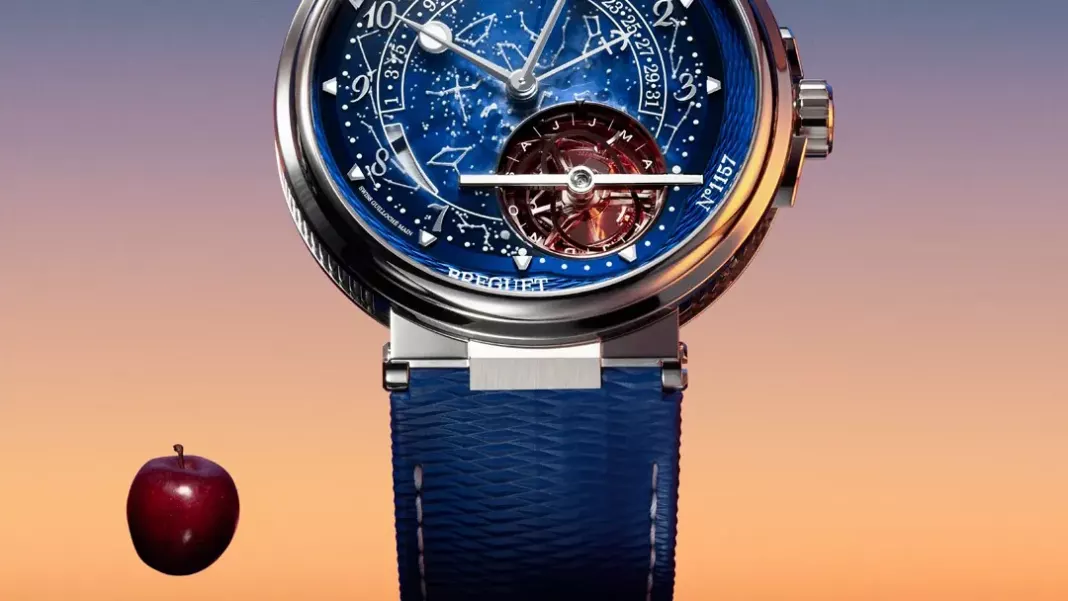
The dial carries applied Roman numerals and luminous Breguet-style hands for civil time, plus the golden-sun-tipped solar hand for the equation display. Wave-pattern guilloché across the surface connects the finishing to the Marine collection’s nautical brief without relying on literal maritime decoration.
Dial and Movement Artistry
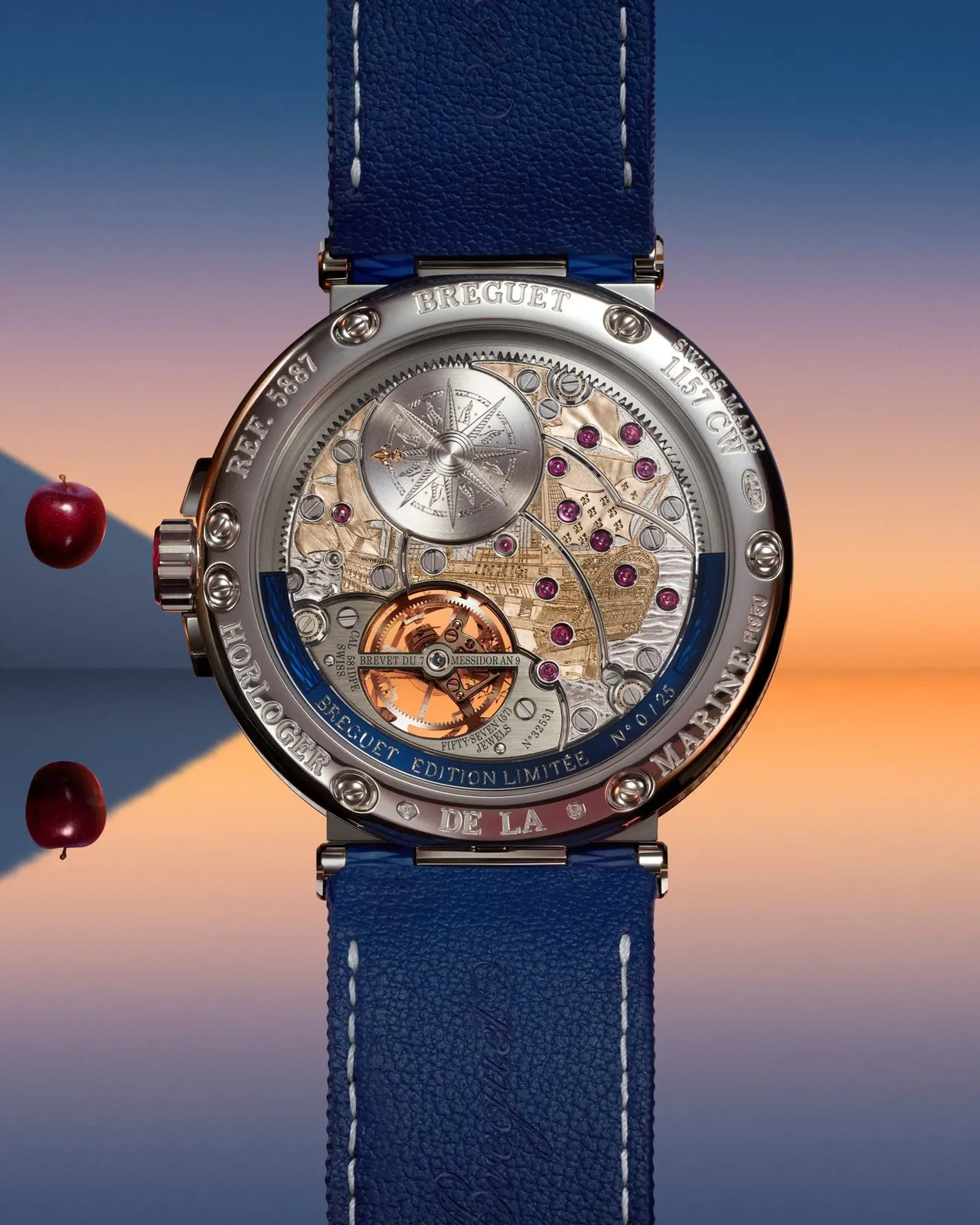
Through the sapphire caseback, Breguet’s master engravers have hand-chiselled a depiction of the Royal Louis — a French Royal Navy warship commissioned in 1752. The barrel carries a hand-engraved compass rose. These are not ornamental choices made after the engineering was complete; they are specific references to Abraham-Louis Breguet’s 1815 appointment as Horloger de la Marine Royale, the historical appointment that defines the Marine collection’s identity.
The kidney-shaped equation cam, mounted on the tourbillon axis and completing one full rotation per year, is visible from the dial side. It translates the mathematical curve of the equation of time into the physical movement of the solar hand — one of the more arresting mechanical sights in a contemporary wristwatch. For collectors who follow grand complications at Watches and Wonders and beyond, the cam’s annual cycle makes the 5887 a watch that reads differently on every date of the calendar.
Movement and Material Engineering
Caliber 581 DPE builds on the 581 DR base, first introduced in 2013 in the Classique Tourbillon Extra-Plat Ref. 5337 at just 3mm thick. That architecture depends on a peripheral oscillating weight rather than a central rotor, eliminating the height penalty a conventional winding system would impose. In the 5887, the same peripheral rotor is crafted from 950 platinum and decorated with a wave motif — functional geometry made visible.
The tourbillon carriage is in titanium for lightness; the balance spring is silicon, chosen for thermal stability and antimagnetic performance. The combination matters at 28,800 vph: at that frequency, thermal drift and magnetic interference are the two likeliest sources of long-term positional error. Silicon and titanium address both. Abraham-Louis Breguet patented the tourbillon on June 26, 1801 — the 225th anniversary of which Breguet recently marked — and no other manufacture holds the same direct lineage between the original invention and current production.

Specifications at a Glance
| Reference | 5887 |
| Movement | Caliber 581 DPE, self-winding, peripheral platinum rotor |
| Components / Jewels | 563 / 57 |
| Frequency | 28,800 vph (4 Hz) |
| Power Reserve | 80 hours minimum |
| Case | 43.9mm × 11.8mm, 950 platinum (also 18K rose gold) |
| Water Resistance | 100 metres |
| Complications | One-minute tourbillon; running equation of time; perpetual calendar |
For more on grand complications and precision horology across the Middle East, sign up for our weekly editorial briefing.
Visit Breguet for the full Marine collection and official boutique information.
Frequently Asked Questions
What movement does the Breguet Marine Équation Marchante 5887 use?
The 5887 houses Caliber 581 DPE, a self-winding movement built from 563 components running in 57 jewels at 28,800 vibrations per hour. It integrates a one-minute tourbillon, a running equation of time, and a perpetual calendar, and is wound by a peripheral rotor in 950 platinum.
What is a running equation of time, and how does the 5887 display it?
A running equation of time — Équation Marchante — shows true solar time directly in real time, rather than as a numerical offset on a sub-dial. In the 5887, a dedicated solar minute hand tipped with a faceted golden sun moves independently of the conventional minute hand, advancing or retarding as the equation of time changes throughout the year. On the four days per year when solar and civil time coincide, the two hands overlap exactly.
What case material and dimensions does the Breguet 5887 use?
The Marine Équation Marchante 5887 is housed in 950 platinum, measuring 43.9mm in diameter and 11.8mm in height. It is also available in 18K rose gold. Water resistance is rated to 100 metres.
How long is the power reserve on the Breguet 5887?
The Caliber 581 DPE provides a minimum 80-hour power reserve from a single mainspring barrel, indicated by a blued gauge positioned between 7 and 8:30 on the dial.
What is depicted on the caseback of the Breguet Marine Équation Marchante 5887?
Through the sapphire crystal caseback, Breguet's master engravers have hand-chiselled a depiction of the Royal Louis, a French Royal Navy warship commissioned in 1752. The barrel nearby carries a hand-engraved compass rose, both references connecting the watch to Abraham-Louis Breguet's 1815 appointment as chronometer-maker to the French Royal Navy.