

**The Finer Points** h2 + ul
Then prose sections. Let me draft:
—
**H2: The Finer Points**
Bullets:
1. Price-angle: no price stated → use most concrete detail. “Patented in 2006 when Marco Tedeschi was 21, the Central Tourbillon places the barrel at the movement’s centre, shifts the time display to the periphery, and wires its case back for winding — a mechanical architecture the maison has since built twelve planned calibres around.”
2. Three interconnected entities — Kross Manufacture, Kross Studio by Marco Tedeschi, Marco Tedeschi — form a fully integrated ecosystem.
3. MT1 carries a hand-wound movement with a seven-day power reserve and tourbillon at 6 o’clock; the MT1.1 variant adds a visible power reserve indication.
4. Audemars Piguet and Chanel have each committed to Kross Manufacture, the production backbone.
5. Twelve calibres across four acts — energy, the sky, the moment, sound — conclude with the MT12 grand complication.
**H2: The Original Question** (founding idea)
**H2: From Two Calibres to Twelve** (evolution)
**H2: For the Collector** (positioning)
Let me now write the full draft and count:
—
The Finer Points
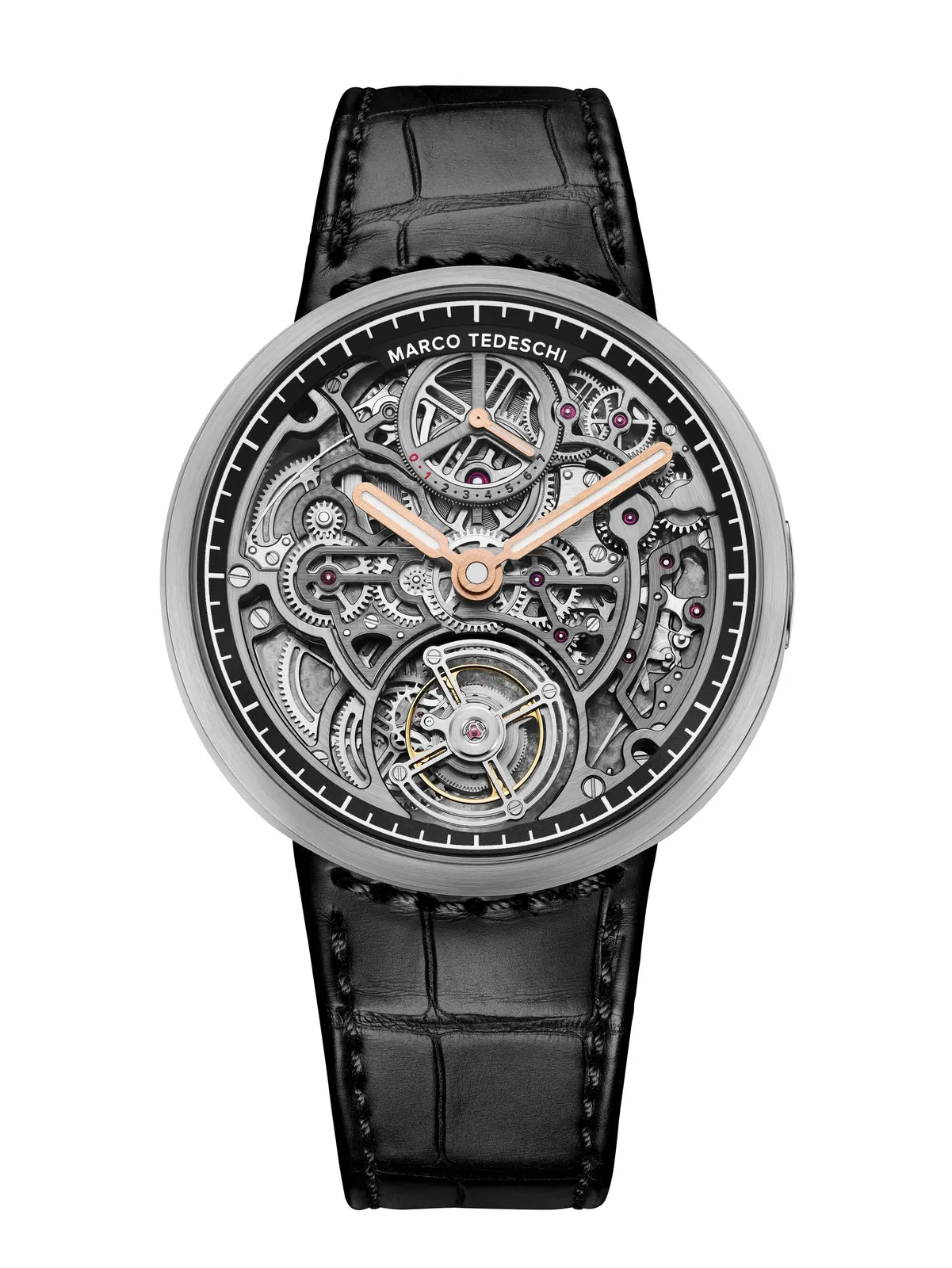
• Patented in 2006 when Marco Tedeschi was 21, the Central Tourbillon moves the barrel to the movement’s centre, relocates the time display to the periphery, and winds through the case back — a single mechanical decision that has since structured twelve planned calibres.
• Three entities — Kross Manufacture, Kross Studio by Marco Tedeschi, and the Marco Tedeschi Maison — operate as one integrated ecosystem.
• The MT1 delivers a hand-wound Central Tourbillon with a seven-day power reserve and tourbillon at 6 o’clock; the MT1.1 adds a visible power reserve indication.
• Audemars Piguet has endorsed Kross Manufacture’s expertise; Chanel has invested in its production capability.
• Twelve proprietary calibres across four acts — energy, the sky, the moment, sound — are planned, closing with the MT12 grand complication.
[image 1 after ul]
**The Original Question**
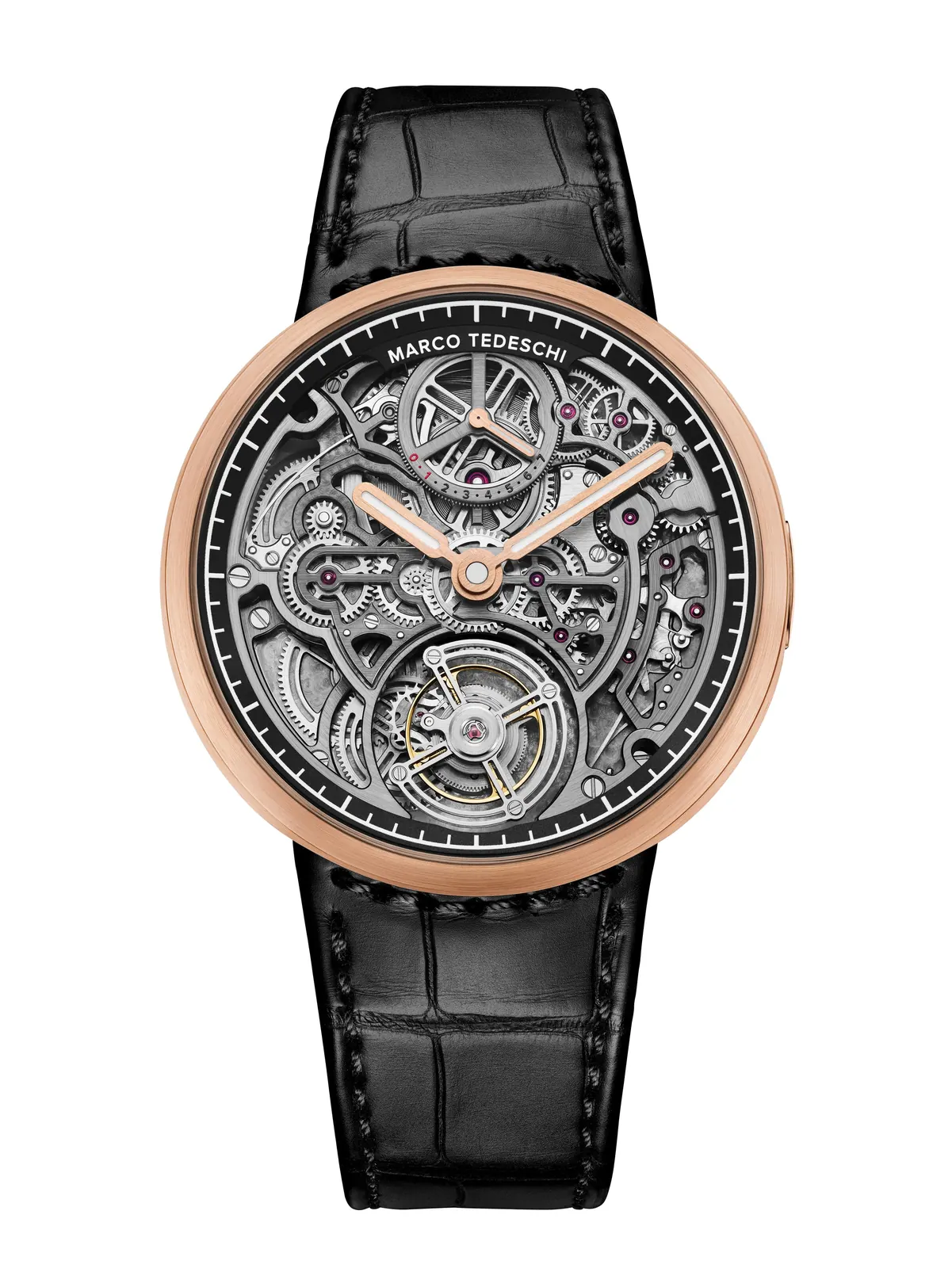
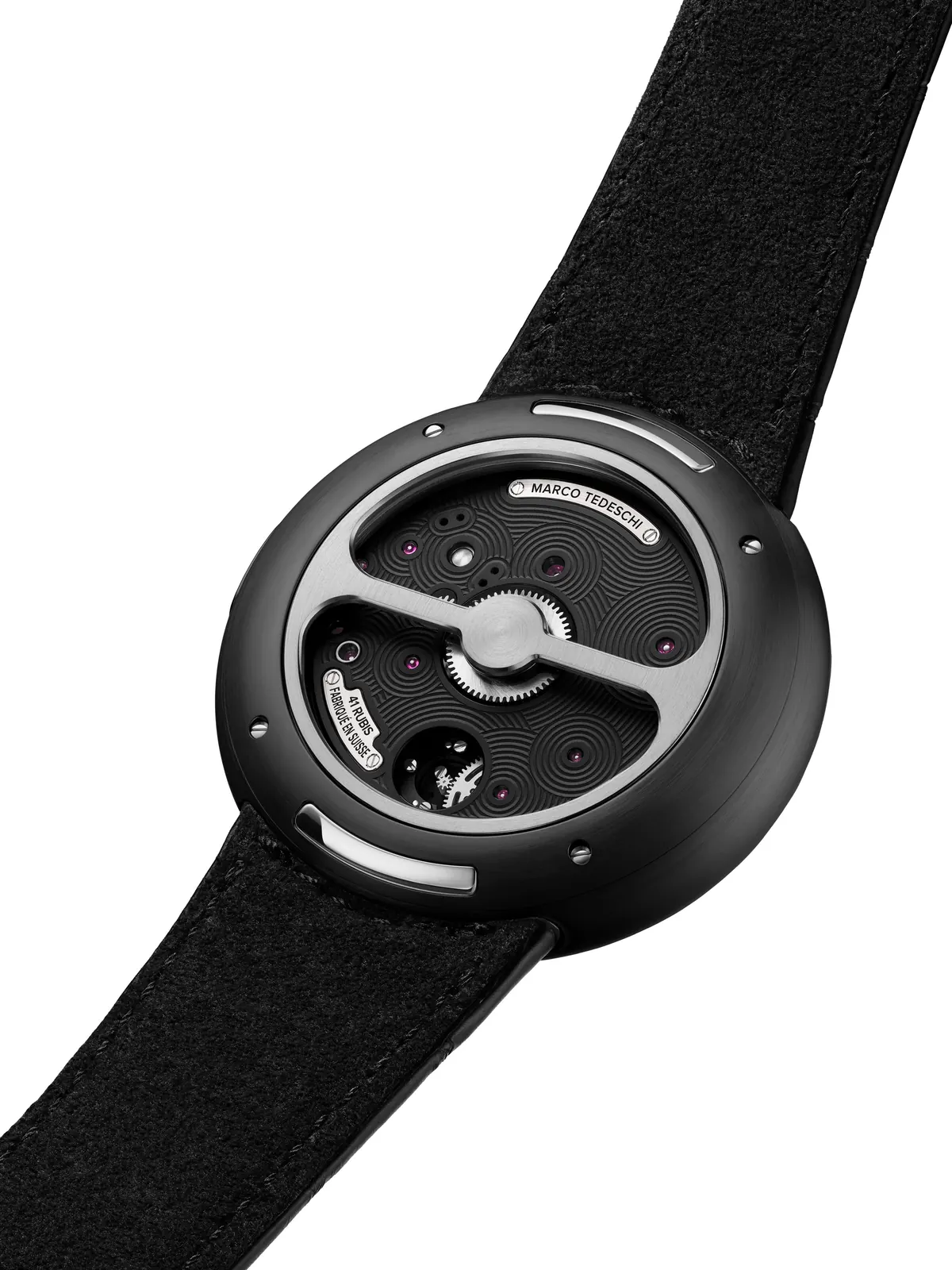
Twenty years ago, an engineering student in Geneva asked why a movement should be designed to fit a case. The answer Marco Tedeschi arrived at, while studying at the École Technique de la Vallée de Joux and later at the Geneva School of Engineering, was that it should not. He reversed the logic: build the architecture around mechanical need, then form the case around it. The Central Tourbillon patent he filed in 2006 placed the barrel at the movement’s centre, freeing the power reserve from the constraints imposed by the conventional central axis. Everything else followed from that one inversion.
[~80 words]
[image 2 BEFORE next section]
**From Two Calibres to Twelve**
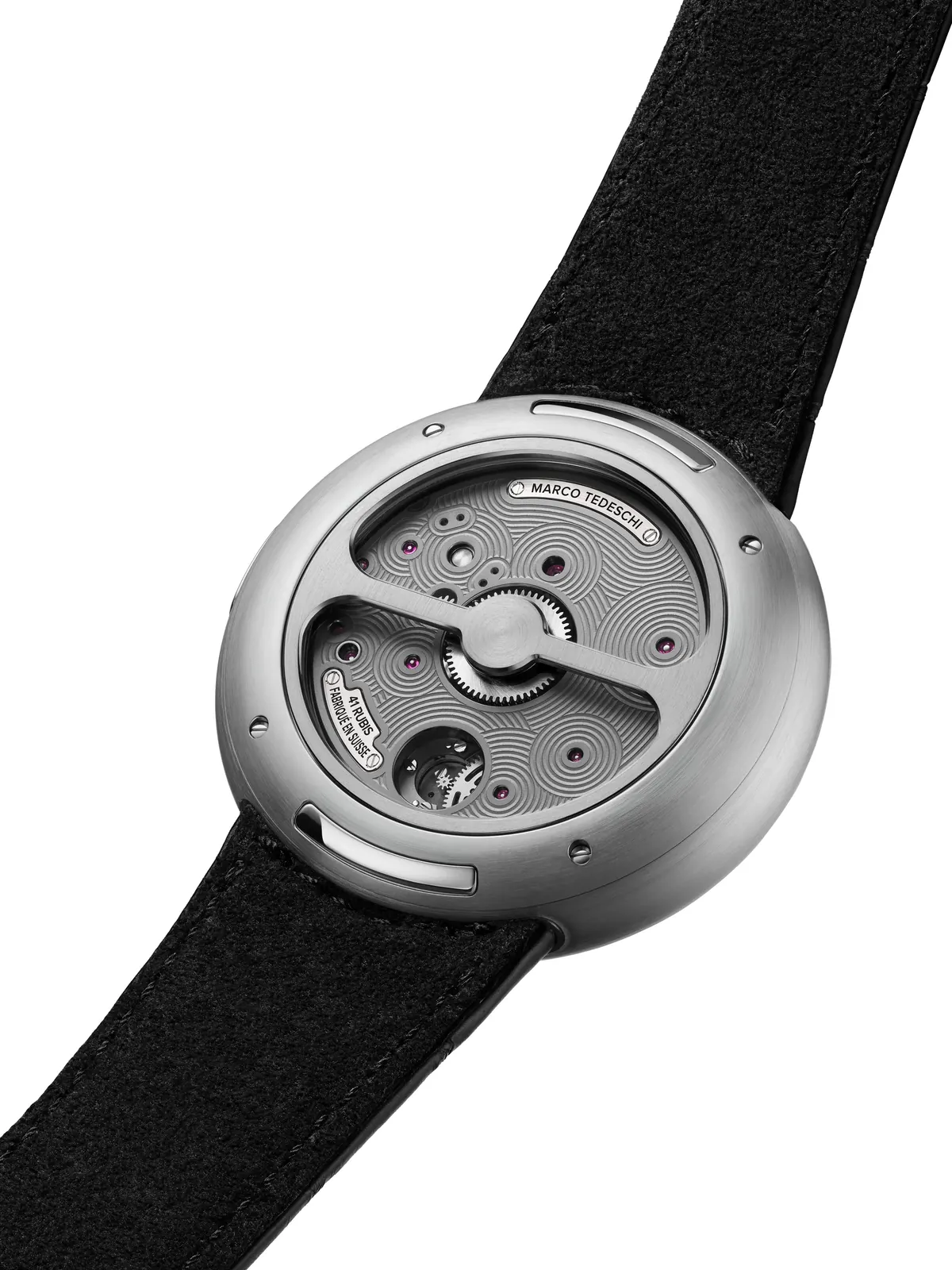
Two calibres have reached collectors so far — the Central Tourbillon and the seven-day tourbillon — but the roadmap names twelve. Organised into four acts, the composition moves from hand-wound energy mechanics (Act I) to astronomical complications including perpetual calendar, moon phases and dual time zone (Act II), to the chronograph (Act III), and finally to striking work — minute repeater and grande sonnerie — in Act IV. The MTO sits at the centre of gravity, the reference from which all twelve variations emerge. [image 3 in middle] The case itself has evolved in parallel: originally 45 mm, it is moving to 42 mm, though the maison frames ergonomics, not size, as the governing consideration. No lugs, a pure round form and a domed sapphire crystal remain constant.
[~110 words]
**For the Collector**
[image 4 after]
Marco Tedeschi quotes himself directly in the press release: “I was 21 when I first questioned why a movement should be designed to fit a case. That question has stayed with me ever since. It led me to rethink the architecture, build my own manufacture and imagine twelve movements around one original idea.” The production layer behind that ambition is credible. Kross Manufacture holds manufacturing relationships with two of the industry’s most exacting names, and the maison operates from a fully integrated facility covering development, production, decoration and assembly. For collectors across the Gulf who follow independent Haute Horlogerie, the Marco Tedeschi proposition is now formally structured: a transparent roadmap, a named sequence of releases, and a manufacture that controls every stage. The score, as Tedeschi puts it, is written. The surprises are still to come.
[image 4 after this section]
CTA
—
Let me count all body words now (excluding HTML tags, h2/ul text):
Opening ul bullets: ~95 words
“The Original Question” prose: ~95 words
“From Two Calibres to Twelve” prose: ~110 words
“For the Collector” prose: ~115 words
CTA: ~35 words
Total: ~450. That’s at the ceiling. Let me trim slightly.
Actually the ul bullets count as body content. Let me be more careful. The 350-450 word count instruction typically refers to the full article body. Let me recount more carefully including headings and bullets:
H2 headings: ~15 words
Bullets (5): ~110 words
Prose section 1: ~95 words
Prose section 2: ~110 words
Prose section 3: ~115 words
CTA: ~35 words
Total: ~480 words. A bit over. Let me trim the bullets and sections.
Let me reduce bullets to 4 and trim prose. Aiming for ~420 words total.
Let me redraft more tightly:
Bullets (4):
1. [60 words] → trim to 45
2. [20 words]
3. [25 words]
4. [20 words]
Prose 1: trim to ~75 words
Prose 2: trim to ~90 words
Prose 3: trim to ~90 words
CTA: ~30 words
~395 words + headings ~15 = ~410. Good.
Let me write the final clean version now:
—
“`html
Marco Tedeschi marks 20 years with a 12-movement roadmap built on one founding idea: let the movement dictate the form. Full editorial from the Middle East.
The Finer Points
- Patented in 2006 when Marco Tedeschi was 21, the Central Tourbillon places the barrel at the movement’s centre, shifts the time display to the periphery, and winds through the case back — a single inversion that now structures twelve planned calibres.
- Two calibres are already in production; the MT1 carries a hand-wound movement with a seven-day power reserve and tourbillon at 6 o’clock, while the MT1.1 adds a visible power reserve indication.
- Audemars Piguet has endorsed Kross Manufacture’s expertise; Chanel has invested directly in its production capability.
- Twelve proprietary calibres across four acts — energy, the sky, the moment, sound — are planned, closing with the MT12 grand complication that unites all four.
The Original Question
Twenty years ago, an engineering student in Geneva asked why a movement should be designed to fit a case. Trained at the École Technique de la Vallée de Joux and later at the Geneva School of Engineering, Marco Tedeschi answered by reversing the logic entirely. He built the architecture around mechanical need, then formed the case around it. The Central Tourbillon patent he filed in 2006 placed the barrel at the movement’s centre, freeing the power reserve from the constraints imposed by the conventional central axis. Every choice since has followed from that first inversion.
From Two Calibres to Twelve
Two calibres have reached collectors so far. The roadmap names twelve, organised across four acts: hand-wound energy mechanics in Act I, astronomical complications — perpetual calendar, moon phases, dual time zone — in Act II, the chronograph in Act III, and striking work, minute repeater through to grande sonnerie, in Act IV. The MTO sits as the central reference from which all twelve variations emerge.
The case has evolved alongside the calibres. Originally 45 mm, it is moving to 42 mm, though the maison frames ergonomics rather than dimension as the governing principle. No lugs, a round form and a domed sapphire crystal remain fixed.
For the Collector
Marco Tedeschi stated in the press release: “I was 21 when I first questioned why a movement should be designed to fit a case. That question has stayed with me ever since. It led me to rethink the architecture, build my own manufacture and imagine twelve movements around one original idea.” The production layer behind that ambition is independently validated: Kross Manufacture holds active relationships with Audemars Piguet and Chanel, and covers every production stage in-house. For collectors across the Gulf who follow independent Haute Horlogerie and keep track of events such as Watches and Wonders, the Marco Tedeschi proposition now carries a transparent architecture — a named roadmap, a defined sequence and a manufacture with full control. The score is written. The surprises remain.
For more on horology that matters to collectors in Europe and the Middle East, sign up for our weekly editorial briefing.
Frequently Asked Questions
What is the founding principle behind every Marco Tedeschi watch?
Marco Tedeschi designs every watch around the principle 'Form Follows the Movement': the movement architecture is established first, and the case takes shape around it, rather than the reverse.
How many movements does Marco Tedeschi plan to release, and what is the roadmap?
The maison has mapped out twelve proprietary calibres organised across four acts — energy and hand-wound mechanics, astronomical complications, chronograph, and striking work — culminating in the MT12 grand complication that unites all four acts.
What distinguishes the MT1 from the MT1.1?
Both carry a hand-wound Central Tourbillon with a seven-day power reserve, but the MT1.1 adds a power reserve indication, making the stored energy directly visible on the dial.
Which major industry partners have validated Kross Manufacture's production capabilities?
Audemars Piguet has entrusted its expertise to Kross Manufacture, and Chanel has invested directly in its manufacturing capabilities, confirming the manufacture's standing among the most demanding names in the industry.
Is the Marco Tedeschi Central Tourbillon available to collectors in the Middle East?
The watches are available on request from the maison or an authorised retailer in the Middle East; prospective collectors may contact Marco Tedeschi directly through the official website at marco-tedeschi.com.