
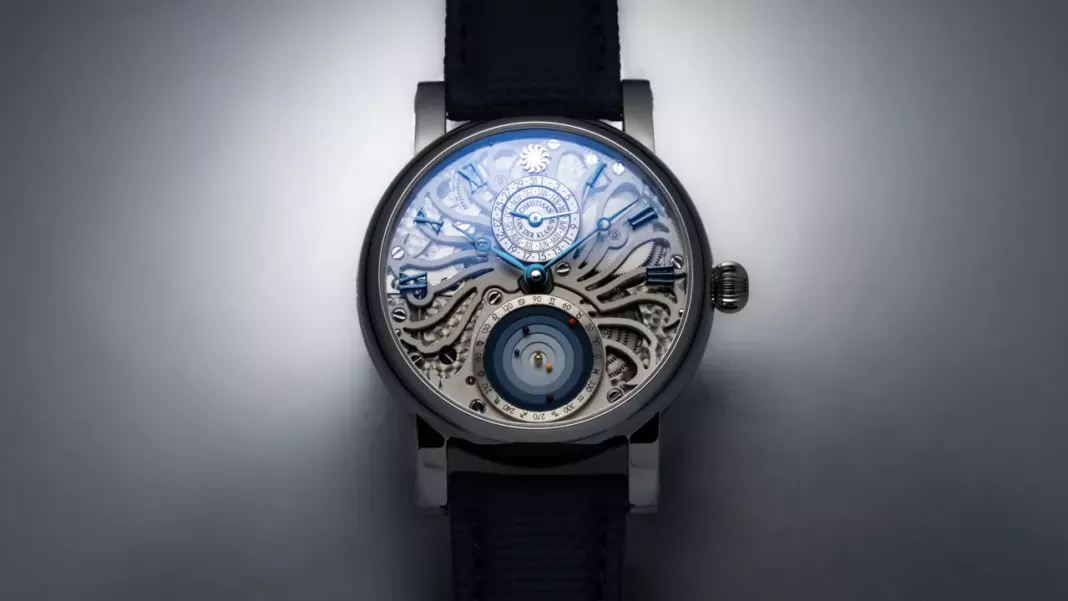
Christiaan van der Klaauw's Planetarium Skeleton Platinum (CKPT22SK) limits production to six pieces. EUR 86,000. Full specs and details for GCC collectors.
Signature Features
- Six individually numbered examples constitute the entire production run of reference CKPT22SK — a layout first produced as a unique piece and now offered for the first time as a limited edition.
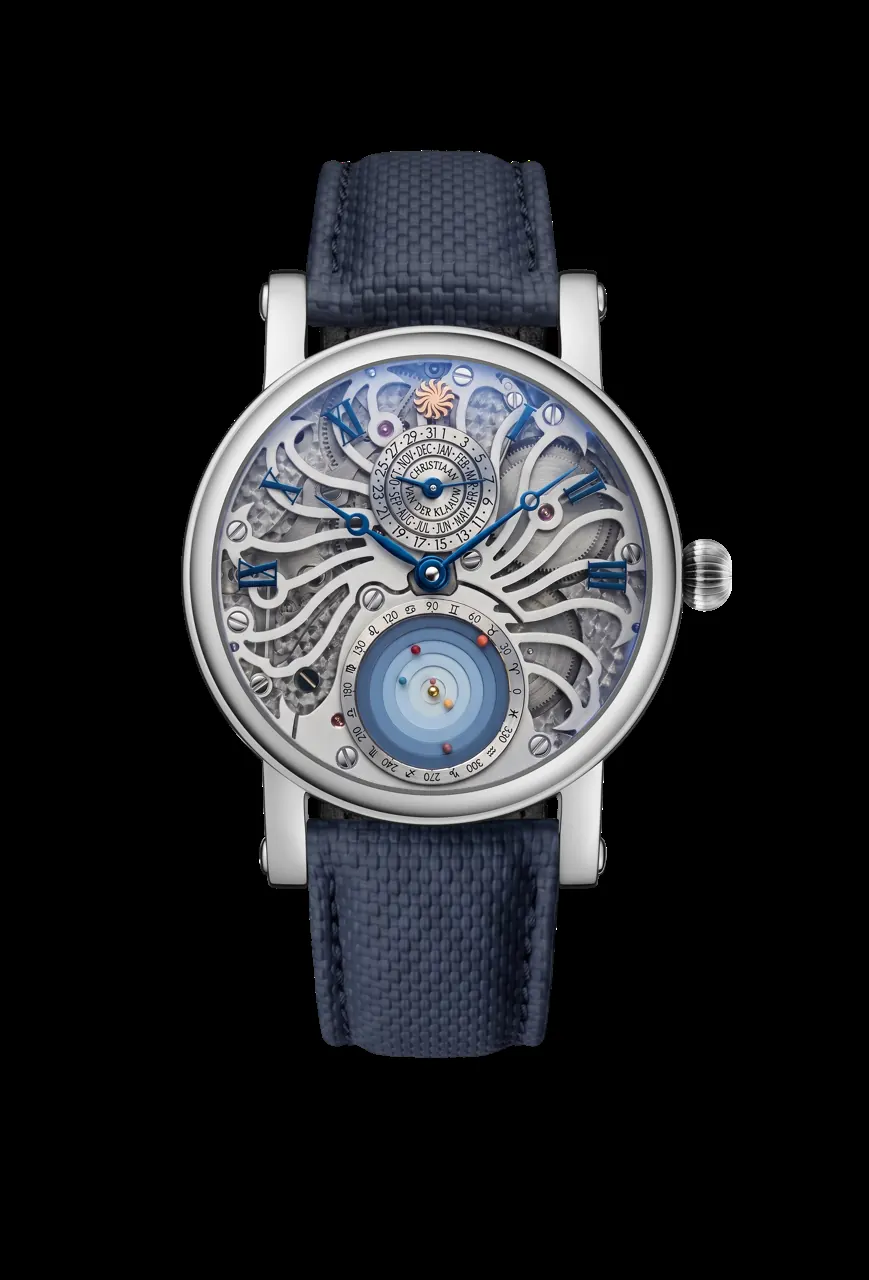
- A fully transparent sapphire dial exposes the smallest mechanical Planetarium in the world, displaying the real-time orbits of six planets around the Sun.
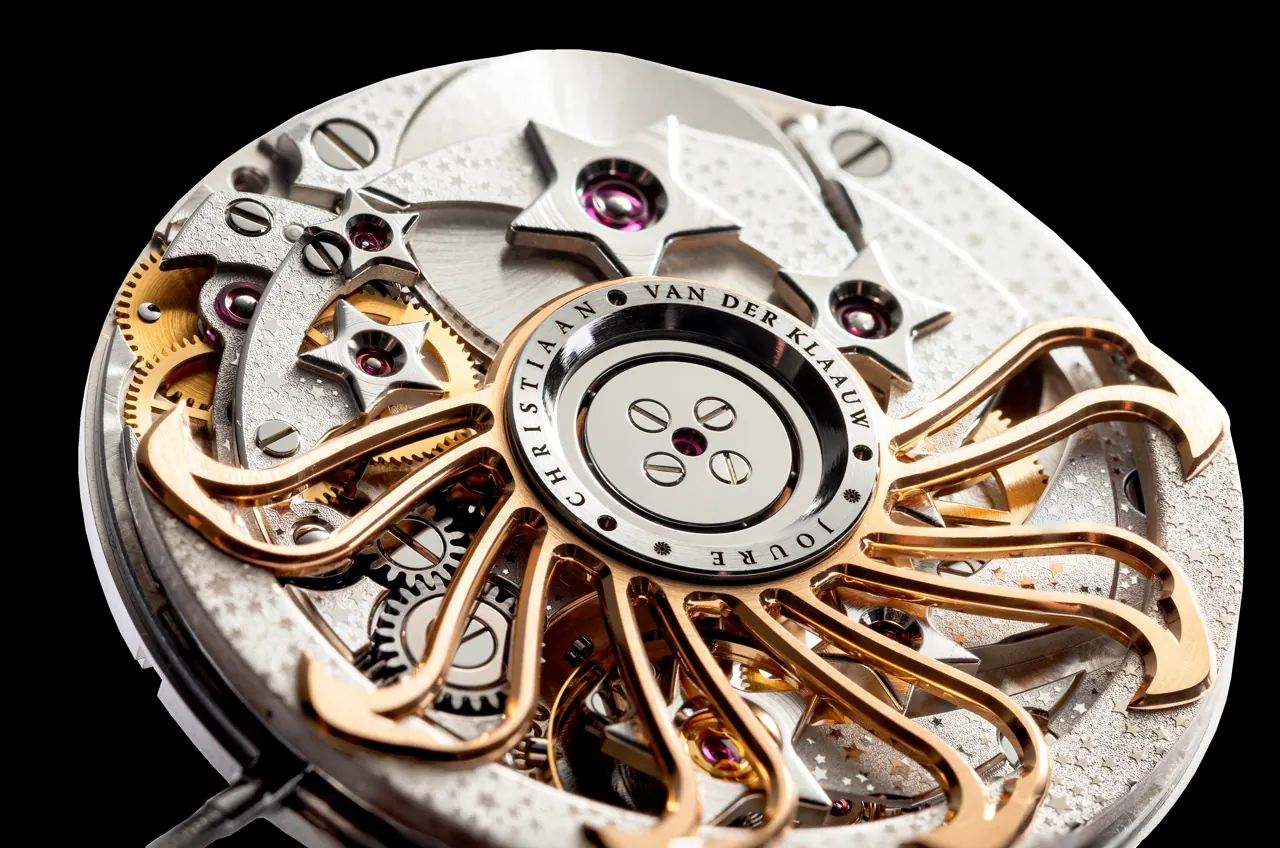
- Custom sun-shaped bridges, formed in the CVDK logo, radiate twelve sculptural claws across the module in rhodium-plated finish.
- Priced at EUR 86,000 excluding VAT; powered by the in-house CKM-01 automatic movement with a 60-hour power reserve.
Six pieces. That is the entire production run of the Christiaan van der Klaauw Planetarium Skeleton Platinum, announced on 2 September 2026 from Naarden. The brand states that this skeletonised configuration — reference CKPT22SK — was previously produced only as a unique piece; this edition marks its first appearance as a numbered series.
Design & Mechanics
Skeletonisation here is an act of clarity, not decoration. The sapphire dial removes every visual barrier between the wearer and the planetary module, so the gearing that drives Mercury, Venus, Earth, Mars, Jupiter and Saturn becomes part of the composition itself. Blued Roman numeral indexes provide chromatic precision against the rhodium-plated bridges and platine, giving depth without competing with the mechanics below.
Those bridges are the design’s most distinctive element. Cast in the shape of the CVDK logo — the Sun — twelve sculptural claws radiate outward across the module, connecting the architectural identity of the Maison with the functional structure of the complication. Against the cool rhodium finish, the effect is precise and unmistakably astronomical.
Movement & Materials
The 40 mm platinum case houses the CKM-01 manufacture movement: uni-directional automatic winding, a free-sprung hairspring, a variable-inertia balance wheel beating at 3 Hz, and a 60-hour power reserve. Finishing extends to hand circular decoration on the star-shaped bridges, frosted star decoration, perlage on the main plate, and a skeletonised rose gold-plated rotor carrying a rhodium-plated tungsten weight. The strap is FKM sailcloth, fastened with a platinum logo on a stainless steel folding clasp. Water resistance is rated at 5 ATM.
The planetary periods displayed are drawn from astronomical fact: 87.97 days for Mercury, 224.70 days for Venus, 365.24 days for Earth, 686.98 days for Mars, 11.86 years for Jupiter, and 29.46 years for Saturn. Hours, minutes, date and month complete the indications.
Heritage & Lineage
Christiaan van der Klaauw created the first mechanical Planetarium wristwatch in 1999. The brand notes that it remains the smallest in the world, a distinction held for twenty-seven years. The blue-accented planetary rings in this edition trace back to that original 2000 creation: a gradient that moves from bright light blue at the centre outward to deeper tones, expressing the diminishing reach of sunlight across the solar system.
Who It Is For
For collectors whose interest in astronomical complications extends beyond exhibition pieces into scientific accuracy, the Planetarium Skeleton Platinum occupies a position that is genuinely rare. Only six exist. Each is individually numbered. The price of EUR 86,000 excluding VAT positions it among the most serious editions Christiaan van der Klaauw has offered, appropriate for buyers who attend Watches and Wonders and seek complications with verifiable mechanical depth rather than decorative approximation.
| Specification | Detail |
|---|---|
| Movement | CKM-01 manufacture, uni-directional automatic, Swiss lever escapement, 30 jewels, 3 Hz |
| Case size | 40 mm |
| Case material | Platinum, sapphire crystal and sapphire case-back |
| Dial | Transparent sapphire with blued Roman numeral indexes |
| Strap | FKM sailcloth; platinum logo on stainless steel folding clasp |
| Water resistance | 5 ATM |
| Price | EUR 86,000 excluding VAT |
| Availability | On request from the maison or an authorised GCC retailer |
For more on horology that matters in the Gulf, sign up for our weekly editorial briefing.
Frequently Asked Questions
How many pieces of the Planetarium Skeleton Platinum are being made?
The Planetarium Skeleton Platinum, reference CKPT22SK, is limited to six individually numbered pieces. This edition marks the first time the skeletonised layout — previously produced as a unique piece — has been offered as a limited run.
What movement powers the Christiaan van der Klaauw Planetarium Skeleton Platinum?
The watch uses the CKM-01 manufacture movement, a uni-directional automatic with a free-sprung hairspring, variable-inertia balance wheel, 21,600 vibrations per hour (3 Hz) and a 60-hour power reserve.
What is the price of the CVDK Planetarium Skeleton Platinum?
The Planetarium Skeleton Platinum is priced at EUR 86,000 excluding VAT.
Is the Christiaan van der Klaauw Planetarium Skeleton Platinum available in Dubai or the GCC?
The edition is available on request from the maison or an authorised GCC retailer. With only six pieces produced, prospective buyers should contact Christiaan van der Klaauw directly at [email protected].
Which planets does the Planetarium complication display, and how accurate are the orbital periods?
The complication displays Mercury, Venus, Earth, Mars, Jupiter and Saturn orbiting the Sun at their correct heliocentric periods: 87.97 days for Mercury, 224.70 days for Venus, 365.24 days for Earth, 686.98 days for Mars, 11.86 years for Jupiter and 29.46 years for Saturn.
Explore more from CHRISTIAAN VAN DER KLAAUW: Venus Annual Calendar — Christiaan van der Klaauw Zodiac Complication · TUDOR Northflag Returns with GMT and Master Chronometer.