The Standout Details
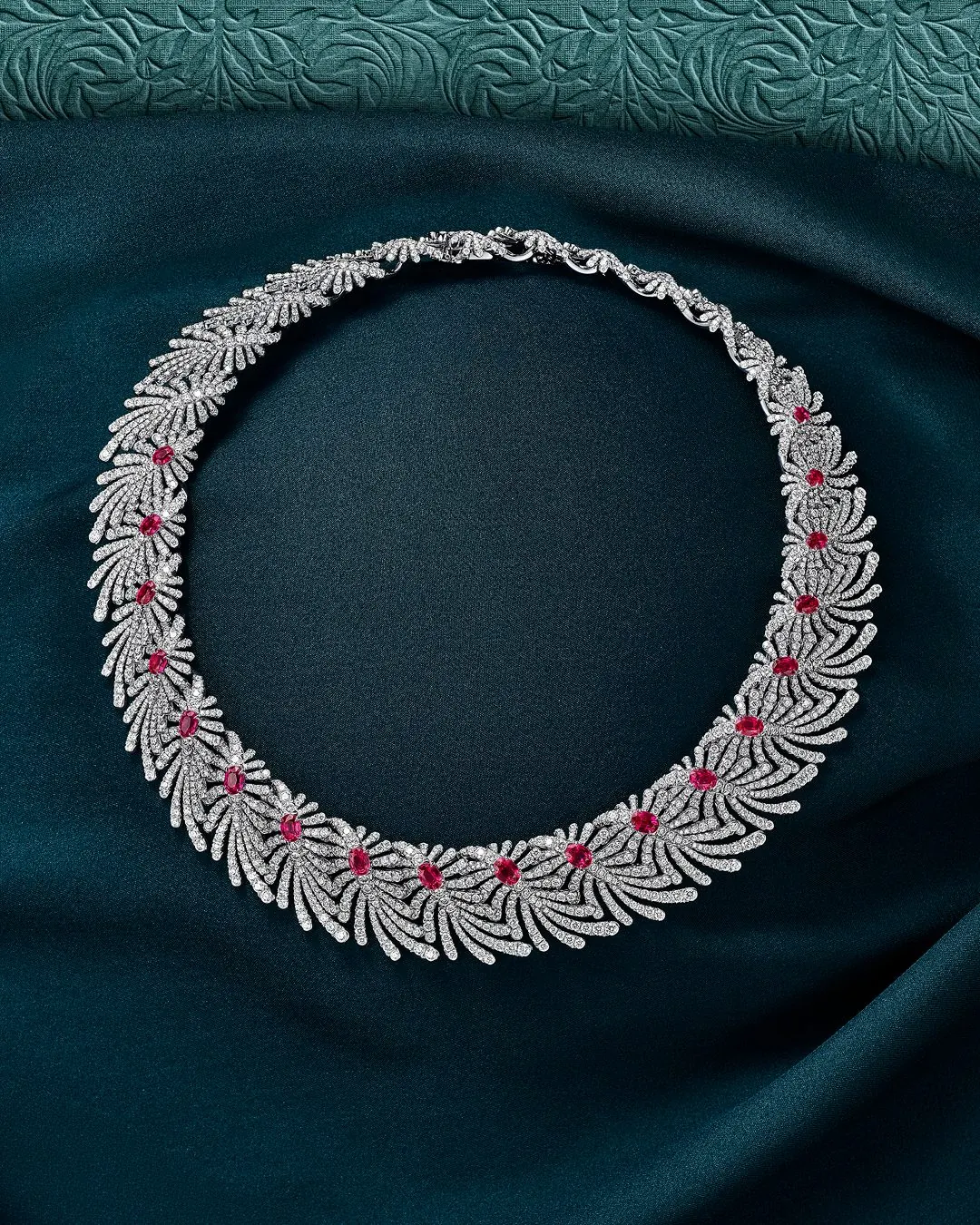
- The Tiffany & Co. Blue Book 2026 Palm chapter is the eleventh and final chapter of the Hidden Garden High Jewellery collection, comprising two parallel suites — the Ruby Suite and the Diamond Suite — set in platinum, featuring 22 unenhanced oval Mozambique rubies totalling over 13 carats and diamonds exceeding 46 carats in total.
- All 22 rubies are unenhanced and matched by Tiffany gemologists for both fluorescence and vivid hue, ensuring visual unity across every lighting condition.
- The design draws directly from Jean Schlumberger’s archival palm frond sketches, translated by Chief Artistic Officer Nathalie Verdeille and the Tiffany Design Studio.
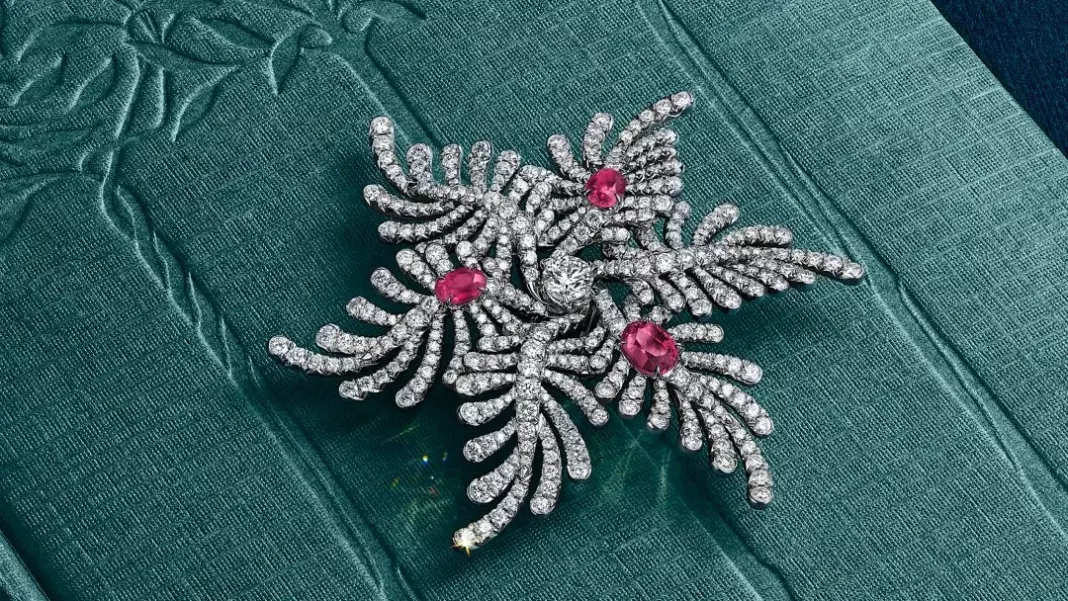
- The Diamond Suite centres on a 4.26-carat cushion-cut diamond; the Ruby Suite includes a necklace, a brooch with three rubies of 1.79 carats, and a ring with five rubies of 2.67 carats.
Design & Botanical Architecture
Schlumberger returned to the palm repeatedly across his career — its arching fronds, their tension between structural rigidity and organic softness, made the form an enduring subject for him. The 2026 Palm chapter takes those archival references as its explicit starting point. Curved, diamond-set elements fan outward in repeating modules, producing leaf structures whose visual rhythm mirrors the radial symmetry of a palm crown.
The result is fronds that appear caught mid-sway, individual leaflets separating and overlapping in patterns that suggest wind rather than stillness. Achieving botanical movement in diamond-set platinum — a material that is, by nature, rigid — requires building organic form from precise, modular geometry. Katerina Perez described the Palm designs as “a study of balance between structure and spontaneity,” a phrase that identifies exactly what makes the execution unusual among High Jewellery collections this year.
Gemstone Provenance & the Matching Standard
The 22 oval rubies at the centre of the Ruby Suite are unenhanced stones from Mozambique — no heat treatment, no artificial improvement of any kind. Mozambique has emerged as one of the world’s primary ruby-producing origins, its finest stones comparable in colour intensity to the historically dominant Burmese mines. The Maison’s decision to use only unenhanced material across this chapter mirrors the same commitment applied to the unenhanced Madagascar sapphire at the centre of the Legendary Bird, the collection’s annual one-of-a-kind masterpiece.
What distinguishes the Palm chapter’s gemstone work is the precision of the matching itself. Unlike diamonds, which follow a standardised international grading scale, rubies are assessed subjectively for hue, tone, saturation, and fluorescence. To present 22 stones that read as a single, unified field of red, Tiffany’s gemologists evaluated potentially hundreds of candidate rubies. The Natural Diamonds Council noted that these gems are “a prime example of Tiffany & Co.’s legacy of sourcing exceptional stones.” The fluorescence criterion is particularly demanding: many Mozambique rubies exhibit strong red fluorescence under ultraviolet light, which amplifies apparent colour in daylight. Matching stones for fluorescence as well as hue ensures that the rubies respond identically whether viewed under gallery lighting or full Gulf sunlight.
Two Suites, One Motif
The Palm chapter is organised across two parallel suites that interpret the same botanical subject through different chromatic registers.
The Ruby Suite pairs the vivid red of unenhanced Mozambique rubies against the white fire of diamonds — a contrast that is deliberately dramatic. The suite comprises a necklace in platinum, a brooch with three unenhanced oval rubies of 1.79 carats, and a ring set with five unenhanced oval rubies totalling 2.67 carats. The Diamond Suite removes the chromatic contrast entirely, replacing the rubies with radiant cushion-cut diamonds and diamond accents in cut-down pavé settings. Its necklace centres on a 4.26-carat cushion-cut diamond, capturing the quality of sunlit foliage rendered in white light alone. The same fronds, the same botanical architecture, two fundamentally different emotional registers.
The Closing Chapter
Palm is the eleventh and final chapter of the Hidden Garden spring launch, following Butterfly, Monarch, Bird on a Rock, Paradise Bird, Parrot, Bee, Jasmine, Marguerite, Bloom, and Twin Bud. Closing a High Jewellery collection with a study in leaves rather than flowers — canopy rather than bloom — gives Hidden Garden an unusual structural intelligence. Where many collections close on their most visually explosive creation, Verdeille’s garden closes with something quieter: a palm gently swaying, its diamond fronds parting to reveal rubies of exceptional intensity. It is an ending that rewards attention rather than demanding it.
For collectors in the Middle East drawn to High Jewellery with documented provenance — whether from Bulgari, Chaumet, or Piaget — the Palm chapter’s commitment to unenhanced stones and fluorescence-matched gemology represents a level of sourcing rigour that positions both suites firmly at the top of this year’s High Jewellery market. Further details are available directly at Tiffany & Co.
Stay ahead of the latest releases. Subscribe to our newsletter for editor-curated coverage of luxury timepieces across the Middle East.
Frequently Asked Questions
What gemstones are used in the Tiffany Blue Book 2026 Palm chapter?
The Palm chapter features 22 unenhanced oval rubies sourced from Mozambique, totalling over 13 carats, set alongside diamonds exceeding 46 total carats, all mounted in platinum.
What is the difference between the Ruby Suite and the Diamond Suite in the Palm chapter?
The Ruby Suite places vivid unenhanced Mozambique rubies between diamond palm fronds for a dramatic chromatic contrast. The Diamond Suite replaces the rubies with radiant cushion-cut diamonds and cut-down pavé accents, capturing the quality of sunlit foliage rendered entirely in white light. The Diamond Suite necklace centres on a 4.26-carat cushion-cut diamond.
Who designed the Palm chapter of Tiffany Blue Book 2026: Hidden Garden?
The Palm chapter was designed by Chief Artistic Officer Nathalie Verdeille and the Tiffany Design Studio, drawing directly on archival references from Jean Schlumberger, whose palm frond sketches and jewels form the chapter's explicit creative starting point.
Is the Palm chapter jewellery available to view or purchase in the Middle East?
Tiffany & Co. directs collectors to tiffany.com for discovery and access to its High Jewellery pieces; availability at specific Middle East boutiques is best confirmed directly with the Maison.
Why does Tiffany & Co. match the rubies in the Palm chapter for fluorescence?
Many Mozambique rubies exhibit strong red fluorescence under ultraviolet light, which amplifies apparent colour in natural daylight. Matching all 22 stones for fluorescence as well as hue ensures they behave identically across every lighting condition, from gallery interiors to outdoor settings.