
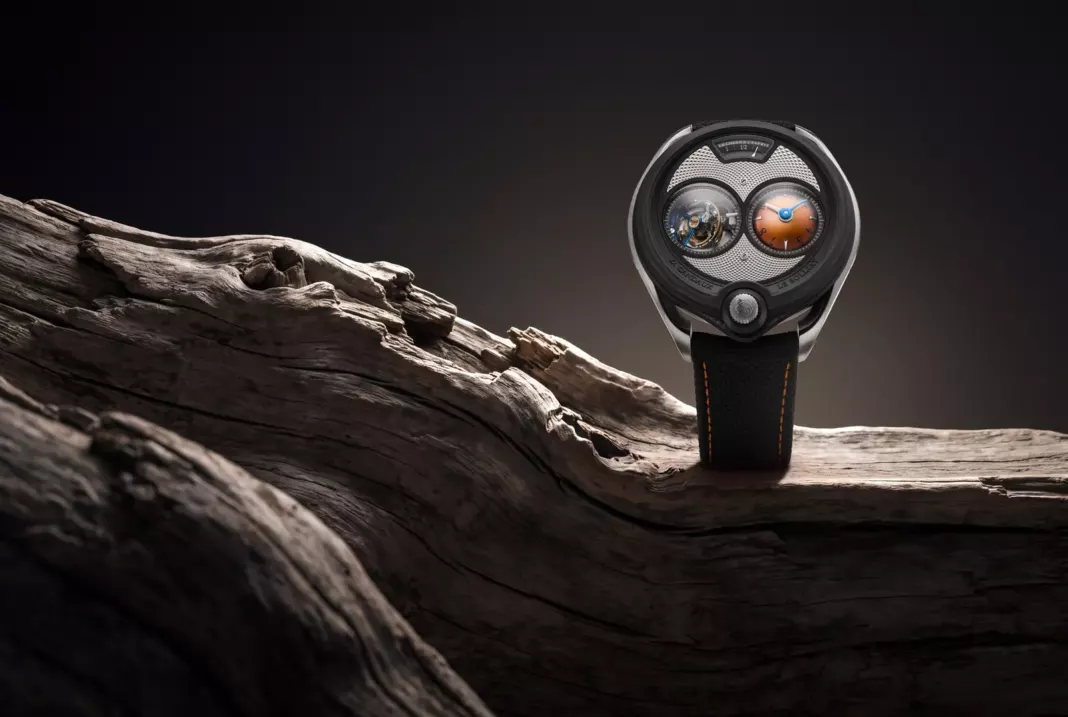
David Candaux and Luminari Motor Company unveil the DC55, a carbon-bodied 1955 300SL Gullwing restomod limited to 5 cars. First car shown in New York, November 2026.
The Essentials Up Front
- Five unique cars — the DC55 is limited to that number, with car one of five unveiled on 18 November 2026 at Rétromobile New York; each is priced upon request.
- The body is carbon fiber, hand-laid by Luminari Motor Company on a Mercedes-Benz SLK55 AMG (R172) base structure, with a silhouette drawn from the 1955 300SL Gullwing.
- Under the carbon sits the AMG M152: a naturally aspirated 5.5-litre V8 rated at 416 hp at 6,800 rpm and 540 Nm at 4,500 rpm, driving the rear wheels through a 7-speed AMG Speedshift Plus automatic.
- The collaboration mirrors David Candaux’s practice of replacing traditional watchmaking brass with titanium: in both cases, historical craft gestures are retained while the material moves to match what technology now allows.
Design and the Logic Behind the Doors
Seventy-two years after the 300SL appeared at the International Motor Sports Show in New York, the DC55 was unveiled in the same city. The Gullwing doors of the original were not a stylistic choice. The 300SL’s tubular steel racing frame ran high along the cockpit sides, bringing the sills to waist height. A conventional door had no path. The doors were therefore hinged at the roof, and that constraint became the car’s most recognisable feature.
Luminari preserved the same silhouette in carbon fiber. Every exterior element was made by hand: custom glass, modernised headlights, retro-inspired taillights drawn from 1950s forms, and 19-inch wheels styled after the originals. The paint is a custom-blend midnight blue, reference #0B1F41, taken from the David Candaux brand identity.
Materials Then and Now
SL stood for Sport-Leicht. In 1955, lightness meant aluminium: the 300SL combined a steel shell with aluminium hood, doors and trunk lid. A handful were built entirely in aluminium for competition use. For Luminari, lightness now means carbon fiber, laid layer by layer and fitted by hand. The carbon panels are not pressed from a mould and bolted on; each one is finished individually.
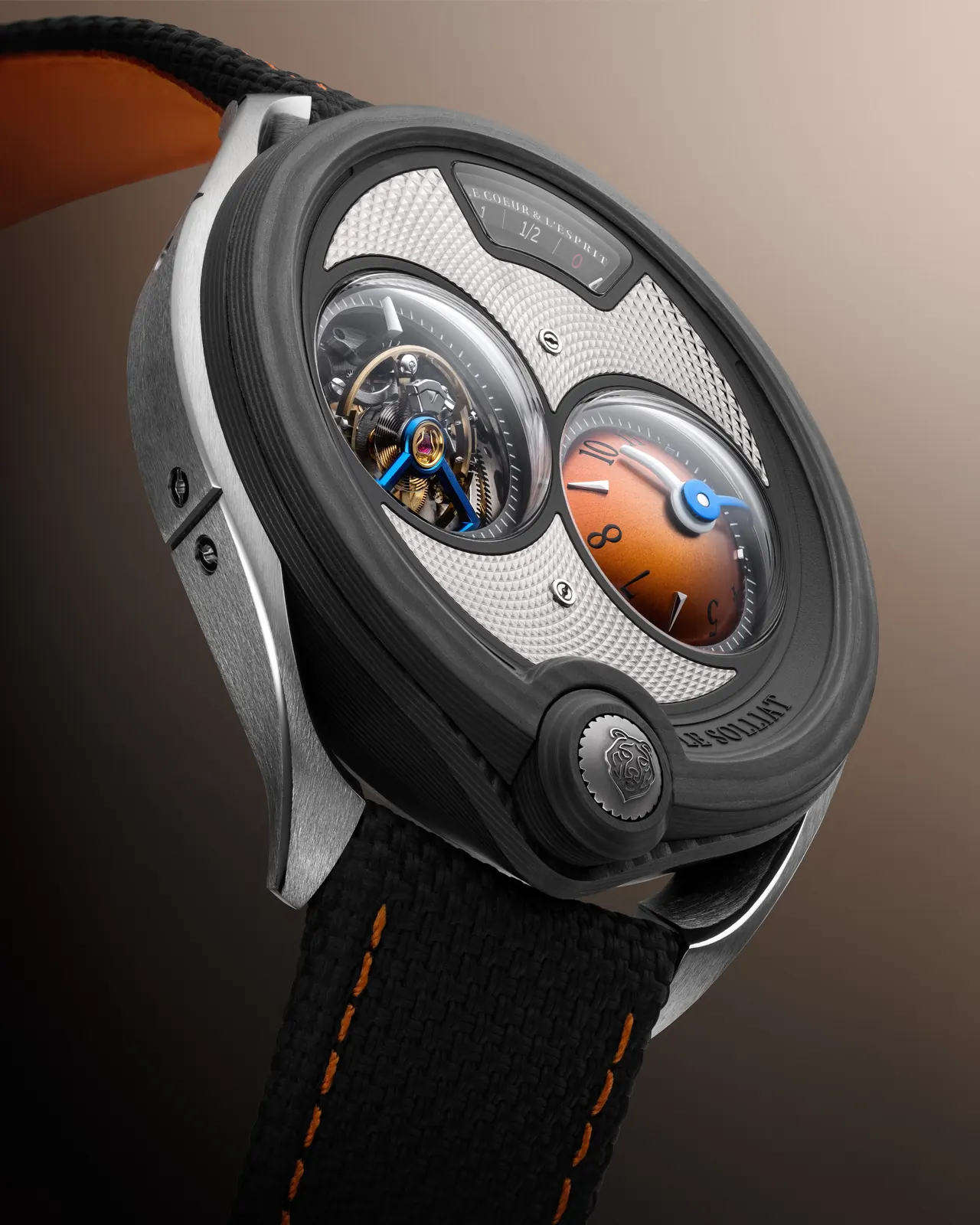
David Candaux takes the same position at the bench. Where watchmakers have used brass for three centuries, he builds the bridges and mainplates of every calibre in titanium. According to the brand, the forms and gestures of the Vallée de Joux remain; the material is contemporary. The DC55 makes the same argument in a different scale.
The Shared Starting Point
Both parties began with a question rather than a brief. David Candaux states: “We speak the same language, each in his own material. I shared with Luminari how I think and how I build.” Luminari Motor Company describes the same method: “Respect what came before, and build it with the materials of today.”
In David Candaux’s movement work, that means tracing a complication back to its earliest mechanisms and asking what problem the original makers were solving. Luminari applied the same enquiry to the 1954 engineering challenge: the high sill, the tilted straight-six, the tilting steering wheel. The DC55’s detachable custom steering wheel addresses the entry problem by exactly the same logic, updated for a modern cabin with Recaro seats and hand-made trim.
The DC6 Wildfire Connection
The DC55 carries no dedicated watch. It meets the DC6 Wildfire, unveiled in September 2026, through the one material they share. The DC6 Wildfire houses its titanium chamber in UD carbon held by titanium stretchers. The DC55 clothes its AMG drivetrain in a carbon-fiber body. On the watch as on the car, carbon is placed where both lightness and strength are required simultaneously, and in both cases, it is finished by hand.
| Base vehicle | Mercedes-Benz SLK55 AMG (R172) |
| Body | Carbon fiber, hand-made on SLK55 AMG base; gullwing doors hinged at the roof |
| Engine | AMG M152, naturally aspirated 5.5-litre V8 — 416 hp at 6,800 rpm; 540 Nm at 4,500 rpm |
| Transmission | AMG Speedshift Plus 7G-Tronic, seven-speed automatic, rear-wheel drive |
| 0–100 km/h | 4.6 seconds |
| Edition | 1 of 5 unique cars |
| Price | Upon request |
| Availability | On request from the maison or an authorised retailer in the Middle East |
For more on the watches that informed this collaboration, sign up for our weekly editorial briefing — editor-curated coverage of independent watchmaking for collectors in Europe and the Middle East.
Frequently Asked Questions
What is the DC55 and how many will be built?
The DC55 is a restomod built by Luminari Motor Company in collaboration with David Candaux, limited to five unique cars. Its carbon-fiber body interprets the silhouette of the 1955 Mercedes-Benz 300SL Gullwing on a modern SLK55 AMG base. The first car was unveiled on 18 November 2026 in New York.
What engine does the DC55 use?
The DC55 uses the AMG M152, a naturally aspirated 5.5-litre V8 producing 416 hp at 6,800 rpm and 540 Nm of torque at 4,500 rpm, paired with an AMG Speedshift Plus 7G-Tronic seven-speed automatic transmission driving the rear wheels.
How does the DC55 connect to David Candaux's watchmaking?
David Candaux builds the bridges and mainplates of all his calibres in titanium rather than the traditional brass, applying historic gestures to contemporary materials. Luminari follows the same logic with the DC55: the original 300SL's aluminium lightness is answered by an entirely hand-laid carbon-fiber body.
Which David Candaux watch is associated with the DC55?
The DC55 has no dedicated watch of its own. It meets the DC6 Wildfire, unveiled in September 2026, through the shared material of carbon fiber: the DC6 Wildfire's titanium chamber is clad in UD carbon, while the DC55 wraps its AMG drivetrain in a carbon-fiber body.
Is the DC55 available to order in the Middle East?
The DC55 is priced upon request and limited to five unique examples. Interested parties in the Middle East should contact David Candaux directly through the maison.
Explore more from DAVID CANDAUX: DC6 Wildfire: David Candaux’s Eight-Piece Orange Tourbillon · David Candaux Enters Two Creations at GPHG 2026.