

Key Highlights
- Commemorates the 210th anniversary of the world’s first chronograph, created by Louis Moinet in 1816
- Strictly limited to 12 pieces, reference LM-170.20.60
- In-house LM114 calibre: hand-wound, flying tourbillon with off-centre cage, monopusher column-wheel chronograph
- 40.6 mm grade 5 titanium case with 96-hour power reserve
- Rhodium-plated dial with blued-steel hands and blue DLC tourbillon cage
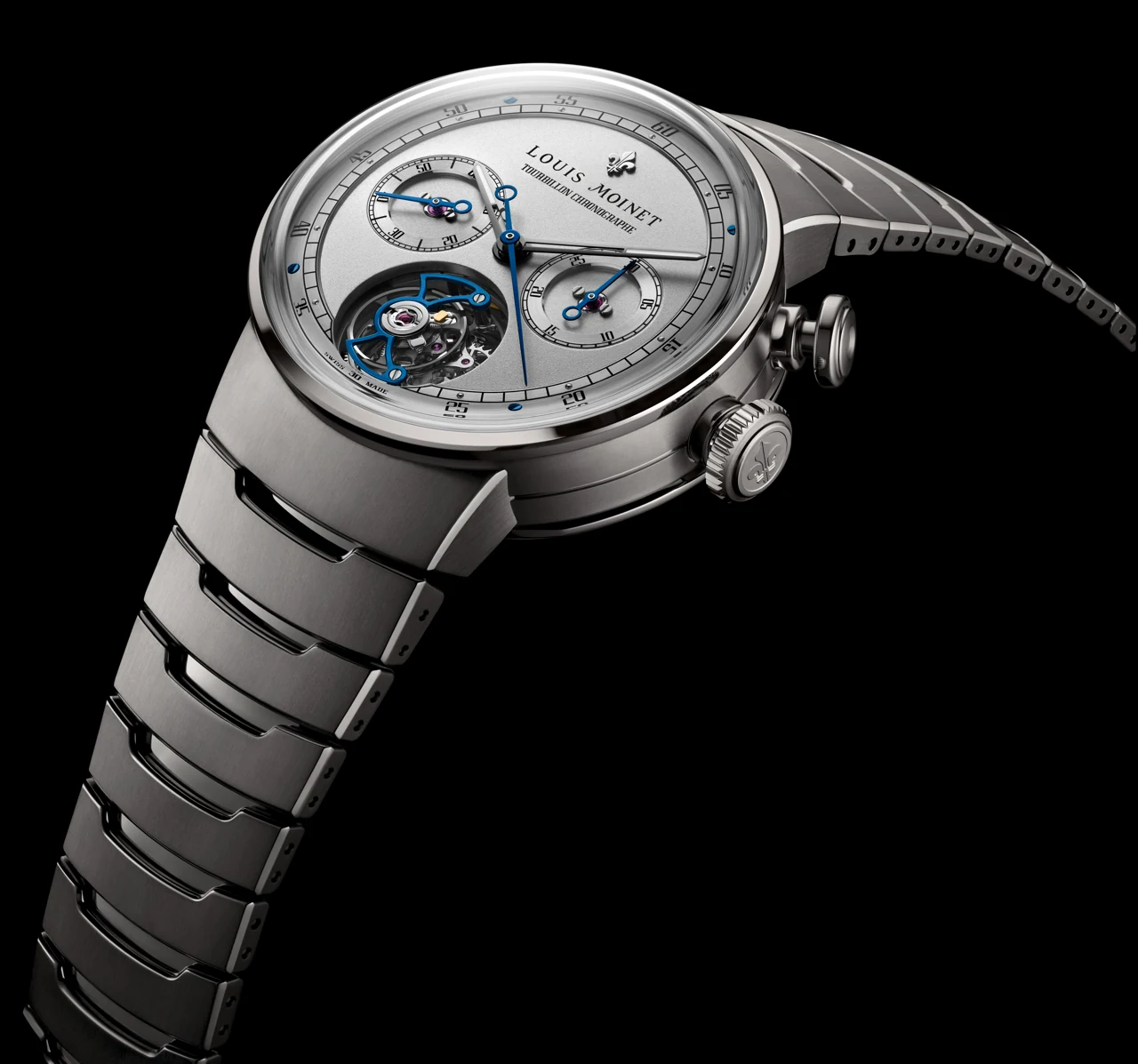
 Louis Moinet 1816 Tourbillon Chronograph — rhodium-plated dial with blued-steel hands and flying tourbillon” />
A Creation Born in History
Some inventions transcend the era of their making, their design logic so clear and purposeful that it requires no revision. The Compteur de Tierces, the world’s first chronograph completed by Louis Moinet in 1816, is precisely such an object. Conceived to measure planetary and stellar movements with exceptional precision, it established principles of legibility and counter layout that remain striking more than two centuries on. The new 1816 TOURBILLON CHRONOGRAPH draws its identity directly from that founding instrument, presenting it through contemporary materials and manufacture-level complications.
The occasion is a significant one: 2026 marks the 210th anniversary of Moinet’s original invention. To honour the milestone, Les Ateliers Louis Moinet has produced a strictly limited edition of just 12 pieces. The watch also carries a second layer of tribute to the friendship between Louis Moinet and Abraham-Louis Breguet, whose innovations in chronography and horology shaped modern watchmaking. The 1816 TOURBILLON CHRONOGRAPH unites both complications in a single case, making that shared legacy tangible. Collectors interested in the broader 1816 family may also explore the 1816 Chronograph Champagne Edition for comparison.
Case and Dial
The 40.6 mm case is machined from polished and satin-brushed grade 5 titanium and comprises 40 individual components. Its Directoire-style semi-bassine profile, smooth case middle, and double gadroon are taken directly from the Compteur de Tierces. The monopusher sits at two o’clock, and the crown is engraved with a fleur-de-lys, the emblem of Bourges, Louis Moinet’s birthplace. Water resistance is rated to 50 metres, and the sapphire crystal carries a double-sided anti-reflective treatment.
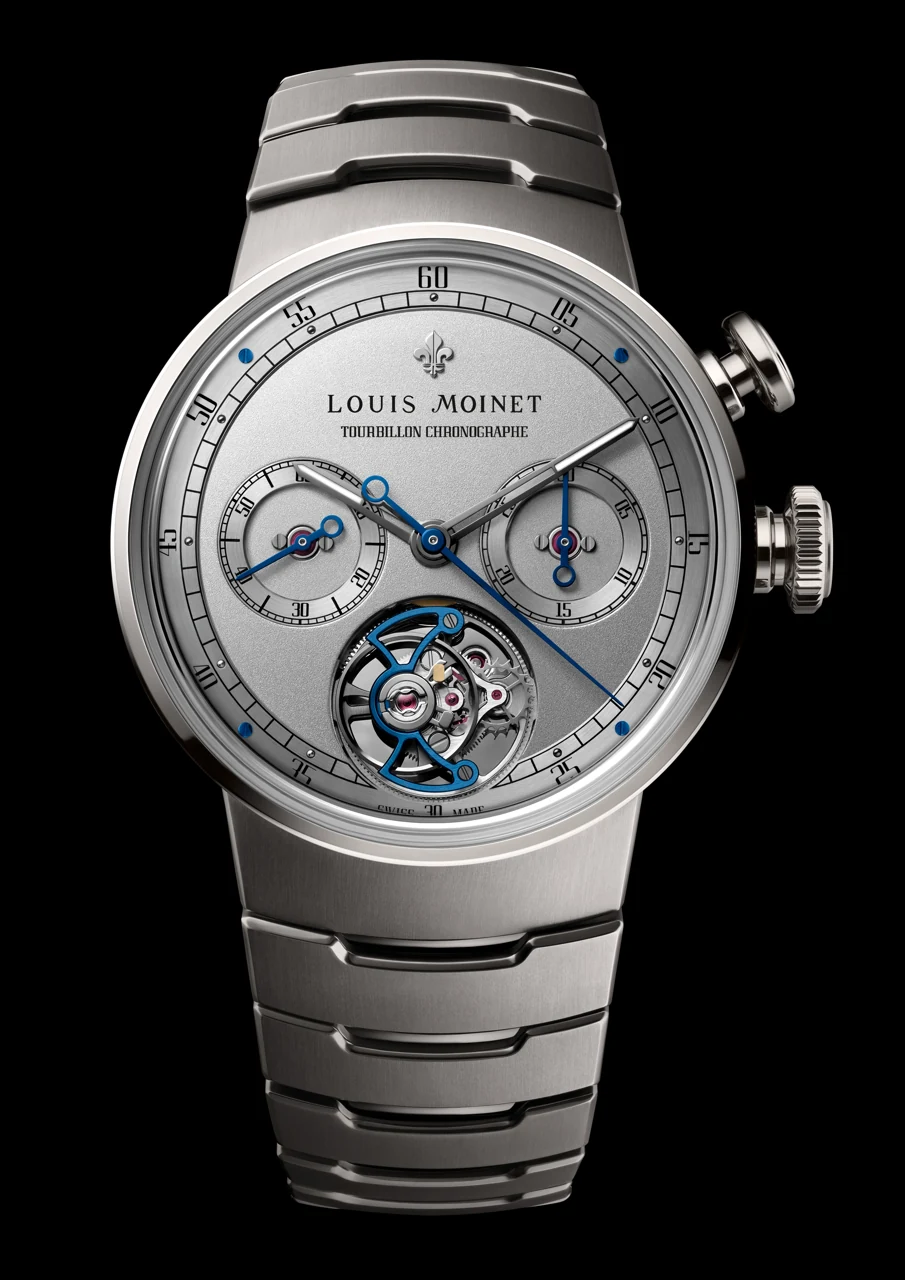
The rhodium-plated dial is constructed from 25 parts and employs a considered interplay of satin-finished and bead-blasted surfaces. Subdials for small seconds and the 30-minute counter feature satin-brushed rings with Arabic numerals, while a ruby-set barrel flanked by polished screws adds a deliberate technical accent. The dial markings and the Louis Moinet signature are engraved and rendered in the typeface of the original 1816 instrument, a detail that ties the piece unmistakably to its source. A fleur-de-lys applique at twelve o’clock completes the composition. For further context on the brand’s approach to skeletonised and tourbillon complications, the Tourbillon Puzzle Fire Horse offers an instructive counterpoint.
The LM114 Calibre
At the heart of the 1816 TOURBILLON CHRONOGRAPH is the manufacture LM114 calibre, assembled by Louis Moinet watchmakers in Les Breuleux. The movement is hand-wound, driven by a double barrel, and delivers a power reserve of 96 hours. It beats at 28,800 vph and is supported by 36 jewels. The chronograph function is governed by a column wheel and operated via the single pusher, an architecture that reflects both historical fidelity and technical rigour.
The flying tourbillon carries an off-centre cage finished with blue DLC coating, which creates a deliberate visual contrast against the grey of the rhodium-plated dial. Hours and minutes hands are facetted and skeletonised with luminescent fill; the chronograph and totaliser hands are in traditional blued steel. The movement diameter measures 32 mm with a height of 7.55 mm. The overall case height stands at 15.10 mm; substantial, but proportionate given the complications housed within. Those following haute horlogerie releases at events such as Watches and Wonders will recognise the calibre’s pedigree within Louis Moinet’s wider output.
Bracelet
The bracelet is crafted in the same grade 5 titanium as the case, designed as a structural continuation of it rather than an accessory. Broad links trace an architectural curve that conforms naturally to the wrist, with each link moving in a fluid, continuous motion. Alternating satin-brushed and polished surfaces accentuate the sculptural geometry, producing an ergonomic and visually cohesive ensemble that is resolutely contemporary in character.
Why It Matters
The 1816 TOURBILLON CHRONOGRAPH is not a retrospective exercise. It is a measured argument in titanium, blued steel, and 96 hours of reserve that the principles Louis Moinet established two centuries ago remain as viable and visually compelling today as they were in 1816. With only 12 examples destined for collectors worldwide, the watch represents one of the most tightly constrained expressions of haute horlogerie available this year. For the Middle East collector who values depth of provenance alongside technical complexity, few propositions in 2026 are as considered. Visit the official Louis Moinet website for further details on the 1816 TOURBILLON CHRONOGRAPH.
Discover the watches shaping the Middle East market. Join our mailing list for ongoing reviews, releases, and collector insights.
Frequently Asked Questions
What movement powers the Louis Moinet 1816 Tourbillon Chronograph?
The watch is powered by the in-house LM114 calibre, a hand-wound mechanical movement with a double barrel, 36 jewels, and a 96-hour power reserve. It combines a column-wheel monopusher chronograph with a flying tourbillon featuring an off-centre cage.
How many pieces of the 1816 Tourbillon Chronograph are being produced?
The 1816 Tourbillon Chronograph is a strictly limited edition of just 12 pieces, each carrying the reference LM-170.20.60 and assembled at the Louis Moinet workshop in Saint-Blaise, Switzerland.
What is the case size and material of the 1816 Tourbillon Chronograph?
The case measures 40.6 mm in diameter and 15.10 mm in height. It is crafted from polished and satin-brushed grade 5 titanium and is made up of 40 individual components.
What is the historical significance behind the 1816 Tourbillon Chronograph?
The watch commemorates the 210th anniversary of the world’s first chronograph, the Compteur de Tierces, completed by Louis Moinet in 1816. Its design directly references that original instrument, paying tribute to both Louis Moinet and Abraham-Louis Breguet as founding fathers of modern watchmaking.
What design elements connect the 1816 Tourbillon Chronograph to the original Compteur de Tierces?
Key heritage details include the Directoire-style semi-bassine case profile, double gadroon, monopusher, and the fleur-de-lys crown motif, the emblem of Bourges, Louis Moinet’s birthplace. The dial typography also replicates the typeface of the original 1816 instrument.