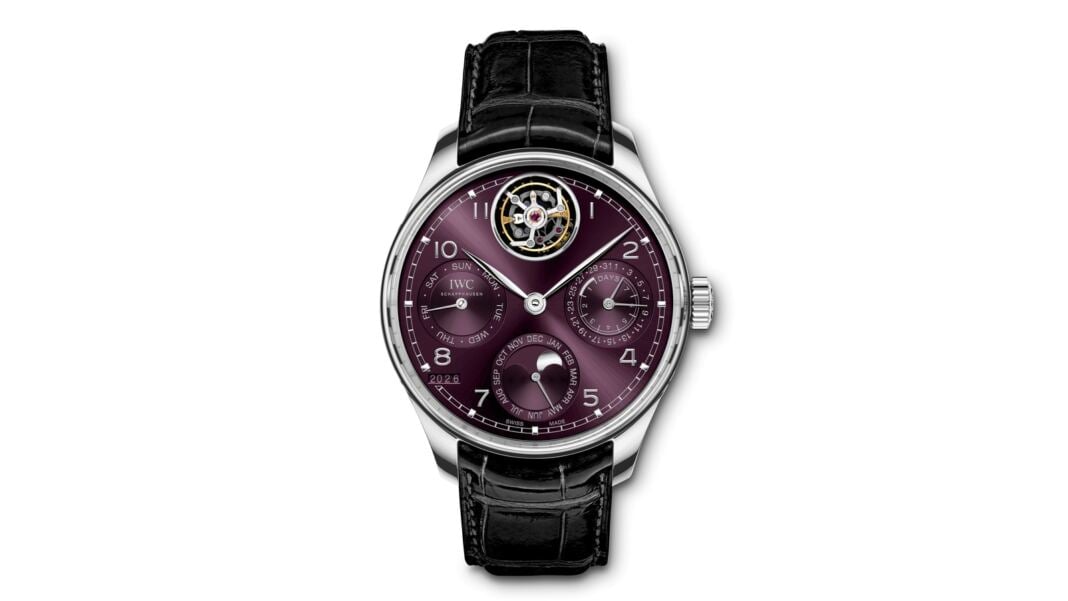
IWC Schaffhausen dresses its Portugieser in platinum and a deep purple sunray dial, and unites two high complications in one 45 mm case: a flying minute tourbillon and the perpetual calendar conceived by Kurt Klaus. The edition is limited to 50 pieces.
Presented in Schaffhausen on 7 October 2026, Reference IW504509 gathers three chapters of the IWC Schaffhausen story in a single watch: the large Portugieser born in the late 1930s, the crown-set calendar of the 1980s and the Pellaton winding system that drives the Maison’s seven-day manufacture movements today.
IWC Schaffhausen at a Glance
- Founded in 1868 in Schaffhausen by the American watchmaker and engineer Florentine Ariosto Jones.
- Known as the Engineer of Watchmaking, with collections led by the Portugieser, Portofino, Pilot’s Watches and Ingenieur.
- Celebrated for functional complications, especially chronographs and calendars designed to be robust and easy to use.
- A pioneer of titanium and ceramic cases, and of performance materials such as Ceratanium®.
- Home to XPL, an engineering division developing technologies for jet aviation and human spaceflight.
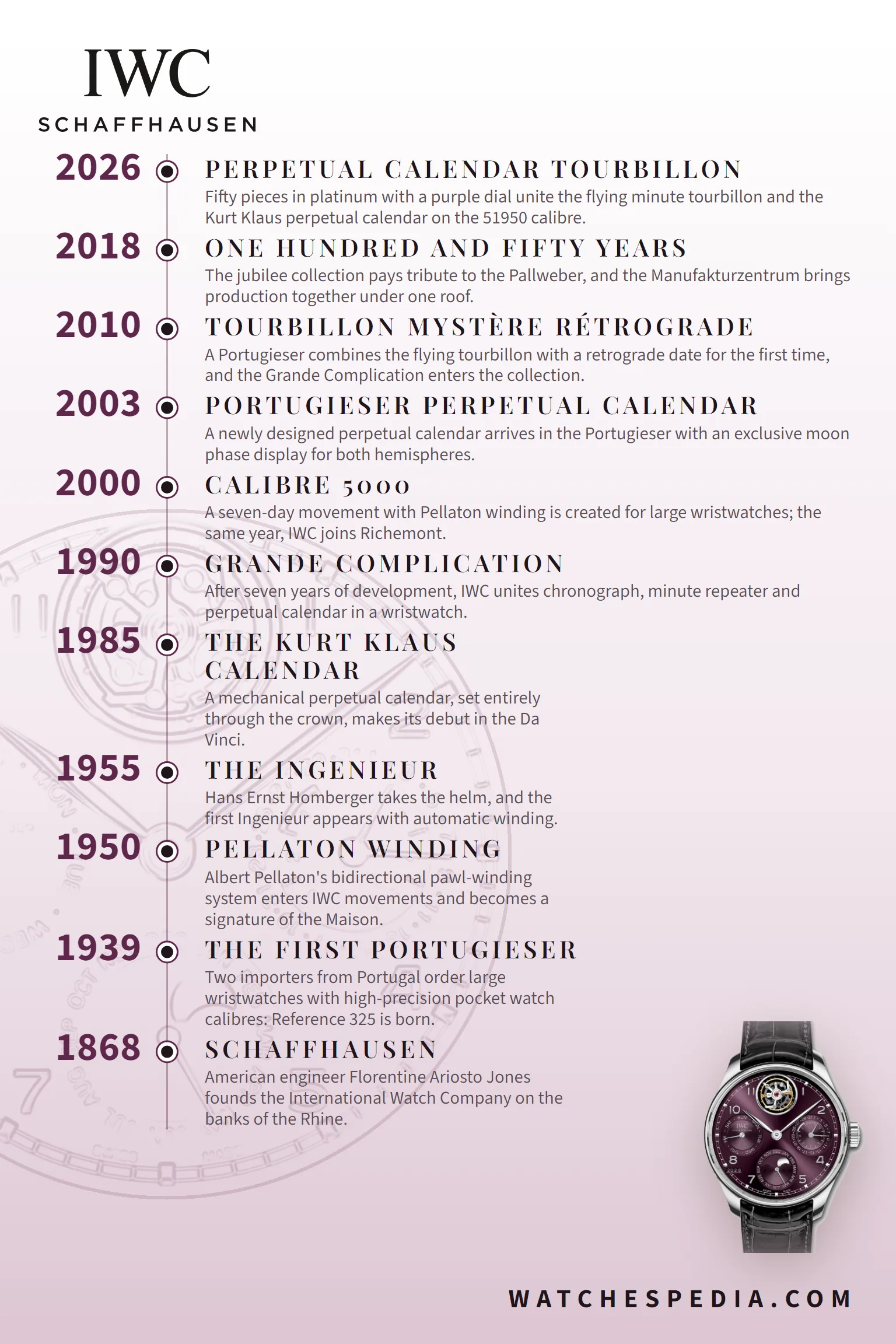
IWC Schaffhausen, 1868-2026: Eleven Milestones
A Portugieser Cast in Platinum
The Portugieser traces its lineage to Reference 325, ordered in the late 1930s by two Portuguese merchants who wanted a large wristwatch with the precision of a pocket watch. That proportion still defines the collection, and over the decades it has welcomed many high complications. The new reference continues the tradition and introduces a dial colour new to the family.
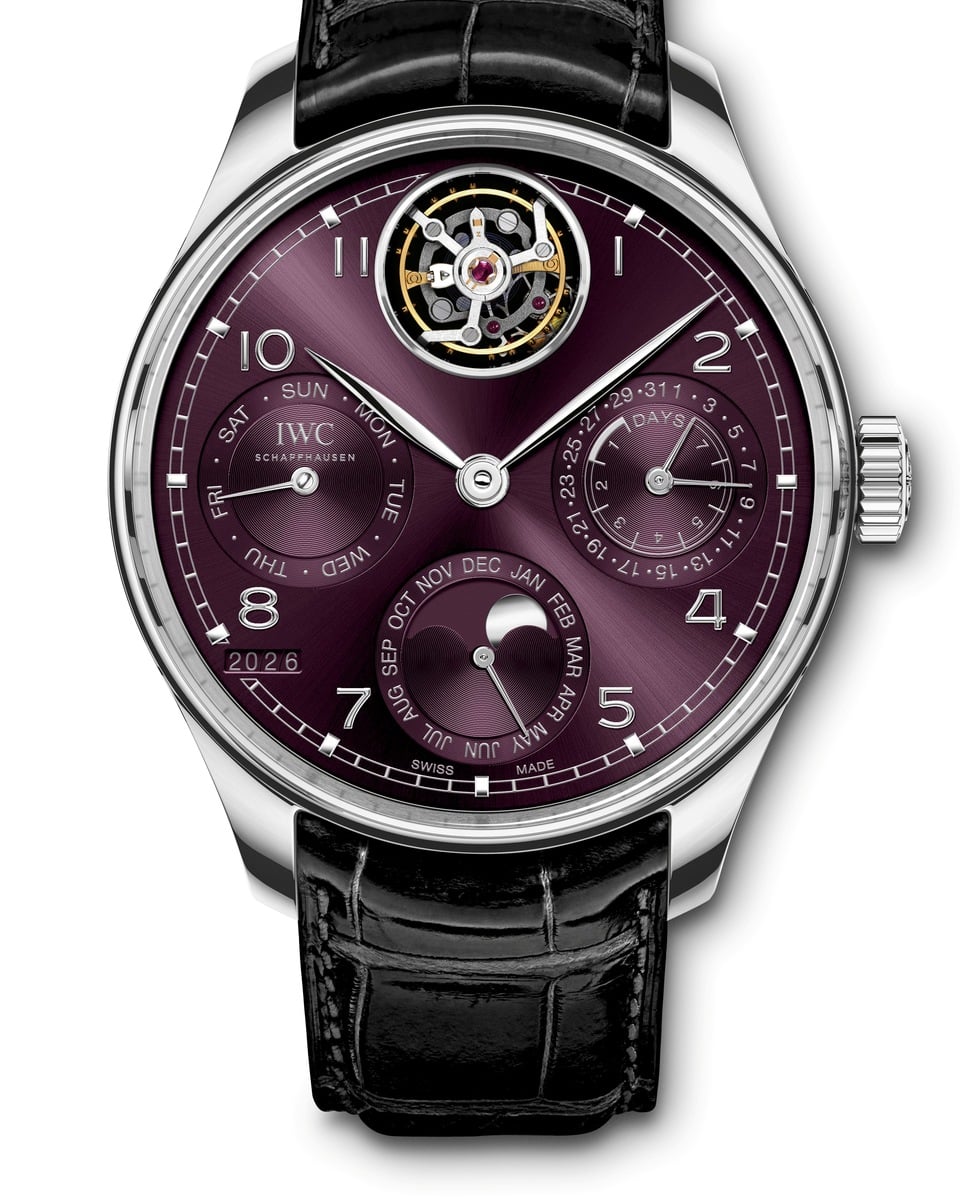
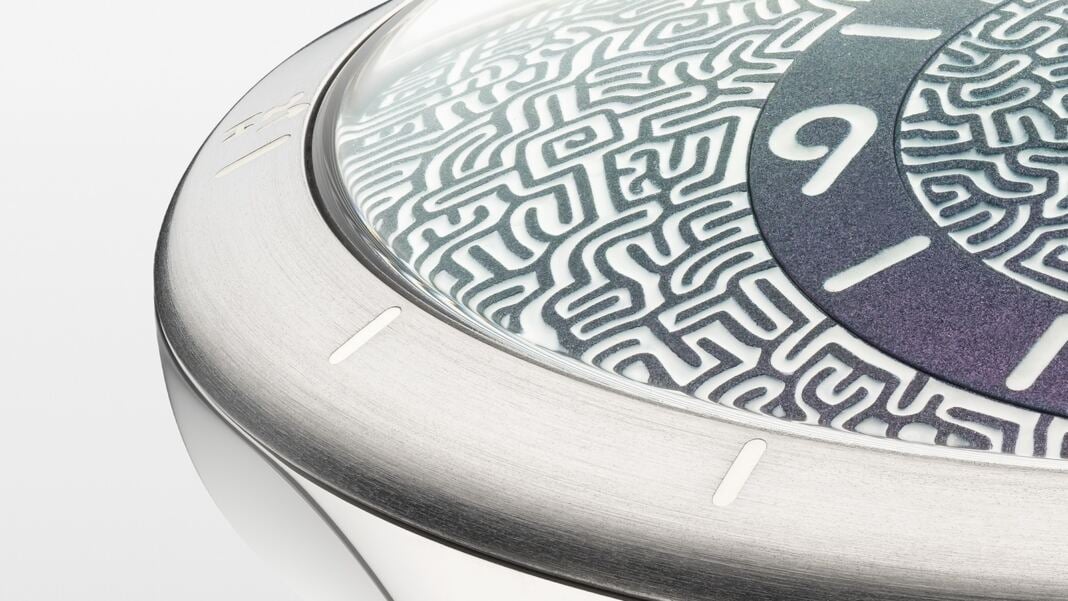
The 45 mm case, 15.3 mm high, is crafted from platinum, one of the rarest, purest and most precious metals in watchmaking, prized for its durability and its silvery-white sheen. Against it, the purple dial carries a sunray finish that shifts from plum to deep violet with the light. The applied Arabic numerals, a Portugieser signature, are rhodium-plated and set individually by hand. The minute scale places its markers between an inner and an outer circle in the manner of a railway track, and the leaf-shaped hands are rhodium-plated as well. A hand-coloured black alligator strap by the Italian leather artisans of Santoni closes with a platinum folding clasp.
A Minute in Flight at Twelve O’Clock
The flying minute tourbillon sits at 12 o’clock, framed by the numerals XI and I. It comprises 82 parts and weighs just 0.635 grams, and IWC counts it among the most demanding mechanisms in watchmaking to assemble and regulate. The tourbillon was first conceived to offset the effect of gravity on the oscillating system: the pallet lever and escape wheel travel inside a small cage that completes one full rotation every minute, refining precision while offering a captivating spectacle on the dial. Readers who followed the assembly of the Ingenieur Tourbillon 41 will recognise the care this complication demands at the bench.
The Kurt Klaus Perpetual Calendar
The second complication carries the name of the legendary watchmaker Kurt Klaus, who developed it in the 1980s. Its information is arranged across three subdials: the date at 3 o’clock, the day of the week at 9 o’clock, and the month together with a perpetual moon phase at 6 o’clock. The year appears in four digits in a small window at 8 o’clock.
A reduction gear train with two intermediate wheels keeps the moon phase accurate to within a single day over 577.5 years. The calendar is mechanically programmed for the varying lengths of the months and adds the leap day every four years at the end of February. Every display is synchronised, so the whole calendar advances with a simple turn of the crown, the same principle found in the Big Pilot’s Perpetual Calendar ProSet.
Calibre 51950: Seven Days of Pellaton Power
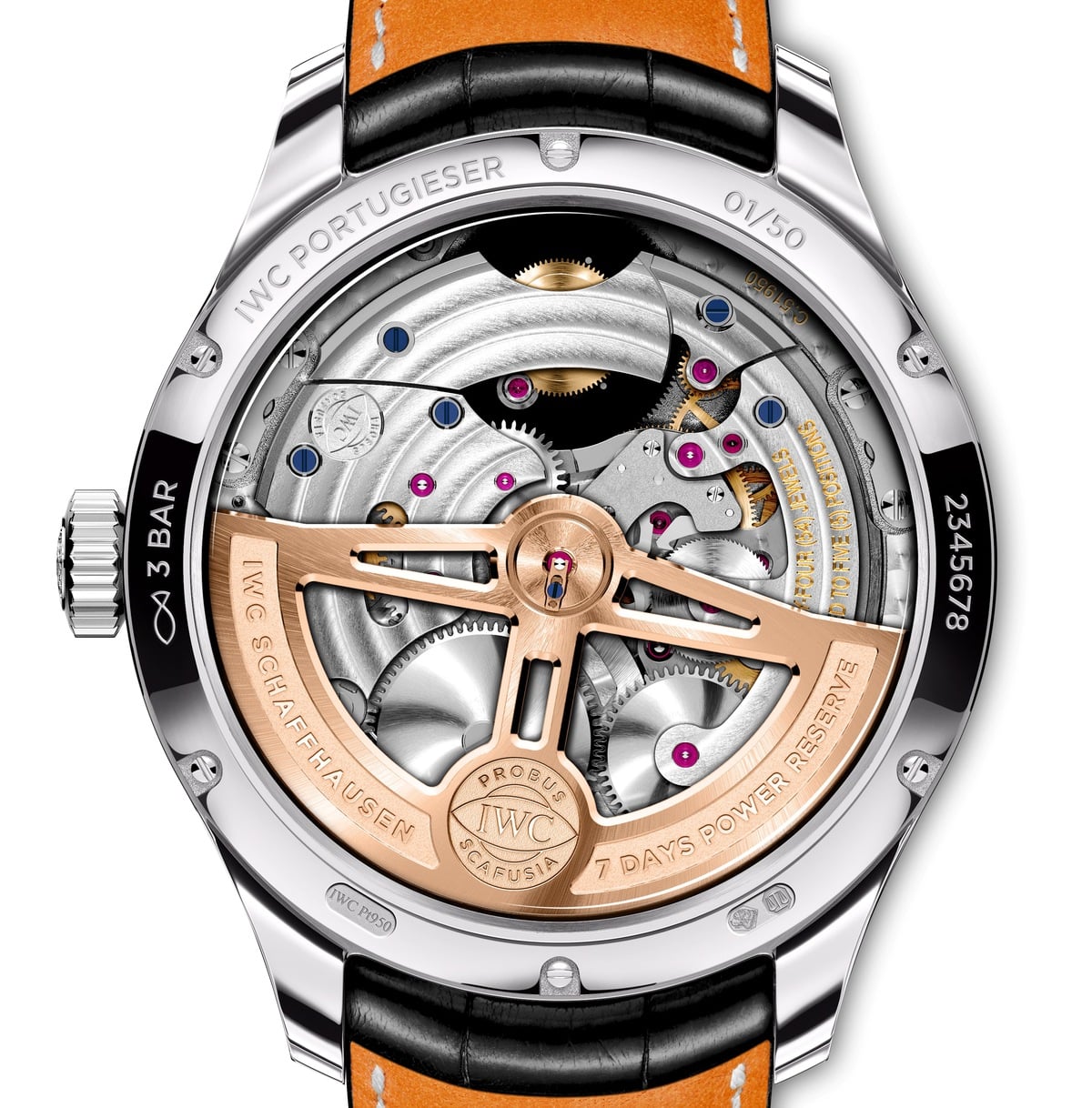
Both complications are driven by the IWC-manufactured 51950 calibre, a movement of 447 individual parts and 54 jewels. Its integrated Pellaton winding system draws energy from the rotor in both directions of rotation and builds a power reserve of seven days, or 168 hours, in a single barrel, shown by a dedicated display. The balance, fitted with a Breguet hairspring, beats at 2.75 hertz, or 19,800 vibrations per hour.
The finishing rewards a closer look through the sapphire case back: Geneva stripes across the bridges and a solid 18-carat gold oscillating weight engraved with the Probus Scafusia emblem and the words “7 Days Power Reserve”. The watch is water-resistant to 3 bar.
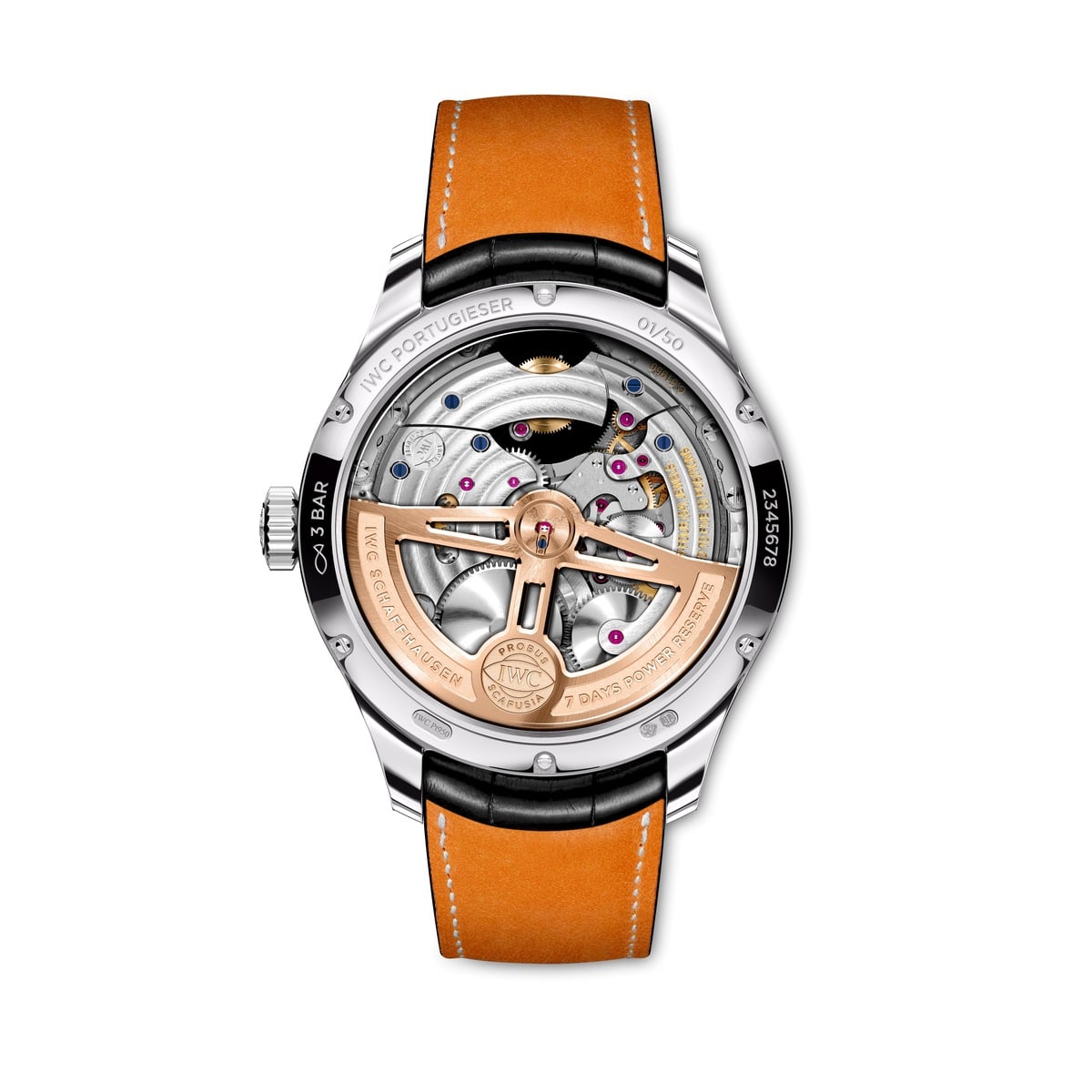
With 50 pieces in platinum, the Portugieser Perpetual Calendar Tourbillon joins a long line of Portugieser complications, from the Tourbillon Mystère Rétrograde of 2010 to the perpetual calendars that have shaped the collection since 2003, all recorded in the history of the Maison.
Frequently Asked Questions
What complications does the IWC Portugieser Perpetual Calendar Tourbillon feature?
The watch combines two high complications: a flying minute tourbillon comprising 82 parts and weighing just 0.635 grams, and the perpetual calendar conceived by Kurt Klaus in the 1980s. The perpetual calendar displays date, day of the week, month, moon phase, and year across multiple subdials and a window.
Why is the IWC Portugieser Perpetual Calendar Tourbillon cased in platinum?
Platinum is one of the rarest, purest and most precious metals in watchmaking, prized for its durability and its silvery-white sheen. The 45 mm platinum case provides an elegant backdrop for the deep purple sunray dial that shifts from plum to deep violet with the light.
How accurate is the perpetual calendar mechanism over time?
The Kurt Klaus perpetual calendar uses a reduction gear train with two intermediate wheels to keep the moon phase accurate to within a single day over 577.5 years. The calendar is mechanically programmed for varying month lengths and automatically adds the leap day every four years at the end of February.