The Core Details
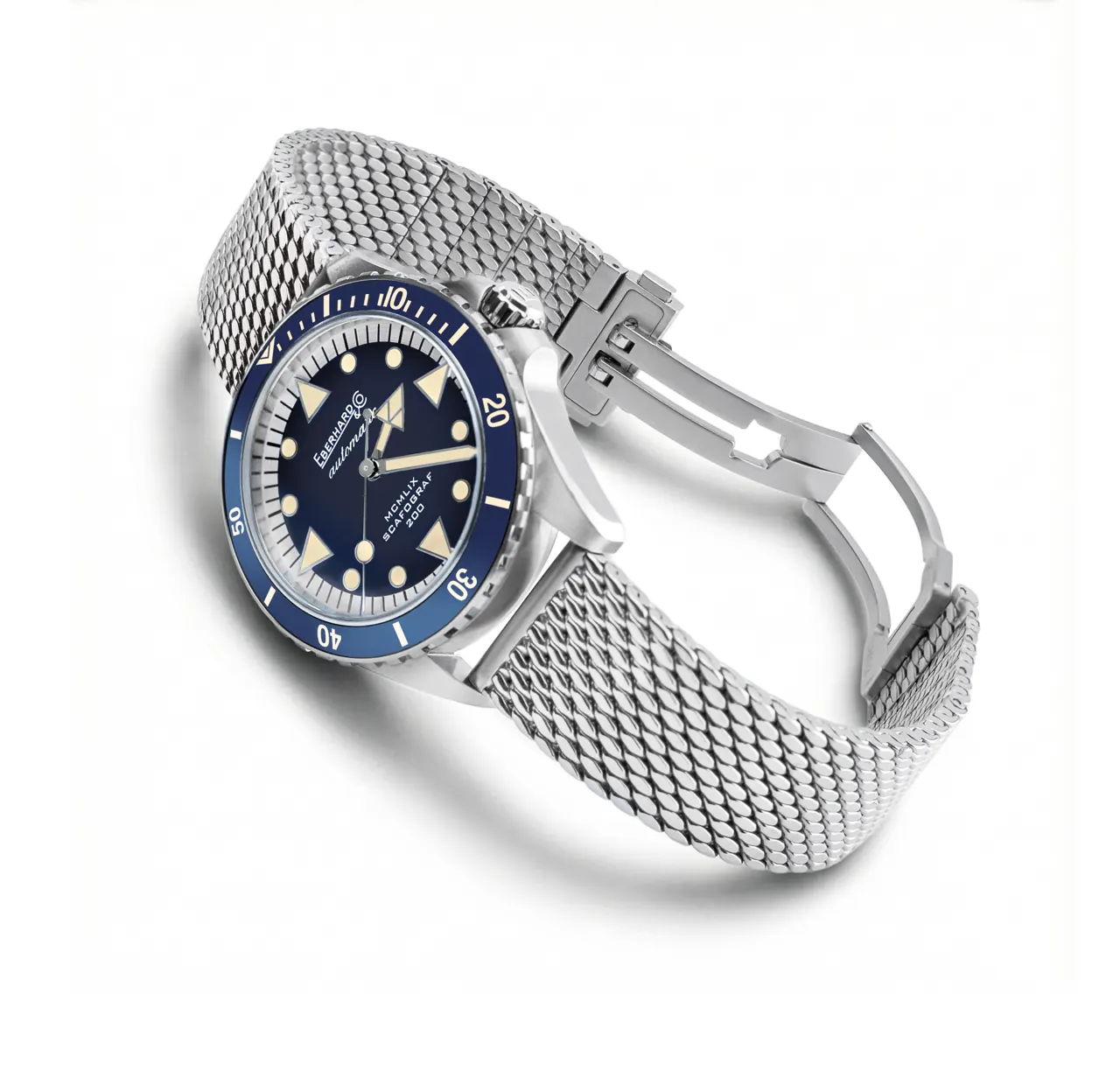
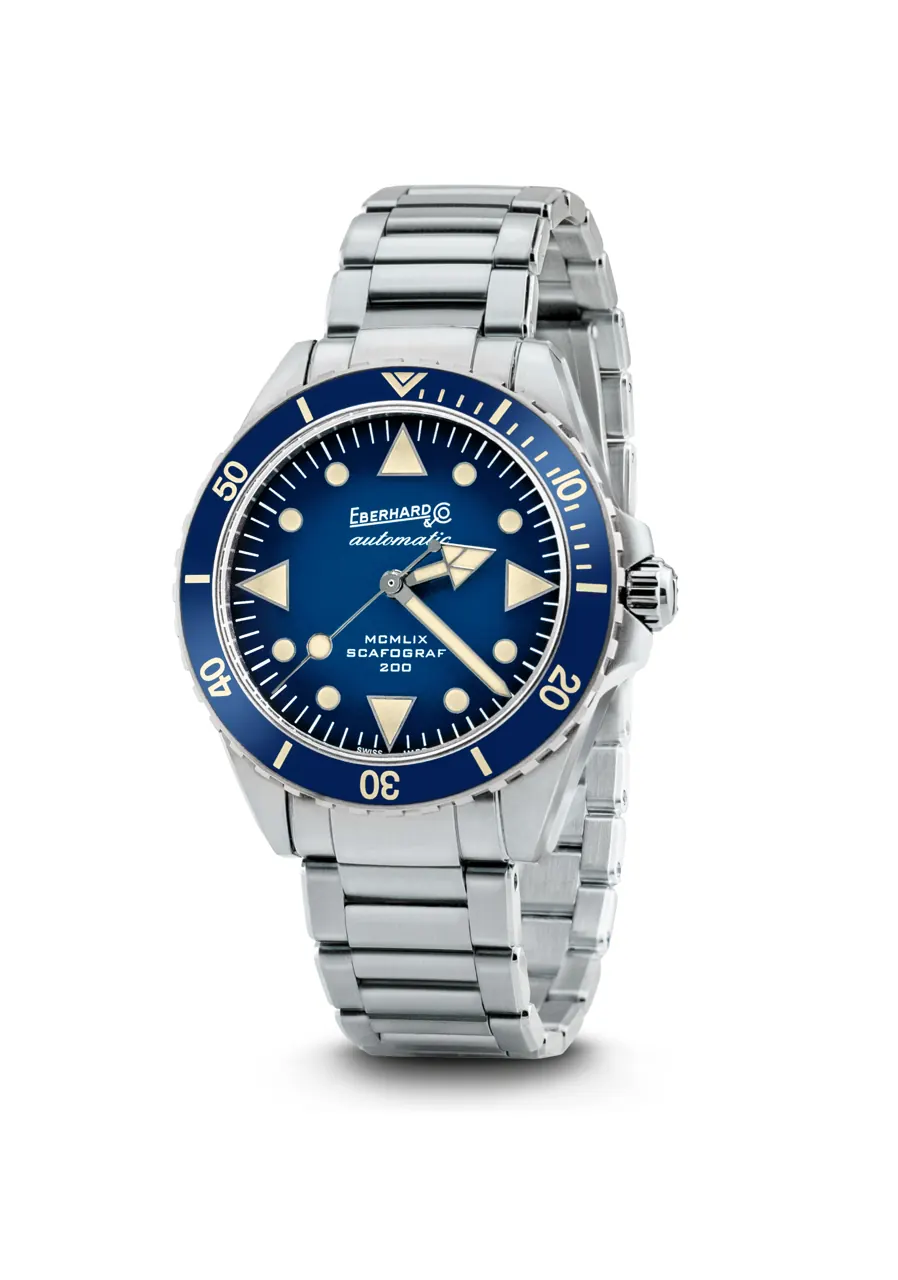
- Priced within the accessible luxury segment of Swiss diving watches, the Scafograf 200 MCMLIX pairs a 39mm stainless-steel case with an automatic helium escape valve and a ceramic unidirectional bezel across four dial configurations.
- The MCMLIX suffix is Roman numeral notation for 1959, the year the original Scafograf 100 became Eberhard & Co.’s inaugural diver’s watch.
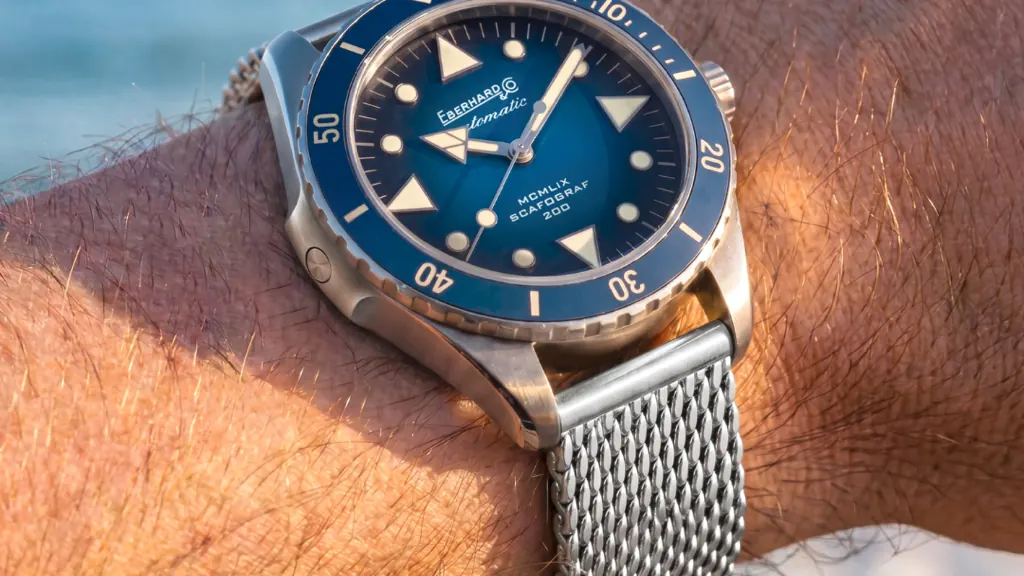
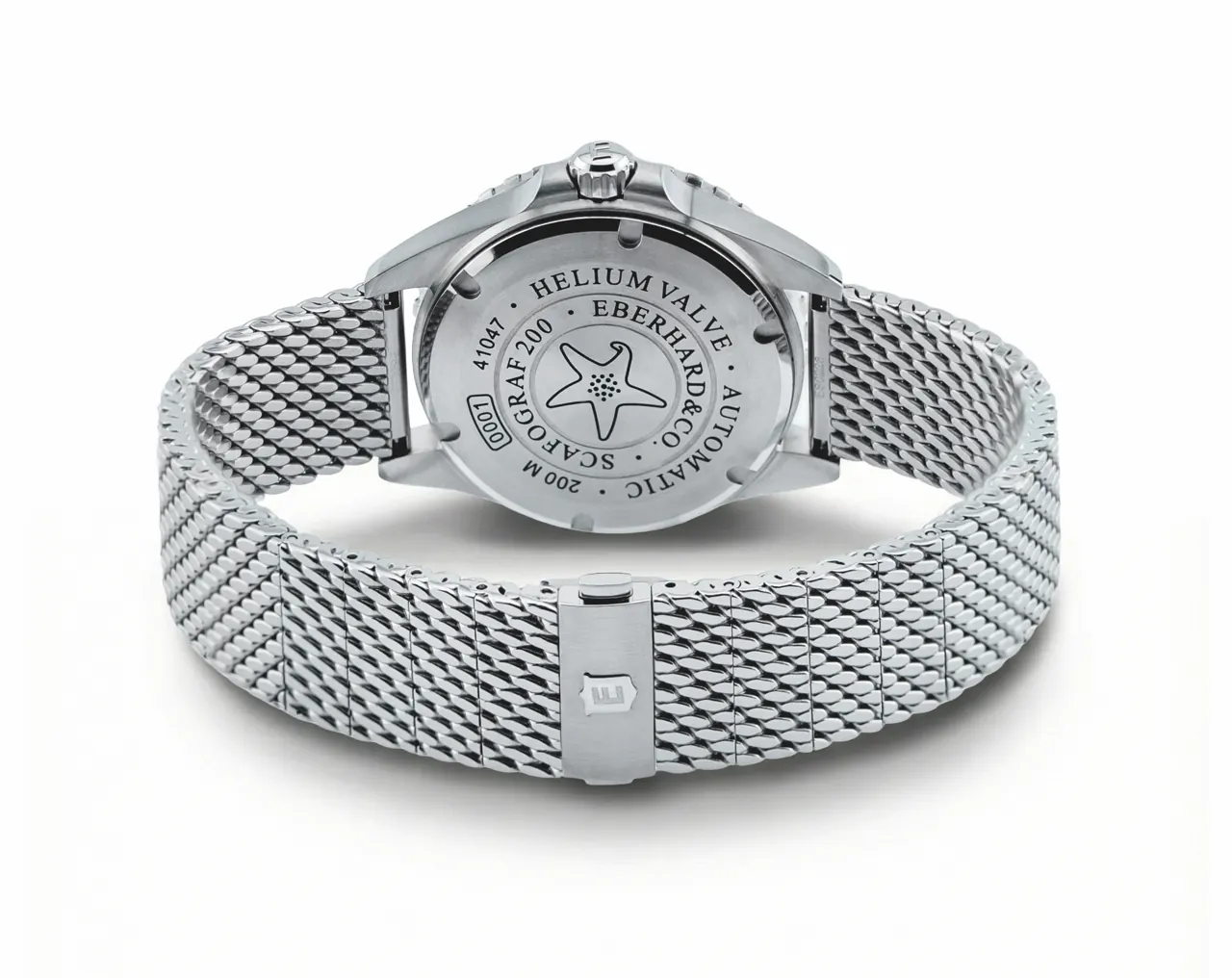
- New to the Scafograf line: a stainless-steel Milanese mesh bracelet fitted with the proprietary 2CLICK® folding clasp, backed by archival evidence dating the brand’s use of this bracelet format to before 1914.
- Four dial variants are offered: black and black dégradé, both with black ceramic bezels; blue and blue dégradé, both with blue ceramic bezels.
- Eberhard & Co. is in its fifth consecutive year as Official Timekeeper of the Genoa International Boat Show, affirming the Scafograf’s continued operational context.
Origins & Lineage
Sixty-five years separate the Scafograf 100 from this reference, and the distance is shorter than the number suggests.
Maurice Eberhard reportedly carried the original Scafograf 100 to the shores of Lake Neuchâtel himself, immersing the prototype before submitting it to formal certification. That direct relationship between maker and instrument has remained the guiding instinct of the collection through each subsequent generation. The 39mm case of the MCMLIX is not a concession to current proportion trends alone; it is a return to the measured dimensions of the early models, before diver cases enlarged through the 1970s and after.
The triangular hour markers alternating with round ones, and the three-tipped hour hand conceived for underwater legibility, have survived every revision intact. These are not decorative retentions. At depth, where peripheral vision contracts and light behaves differently, geometry matters more than aesthetic continuity. The fact that both elements have persisted across six decades reflects their functional validity as much as their visual identity. Collectors familiar with the Istanti Ritratti collection will recognise Eberhard & Co.’s habit of treating archival material as working specification rather than ornament.
The Making: Materials and Mechanics
The 39mm case houses an automatic movement and carries the technical apparatus expected of a serious diving reference.
The automatic helium escape valve addresses conditions specific to saturation diving, where helium under pressure infiltrates the case over extended periods. During decompression ascent, without release, the accumulated pressure differential can dislodge a crystal or case back. The valve opens automatically at the correct threshold, releasing helium without requiring manual intervention. On a watch worn predominantly above water, it is an indicator of specification depth rather than a daily-use feature. For the wearer who actually dives, it is a requirement.
The ceramic bezel insert, available in black or blue depending on the variant, carries a sixty-minute graduated scale. The zero marker and the first fifteen minutes are treated with luminescent material, prioritising the segment most critical to dive-time tracking. A screw-down crown and a domed anti-reflective sapphire crystal complete the pressure resistance chain. The case back is screw-down and engraved with the sea star, a symbol the collection has carried since early production.
The Result on the Wrist
On the wrist, the Scafograf 200 MCMLIX performs differently depending on the bracelet chosen, and the choice genuinely matters.
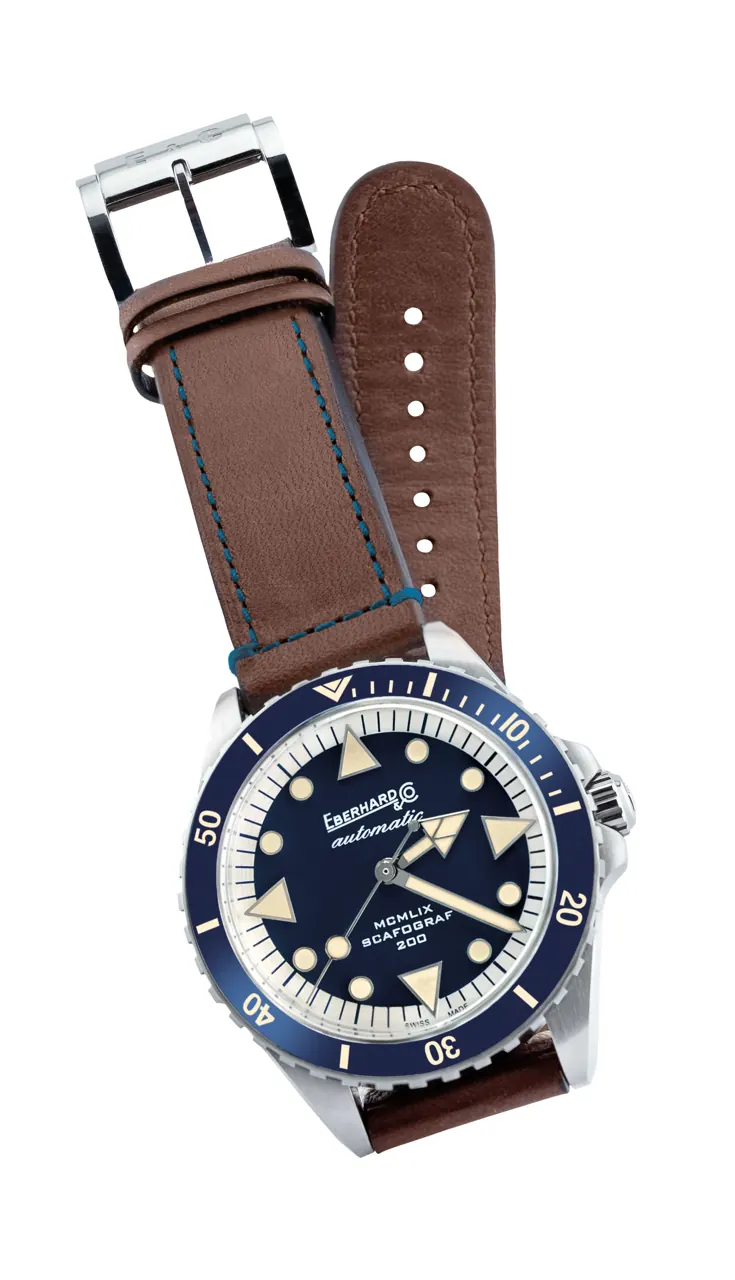
The Milanese mesh option, making its debut on this line, produces a wearing experience distinct from the Chassis® steel bracelet. The dense, flexible weave conforms to the wrist without the rigidity of conventional link construction, and the 2CLICK® folding clasp allows the fit to be adjusted without tools. Archival records confirm Eberhard & Co. was supplying this bracelet format before 1914, which gives the current revival a documented basis rather than a trend-response rationale. By contrast, the Chassis® bracelet with its satin and polished surfaces reads as a contemporary sports interpretation, appropriate for more active contexts. The leather strap option shifts the register entirely, offering a more traditional presentation suited to the Middle East’s formal wearing occasions. At 39mm, the case sits with minimal projection on a mid-sized wrist and remains proportionate across a wider range than the 42-44mm dive watches that have dominated recent years.
| Movement | Automatic |
| Case Size | 39 mm |
| Case Material | Stainless steel |
| Bezel | Unidirectional rotating, black or blue ceramic insert |
For more on horology that matters in the Gulf, sign up for our weekly editorial briefing.
Eberhard & Co.’s full collection can be explored at eberhard-co-watches.ch. For broader context on the season’s major releases, see our Watches and Wonders coverage.
Frequently Asked Questions
What case size does the Scafograf 200 MCMLIX use?
The Scafograf 200 MCMLIX is housed in a 39mm stainless-steel case, a compact dimension that gives it a balanced wrist presence and makes it suitable for both daily wear and diving contexts.
How many dial variants does the Scafograf 200 MCMLIX come in?
The watch is offered in four versions: a black dial with argenté minute track, a black dégradé dial, a blue dial with argenté minute track, and a blue dégradé dial. Each pairs with a matching black or blue ceramic bezel insert.
Is the Eberhard & Co. Scafograf 200 MCMLIX available with a Milanese mesh bracelet?
Yes. The Scafograf 200 MCMLIX marks the debut of a stainless-steel Milanese mesh bracelet on the Scafograf line, fitted with the brand's exclusive 2CLICK® folding clasp. Archival evidence places Eberhard & Co.'s use of this bracelet type before 1914.
What makes the Scafograf 200 MCMLIX suitable for saturation diving?
The watch is equipped with an automatic helium escape valve that releases helium infiltrated during pressurised environments, preventing excessive internal pressure on ascent. It is further supported by a screw-down crown and a domed anti-reflective sapphire crystal.
What is the historical significance of the Scafograf collection?
The Scafograf line originated in 1959 with the Scafograf 100, Eberhard & Co.'s first diver's watch. The MCMLIX suffix references that founding year in Roman numerals, and the collection spans nearly seventy years of continuous development by the Geneva-founded manufacture.