
The Collector’s View
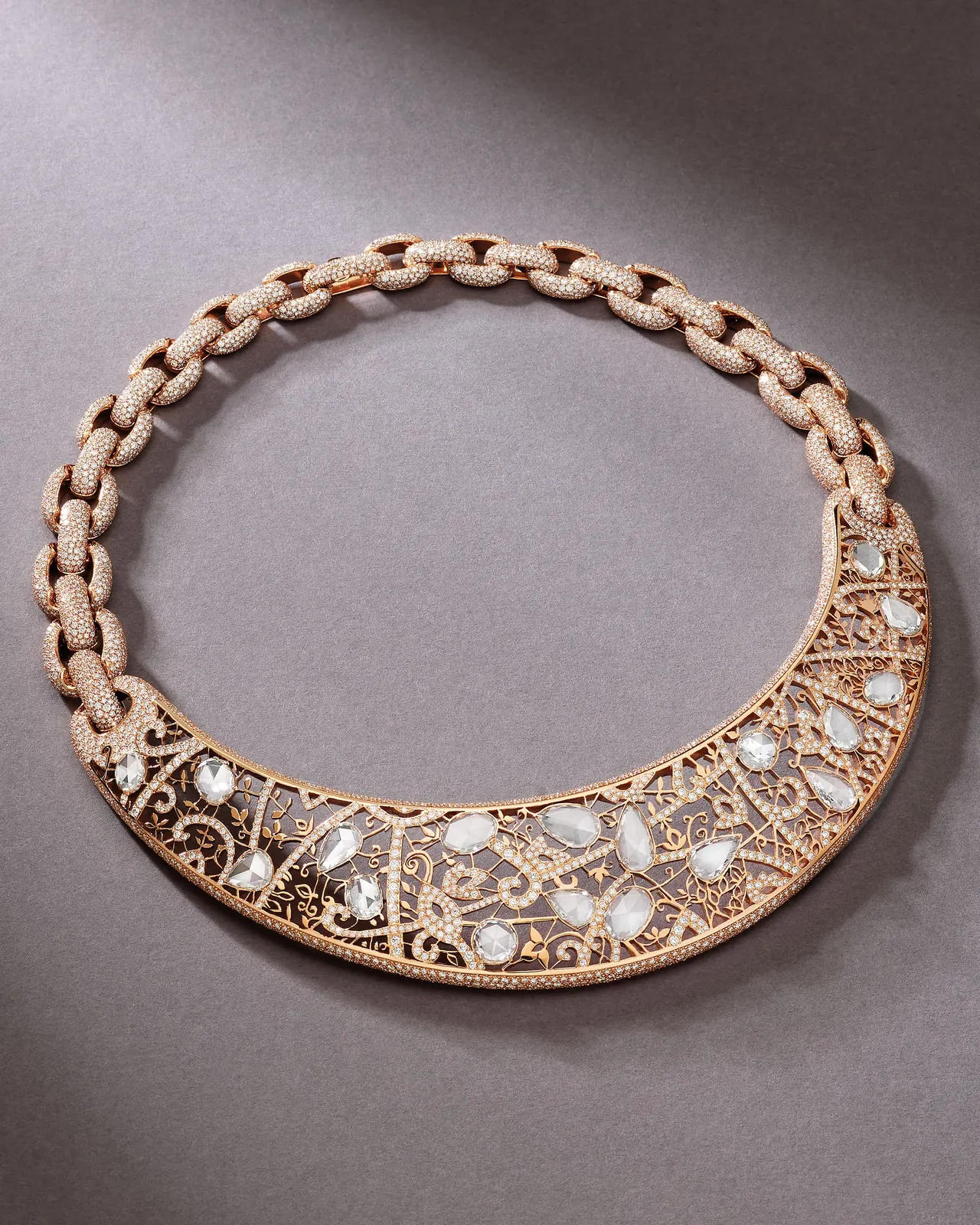
- Pomellato’s Arabesque necklace is a one-of-a-kind High Jewelry creation in 18-karat rose gold, hand-pierced by French artist Sara Bran using the ancient technique of gold lace (dentelle d’or), set with 4,123 diamonds, and realised over 1,450 hours of goldsmithing at Casa Pomellato in Milan as part of the Stile Libero collection unveiled on 23 June 2026.
- The openwork collar is crescent-shaped, its surface reading as fabric rather than metal — architectural in structure, textile in appearance.
- The 4,123 diamonds include 18 fancy rose-cut stones alongside an irregular brilliant-cut pavé, producing luminosity rather than conventional sparkle.
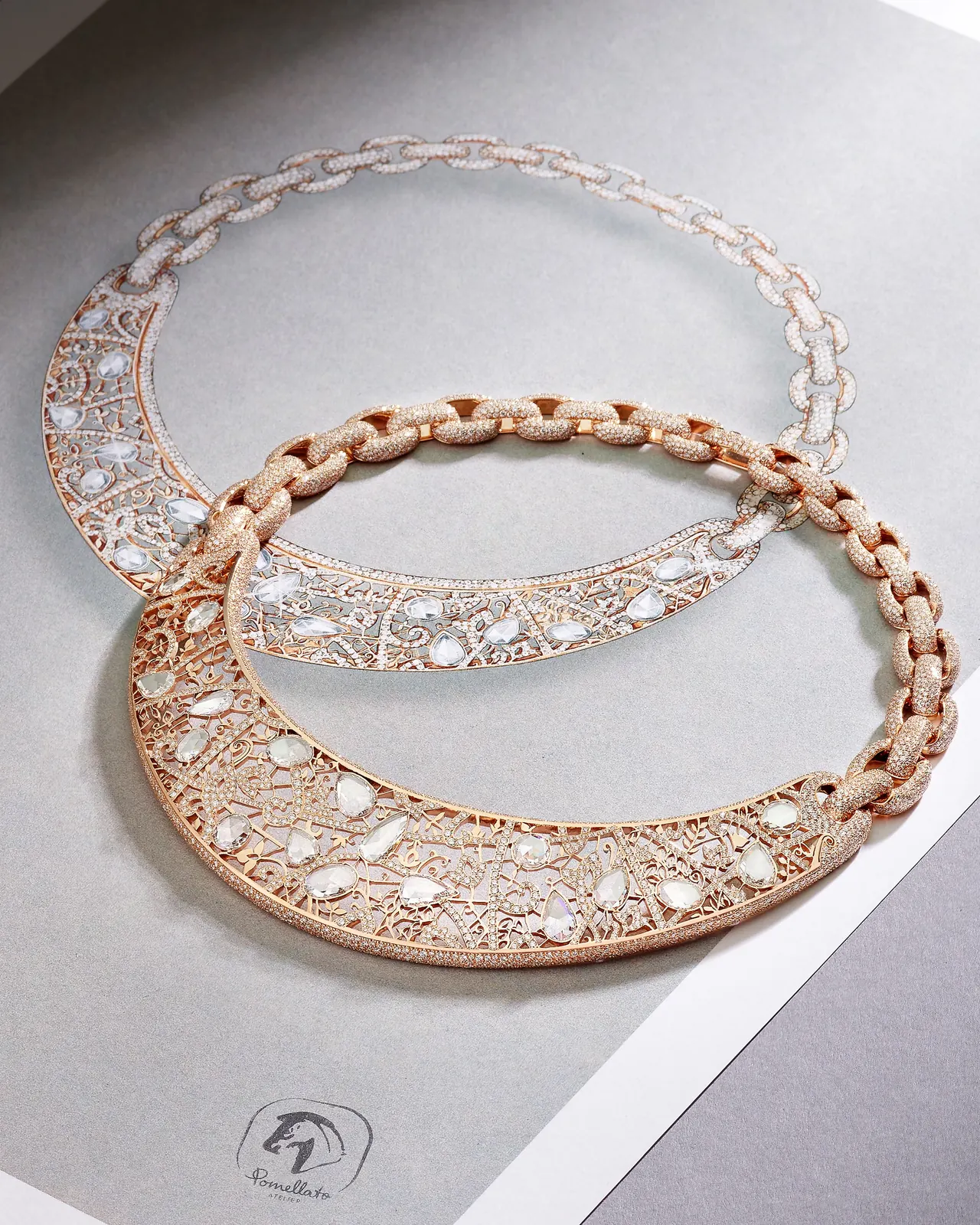
- Matching manchette bracelets in white gold extend the openwork motif into a complete parure, with a deliberate tonal contrast between the rose gold of the necklace and the coolness of white gold at the wrist.
- The piece anchors Chapter III of Stile Libero — Hypnotic Shadows — under Creative Director Vincenzo Castaldo, and represents the furthest reach of Pomellato’s goldsmithing ambition to date.
Setting, Structure and the Logic of Absence
The openwork technique that defines the Arabesque necklace has existed in the goldsmith’s vocabulary for centuries, but Sara Bran’s specific practice — dentelle d’or, or gold lace — pushes the method into territory that challenges the boundary between jewellery and textile. Each aperture in the rose gold plaque is hand-pierced individually, one cut at a time, with no possibility of correction. A single misplaced incision would compromise the integrity of the entire pattern across the crescent-shaped collar.
The motif itself is not invented. Bran drew on a floral pattern from Pomellato’s own archives, a design with roots in the Maison’s long engagement with the Arabesque form across its catalogue. Her contribution was to translate that two-dimensional heritage pattern into a three-dimensional gold architecture — thin florals intertwining with diamonds in an effect that reads as simultaneously structured and organic, grounded in the Maison’s past while occupying ground it has never held before.
The oversized chain that leads into the crescent collar completes the visual logic of the piece. Solid gold transitions into lace, then back again through diamond-set links — a continuous dialogue between presence and absence that Pomellato describes as “a poetic study of solids and voids, light and shadow, in a floral motif.” For collectors who track craft disciplines, this transition alone marks the Arabesque as a piece of serious technical consequence.
Diamond Artistry: Two Cuts, One Source of Light
The choice of rose-cut diamonds for 18 of the 4,123 stones is deliberate in a way that rewards close attention. Rose cuts belong to an earlier era of diamond cutting: faceted on the upper surface only, they produce a diffused, gentle shimmer rather than the aggressive light-return of a modern round brilliant. Their lower profile allows them to sit flush against the gold surface, reinforcing the textile quality of the openwork rather than competing with it.
The brilliant-cut pavé surrounding them operates on a different register. It catches and returns light sharply, producing a secondary layer of visual texture that animates the lace surface from within. Together, the two cuts generate an effect less about conventional sparkle and more about a glow that seems to emanate from inside the gold itself. Houses including Van Cleef & Arpels and Bulgari have long explored the relationship between diamond cutting and surface light in High Jewelry; Pomellato’s approach here is distinctive in subordinating both cuts entirely to the character of the gold lace beneath them.
Materials, Parure and the Milanese Identity
The Arabesque necklace does not stand alone as an object. It is accompanied by matching manchette bracelets in white gold, extending the hand-pierced openwork motif across the wrist in a broader format. The pairing forms a complete parure — a suite of jewels with a shared visual identity, designed to be worn together. The contrast between rose gold’s warmth and white gold’s cooler tone introduces a tonal dialogue at the level of the parure that mirrors, at a different scale, the dialogue between solid and void that defines each individual piece.
All sixty-five creations in Pomellato Stile Libero were handcrafted at Casa Pomellato in Milan, a fact that carries its own significance. Pomellato was founded in Milan in 1967 with a proposition that set it apart from the French houses that have historically shaped Haute Joaillerie: an emphasis on wearability, coloured gemstones, unconventional cuts, and a goldsmithing sensibility rooted in craft rather than ceremony. Where houses such as Piaget developed their jewellery traditions in parallel with fine watchmaking, Pomellato has always placed goldsmithing at the absolute centre. The Arabesque necklace, at 1,450 hours of hand-piercing, is the fullest expression of that tradition — a piece that could only have been produced by artisans trained within the specific Italian goldsmithing culture the Maison has built over nearly sixty years.
Creative Director Vincenzo Castaldo has described the collection’s underlying principle as “the art of moving instinctively.” Within Stile Libero’s three chapters — Visionary Colors, Magnetic Gold, and the Hypnotic Shadows chapter to which the Arabesque belongs — that principle translates into a freedom that is, paradoxically, grounded in the deepest level of technical discipline. The Arabesque necklace, at the furthest edge of what hand-pierced goldsmithing can produce, is the most concentrated proof of that conviction.
Stay ahead of the latest releases. Subscribe to our newsletter for editor-curated coverage of luxury timepieces and jewellery across the Middle East.
| Movement | N/A — jewellery piece |
| Case material | 18-karat rose gold (necklace); white gold (manchette bracelets) |
| Price | Not stated |
Frequently Asked Questions
What makes the Pomellato Arabesque necklace unique among contemporary High Jewelry creations?
The Arabesque necklace is a one-of-a-kind creation in 18-karat rose gold, hand-pierced by French artist Sara Bran using the ancient technique of dentelle d'or — gold lace — over the course of 1,450 hours. The resulting crescent-shaped collar reads as textile rather than metal, a quality that no current production technique can replicate.
How many diamonds are set in the Pomellato Arabesque necklace, and what cuts are used?
The necklace incorporates 4,123 diamonds in total: 18 fancy rose-cut diamonds and an irregular pavé of brilliant-cut diamonds covering the remaining surface, including diamond-set chain links that connect the openwork collar to the body of the necklace.
Which collection does the Arabesque necklace belong to, and when was it unveiled?
The Arabesque necklace belongs to Pomellato Stile Libero, specifically Chapter III: Hypnotic Shadows, the third and final chapter of this 65-piece High Jewelry collection. It was unveiled on 23 June 2026, with all pieces handcrafted at Casa Pomellato in Milan.
Who collaborated with Pomellato on the Arabesque necklace?
French artist Sara Bran, a specialist in the ancient art of gold lace (dentelle d'or), collaborated with Pomellato on the piece. Bran took a floral motif drawn from the Maison's own archives and reinterpreted it as a three-dimensional architecture of hand-pierced rose gold.
Does the Pomellato Arabesque necklace come with matching pieces?
The Arabesque necklace is accompanied by a pair of matching manchette bracelets in white gold, extending the hand-pierced openwork motif across the wrist. Together, the necklace and bracelets form a complete parure designed to be worn as a suite.