The Collector’s View
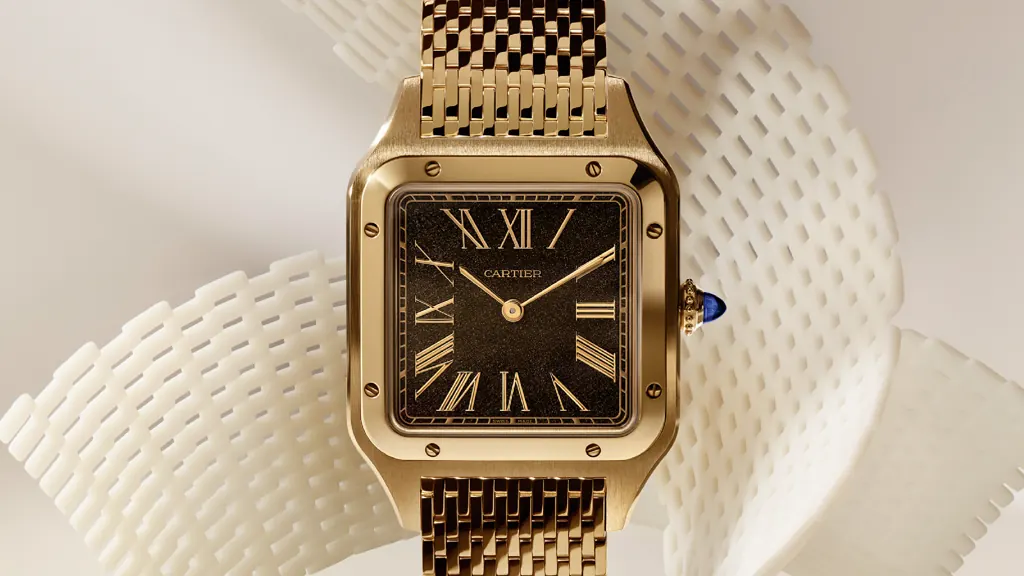
The new Santos-Dumont LM arrives with a dial in gilded obsidian, a volcanic stone from Mexico cut to just 0.3 mm, making every piece entirely one-of-a-kind. That dial sits within a 43.5 × 31.4 mm case, 7.3 mm thick, powered by the 430 MC hand-wound manufacture movement common to all new LM-size references. Completing the picture is a 394-link yellow gold flexible bracelet, engineered from 1.15 mm-thick links across 15 rows, inspired by the Maison’s 1920s metal bracelet tradition. The range spans three LM variants: gilded obsidian in yellow gold, silvered satin-finish sunray in yellow gold, and silvered satin-finish sunray in platinum.
A Design Lineage That Began in 1904
The Codes of the Original
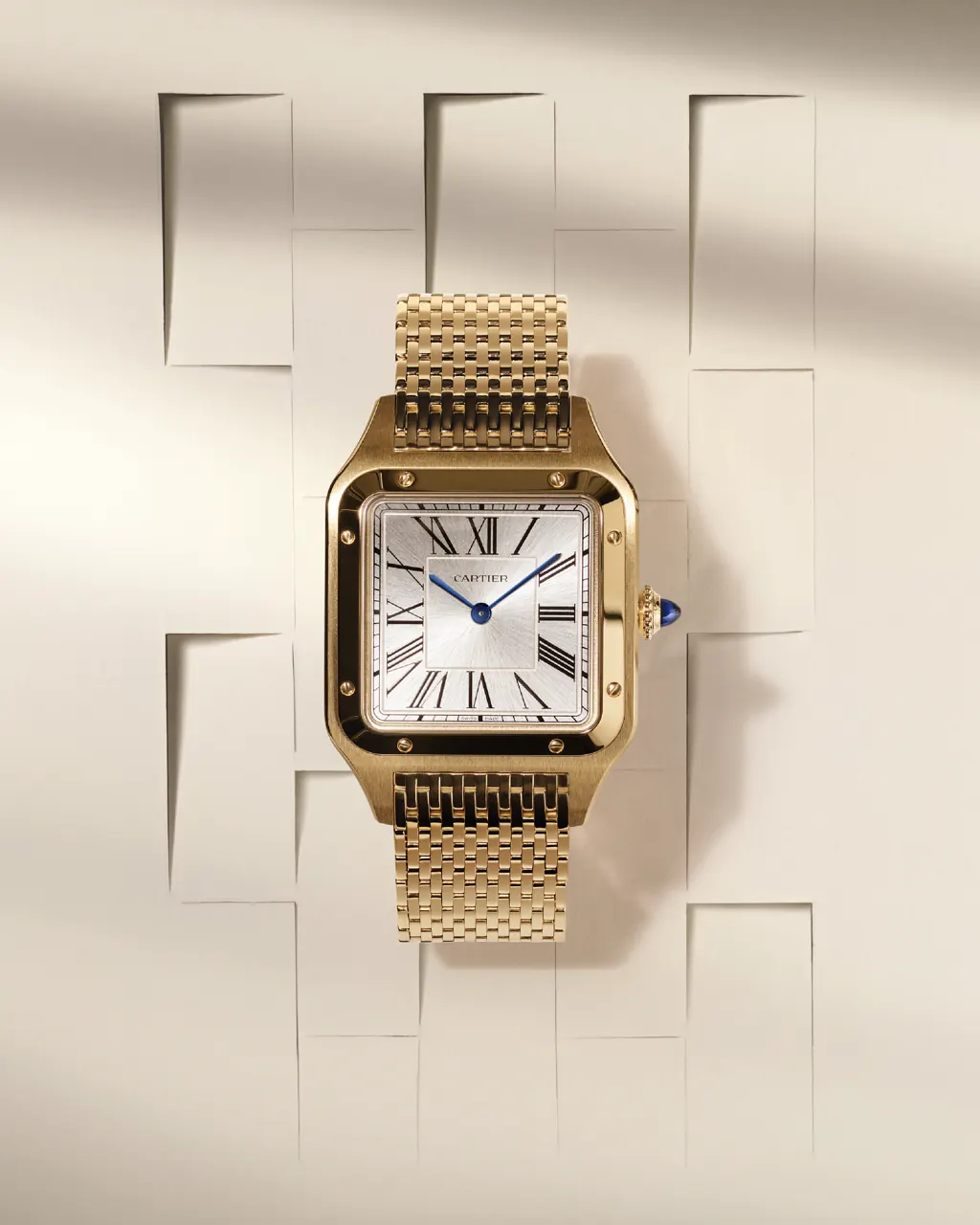
When Cartier created the Santos watch in 1904 at the request of Brazilian aviation pioneer Alberto Santos-Dumont, the brief was functional: a timepiece readable mid-flight, worn on the wrist rather than carried in a pocket. That original object introduced codes that remain unaltered today, namely Roman numerals, exposed screws on the bezel, a circular-grained crown, and the blue cabochon that has become one of the Maison’s most recognisable signatures.
Cartier has also introduced a new colour capsule for the LOVE bracelet, with six models for 2026.
This new LM-size iteration does not merely preserve those codes; it channels the dandyism of Santos-Dumont himself, a figure as famous for his impeccable Parisian dress as for his aeronautical achievements. As Pierre Rainero, Cartier‘s Director of Image, Style and Heritage, states: “The new Santos-Dumont emphasises its resemblance to the original shape, and the bracelet, at once fluid and precious, is an expression of contemporary elegance.”
Vintage Accents, Contemporary Craft
What distinguishes this version is the deliberate accumulation of vintage references filtered through thoroughly modern manufacture capabilities. The watch sits within a long editorial tradition of revisiting founding objects, a conversation that collectors following Cartier’s output at Watches and Wonders will recognise immediately.

The Obsidian Dial and the Gold Bracelet
Gilded Obsidian: A Feat of Gem-Cutting
The centrepiece of the most distinctive new reference is its dial in gilded obsidian. Sourced from Mexico, this volcanic stone owes its shifting, iridescent quality to microscopic air bubbles locked inside the material during formation. No two stones carry the same distribution of bubbles, so no two dials will ever appear identical, a rare proposition in a product category that prides itself on precision and repeatability.
At 0.3 mm in depth, the stone approaches the structural fragility of glass, demanding exceptional skill from the Manufacture’s craftsmen through every stage: cutting, polishing, and final assembly. The result is a surface that reflects light with a depth that no lacquered or enamelled dial can replicate.
The Architecture of the Bracelet
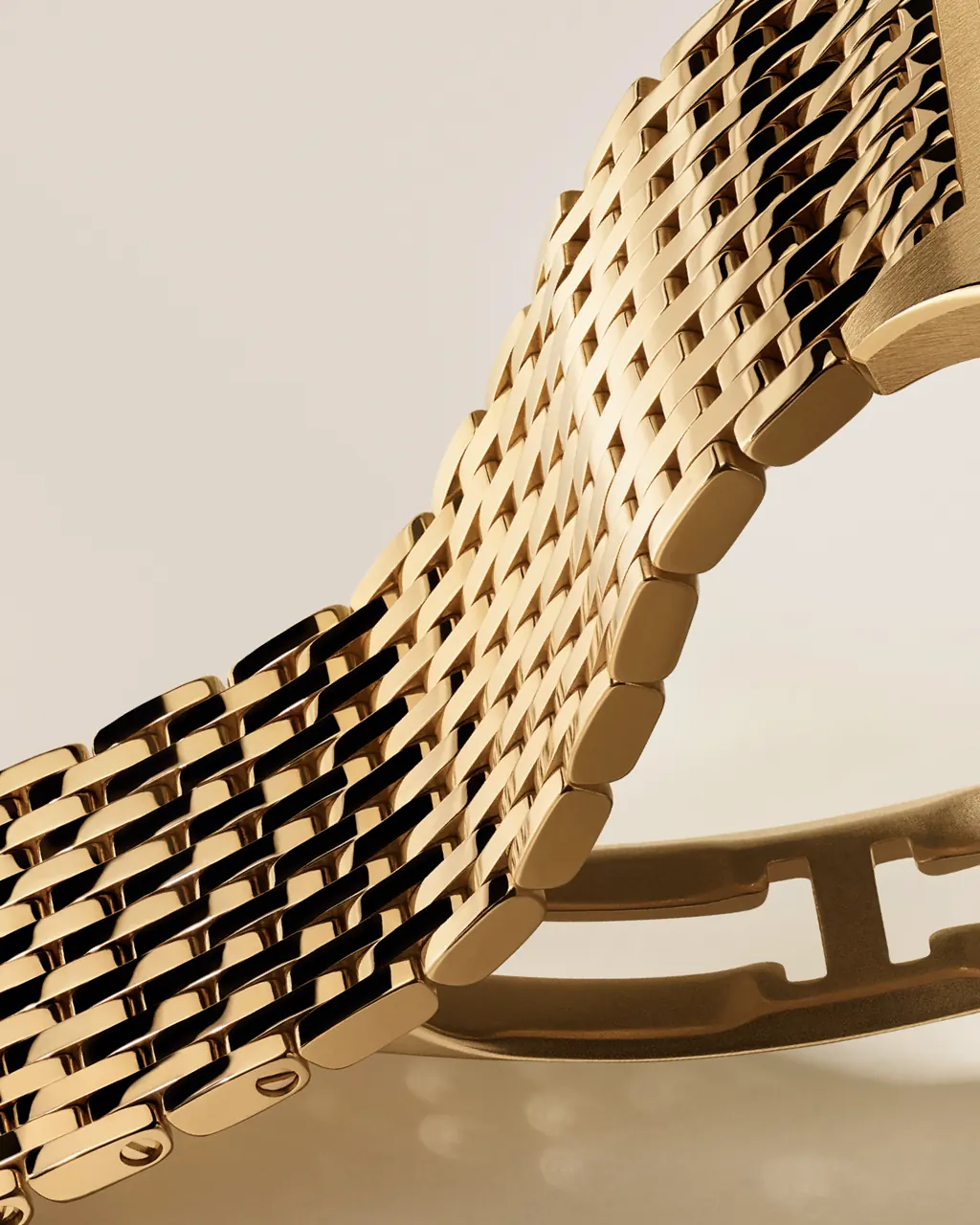
The yellow gold bracelet deserves equal attention. Drawing on the Maison’s own history, specifically the first made-to-measure metal watch bracelets developed in the 1920s, the current design achieves a silky movement against the skin through the refinement of its 1.15 mm links. Fifteen rows, 394 links in total, machined and finished at the Manufacture, then assembled and attached to both case and clasp as a single coherent object. This is the kind of detail that places the Santos-Dumont firmly within the lineage of Cartier’s high jewellery craft, not merely its watchmaking division, a duality also visible in pieces such as the Haryana necklace.

Movement, Specifications, and the Full Range
The 430 MC Manufacture Calibre
All three new LM-size references are driven by the 430 MC, a hand-wound movement developed and produced at the Cartier Manufacture. The case measures 43.5 × 31.4 mm with a 7.3 mm profile, proportions that preserve the elongated, cushion-inflected geometry of the original Santos-Dumont and remain elegant against a tailored cuff. Water resistance is rated to 3 bar (approximately 30 metres).
Three References, One Vocabulary
Beyond the obsidian reference, the LM range introduces two further models: a yellow gold case paired with a silvered satin-finish dial carrying a sunray effect, and a platinum case with the same dial treatment. The platinum version, executed in 950/1000 platinum, offers the cooler tonal contrast that a section of the Middle East collector market has consistently favoured for formal wear. All models feature interchangeable bracelets, consistent with the Santos family’s longstanding commitment to wearability across contexts.


For more on horology that matters in the Gulf, sign up for our weekly editorial briefing.
Frequently Asked Questions
What movement powers the new Cartier Santos-Dumont watch?
The Santos-Dumont is equipped with the 430 MC, a hand-wound mechanical manufacture movement produced by Cartier. It is housed in a case measuring 43.5 × 31.4 mm with a thickness of 7.3 mm.
What makes the obsidian dial on the Santos-Dumont collectible?
The dial is cut from gilded obsidian, a volcanic stone sourced from Mexico whose iridescent reflections come from microscopic air bubbles trapped within the material. At just 0.3 mm in depth, each stone is unique, and the gem-cutting and polishing process is carried out entirely at the Cartier Manufacture.
How many links does the yellow gold bracelet of the Santos-Dumont contain?
The yellow gold bracelet is composed of 15 rows totalling 394 individual links, each 1.15 mm thick. Every link is machined, finished, and assembled at the Manufacture before being attached to the case and clasp.
What case materials are available for the new Santos-Dumont LM?
The new LM-size Santos-Dumont is offered in yellow gold with a gilded obsidian dial, yellow gold with a silvered satin-finish sunray dial, and platinum with a silvered satin-finish sunray dial. Cartier specifies that its watches are made of 750/1000 gold or 950/1000 platinum.
What is the water resistance of the Cartier Santos-Dumont?
The Santos-Dumont is water-resistant up to 3 bar, which is approximately 30 metres.