Key Highlights
- Four new timepieces born from the Vacheron Constantin and Louvre Museum partnership, active since 2019
- Each dial celebrates one civilisation of Antiquity: Pharaonic Egypt, the Assyrian Empire, Ancient Greece, and Imperial Rome
- Nine decorative crafts deployed across the dials, including stone glyptics, a first for Vacheron Constantin using actual marble and limestone sandstone matching the Louvre originals
- Each reference limited to 15 numbered pieces, all Hallmark of Geneva certified
- Powered by Calibre 2460 G4/2: a hands-free, disc-based peripheral display freeing the entire dial surface for artisanal expression
Four Dials, Four Civilisations
Three years of development, carried out in close collaboration with Louvre curators, produced four dials each requiring between 120 and 220 hours of work. The construction principle is consistent across all four: a gold base plate supports a central glyptic applique, accompanied by ornamentation drawn from the decorative arts of the respective era, framed by an outer frieze. Each component must fit the others with micron-level precision, since any misalignment would compromise hours of artisanal labour. The choice of stones was not incidental; the materials used match in nature and origin those of the Louvre originals, verified through research conducted with the museum’s departmental heads.
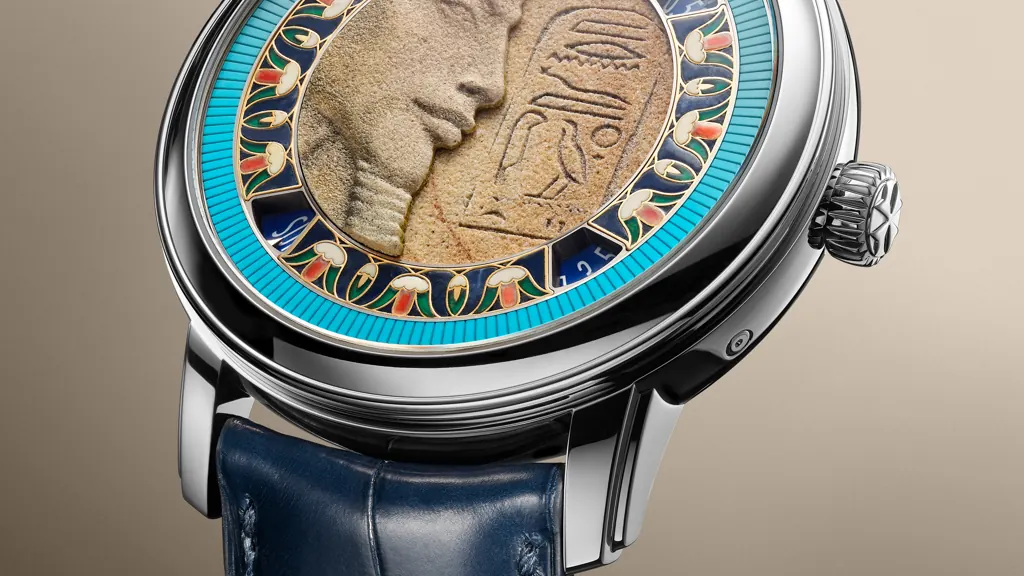
The Buste d’Akhénaton (Reference 7620A/000G-H078) places the elongated profile of the Amarna-period pharaoh at the centre of a white-gold case. Carved from Sinai limestone sandstone and hand-patinated, the portrait is accompanied by an outer frieze of drypoint-engraved turquoise and an inner champlevé frieze assembled from red mother-of-pearl, chrysoprase, opaline, and sodalite. Those two friezes alone demand approximately 150 hours of craft.
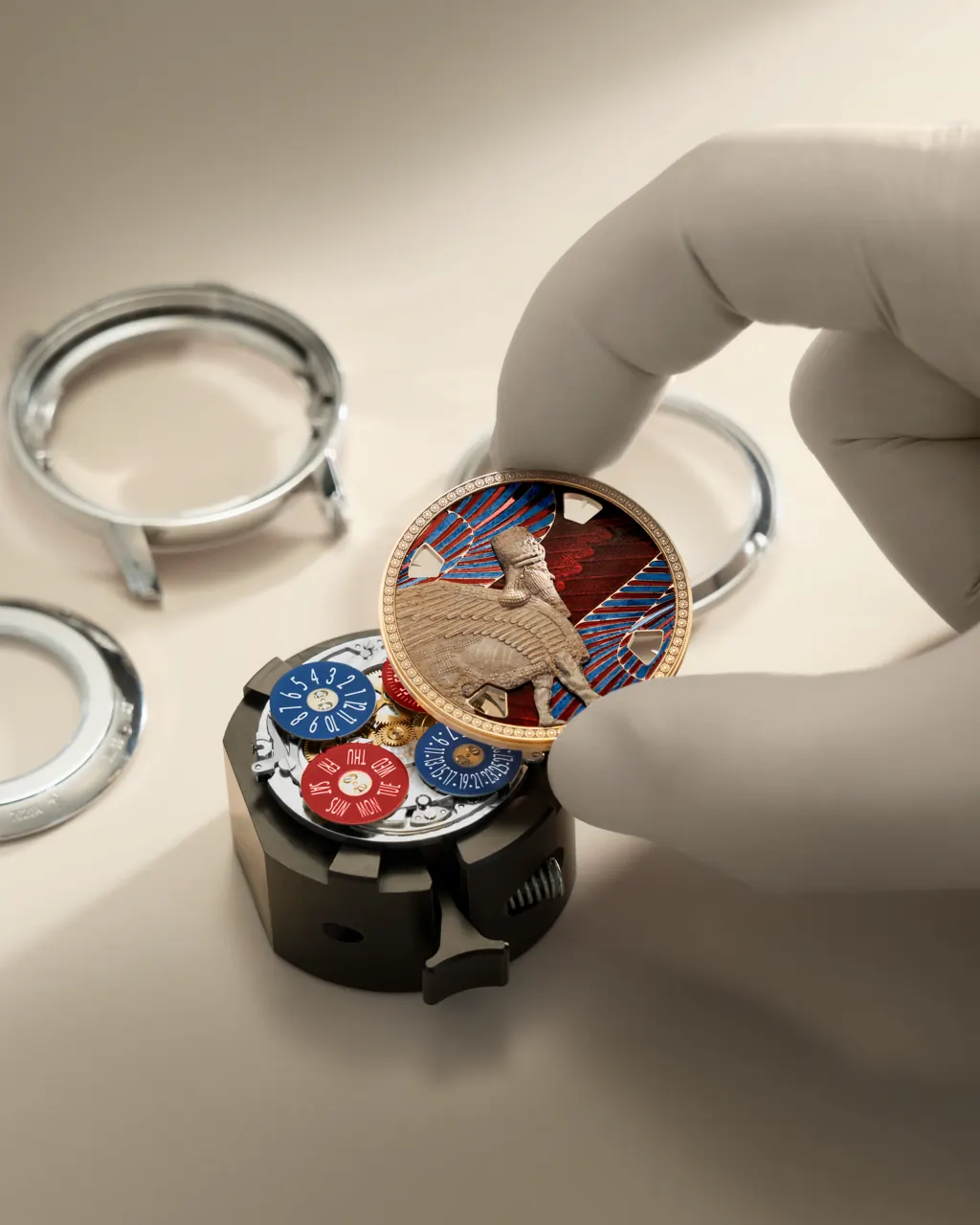
The Lamassu de Sargon II (Reference 7620A/000G-H080) draws from the five-metre-high winged guardians of Sargon II’s palace at Khorsabad, now housed in the Louvre’s Khorsabad Court. The dial’s gold base is ornamented with stone champlevé in red agate and blue dumortierite, overlaid with flinqué enamel evoking the Lamassu’s feathers; the central applique is carved from Italian limestone sandstone sourced to match the alabaster of the originals.
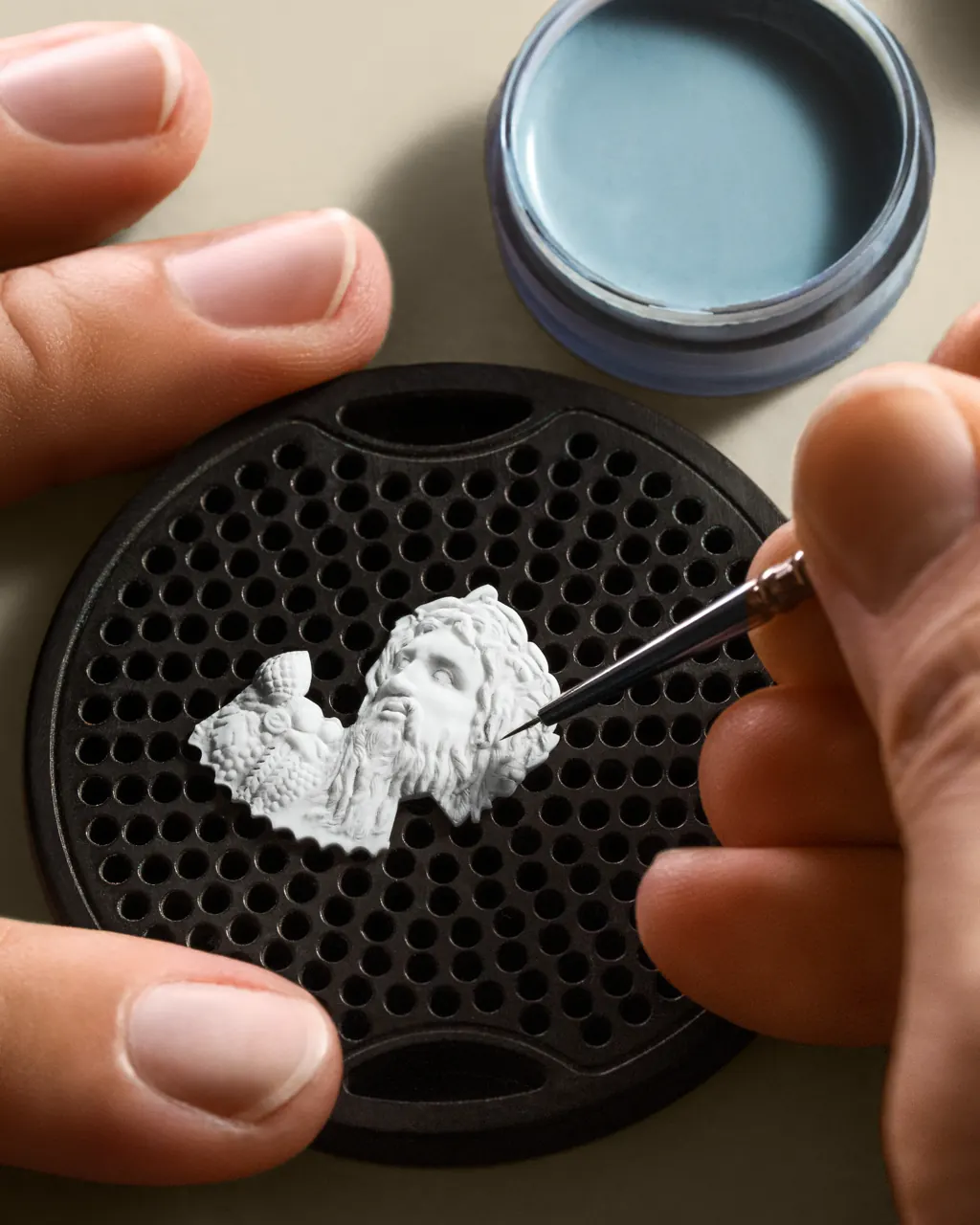
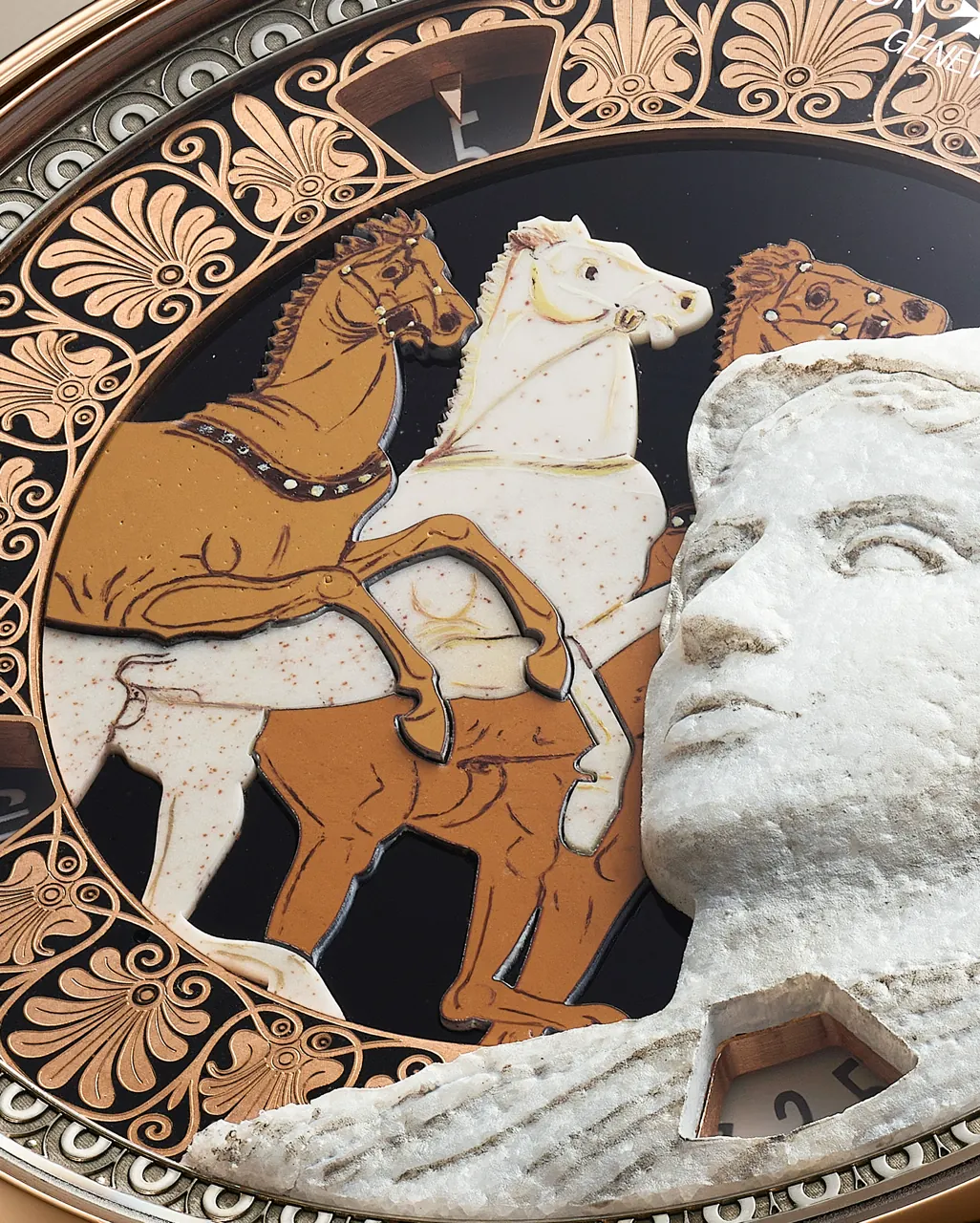
The Athéna de Velletri (Reference 7620A/000R-H081) moves into pink gold. The Pallas of Velletri, a Roman copy of a Greek original attributed to Cresilas and sculpted around 430 BC, is rendered in Parian marble, the same stone as the original, depicted in three-quarter view at a low angle. A black champlevé enamel inner frieze and an engraved white-gold outer frieze frame a central stone marquetry background in onyx and mookaite, animated by miniature painting drawn from a Greek amphora from Milo.
The Tiber de l’Iseum Campense (Reference 7620A/000R-H079), also in pink gold, places the reclining river god in Parian marble alongside a secondary applique in stone micro-mosaic, comprising thousands of fragments of jasper, chrysocolla, and opaline inspired by a late-2nd-century mosaic from Utica, now in the Louvre. Gold leaf textured beneath translucent enamel gives the base its subtly grained luminosity.
Calibre 2460 G4/2 — Technique at the Service of Art
The selection of Calibre 2460 G4/2 to power all four pieces is not incidental. This 237-component self-winding manufacture movement displays hours, minutes, day, and date not through hands but through discs visible in four peripheral apertures. The architecture leaves the entire central dial surface unobstructed, a prerequisite for the level of artisanal work deployed here.
Beating at 4 Hz with a 40-hour power reserve and a movement thickness of 6.05 mm, the calibre also carries an engraved oscillating weight depicting the Louvre’s east façade and its colonnade, hand-carved before stamping. Through the sapphire caseback, bevelled bridges with Côtes de Genève, a circular-grained mainplate, and circled wheels confirm the Fondation Haute Horlogerie standards the Hallmark of Geneva demands. The 42 mm case, measuring 12.9 mm in thickness, accommodates this depth of construction; all four are water-resistant to 3 bar.
A Partnership Grounded in Institutional Commitment
Vacheron Constantin and the Louvre formalised their collaboration in 2019, with conservation, transmission, and shared craft values at its foundation. The first Métiers d’Art Tribute to Great Civilisations series appeared in 2022. In 2025, the partnership reached a further milestone when the Maison’s Watches and Wonders anniversary presentation chose the Louvre to exhibit La Quête du Temps, an astronomical automaton clock of 2,370 components and 22 complications. The Maison also supported the 2016 restoration of La Création du Monde, an 18th-century precision clockmaking masterpiece within the museum’s holdings.
This new series extends that dialogue: the Vacheron Constantin Overseas Dual Time and other contemporaries in the Maison’s portfolio exist in a very different register from these pieces, which sit firmly within the Les Cabinotiers tradition of craft-driven creation. For the Middle East collector, where connoisseurship of both artistic heritage and horological technique is deeply established, the convergence of Mesopotamian, Egyptian, Hellenic, and Roman iconography with Geneva’s most exacting finishing standards is a pairing of rare coherence.
Why It Matters
Each of these 15-piece editions represents something precise: the point at which a museum-quality artefact and a watchmaking manufacture share the same brief, the same stones, and the same accountability to historical record. For collectors in the Gulf region, where the civilisations celebrated, Egyptian, Assyrian, Greek, Roman, carry a particularly resonant geographic proximity, the Métiers d’Art Tribute to Great Civilisations series offers not simply an object of horological interest but a portable archive of Antiquity.
For more on horology that matters in the Gulf, sign up for our weekly editorial briefing.
Frequently Asked Questions
What makes the Vacheron Constantin Métiers d’Art Tribute to Great Civilisations collection unique?
This collection features four limited-edition timepieces created through a partnership with the Louvre Museum, each celebrating a different ancient civilization and showcasing nine decorative crafts including stone glyptics — a first for Vacheron Constantin using actual marble and limestone sandstone matching the Louvre originals. Each watch is limited to just 15 numbered pieces and certified with the Hallmark of Geneva.
How long did it take to develop and create these Vacheron Constantin watches?
Three years of development in collaboration with Louvre curators produced the four dials, with each dial requiring between 120 and 220 hours of work. The Buste d’Akhénaton’s two central dial components alone demanded approximately 60 hours of hand-patination and carving work.
What movement powers these Métiers d’Art watches?
All four timepieces are powered by Calibre 2460 G4/2, a hands-free, disc-based movement that displays hours, minutes, day, and date through peripheral apertures rather than traditional hands, freeing the entire dial surface for artisanal expression. The movement beats at 4 Hz and offers a 40-hour power reserve.