The Art of Watchmaking with ROGER W SMITH LTD
Roger Smith, a watchmaker based on the Isle of Man, represents the highest standard of independent horological practice. His timepieces demonstrate the precision required at every stage of assembly, particularly in two foundational techniques: burnishing pivots and fitting a wheel to its arbor. Both operations directly impact a watch’s performance and service life.
Understanding Burnishing Pivots
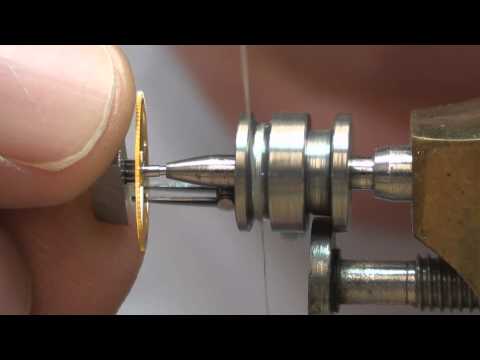
Burnishing pivots refines the ends of pivot points to a polished finish. This operation serves two purposes: it reduces friction at the bearing surfaces and ensures the pivot itself meets dimensional tolerance. Roger Smith uses hand-held burnishing tools to shape and smooth each pivot, removing tool marks left by the lathe. The result is a bearing surface that allows the balance staff or other arbors to rotate with minimal resistance. This direct mechanical improvement translates to better rate stability and lower energy consumption from the mainspring.
The Importance of Precision
Any deviation in pivot diameter or finish directly affects how freely the staff rotates. A rough or undersized pivot accelerates wear on both the pivot itself and its corresponding jewel or steel bearing. Watchmakers spend years developing the touch required to burnish by feel alone—knowing when the surface is truly smooth rather than relying on visual inspection. This accumulated skill is what distinguishes hand-finished watches from those finished by machine or left unfinished.
The Process of Fitting a Wheel
Fitting a wheel to its arbor requires the wheel’s bore to match the arbor’s diameter within a tolerance of a few thousandths of an inch. Too loose and the wheel will slip under torque; too tight and it cannot be pressed on without damage. The arbor must be perfectly straight, and the wheel bore must be concentric. Roger Smith fits each wheel by hand, using a press and gauges to verify concentricity and load.
Achieving the Perfect Fit
The watchmaker checks that the wheel runs true once mounted, ensuring its teeth mesh correctly with the pinion it drives and that no binding occurs. The wheel must also sit at the correct height along the arbor so that it clears adjacent components and meshes with proper depth. This hands-on approach prevents the timing errors and excessive wear that occur when wheels are fitted carelessly or to loose tolerances. Each fitted wheel contributes directly to the watch’s timekeeping accuracy and mechanical longevity.
Conclusion
Burnishing pivots and fitting wheels represent only a fraction of the operations required to complete a watch. Smith’s workshop demonstrates that these fundamental techniques, performed with precision and care, are what separate a functional timepiece from one capable of reliable performance across decades. To discover more about ROGER W SMITH LTD’s exclusive collections, click here to explore ROGER W SMITH LTD collections and experience the legacy of luxury timekeeping.