First Look
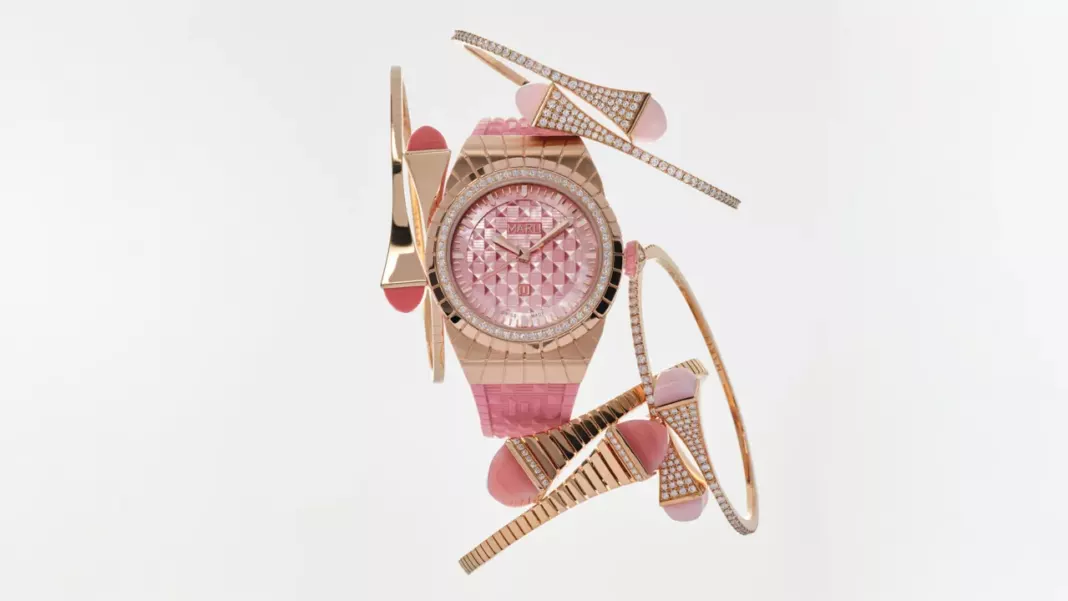
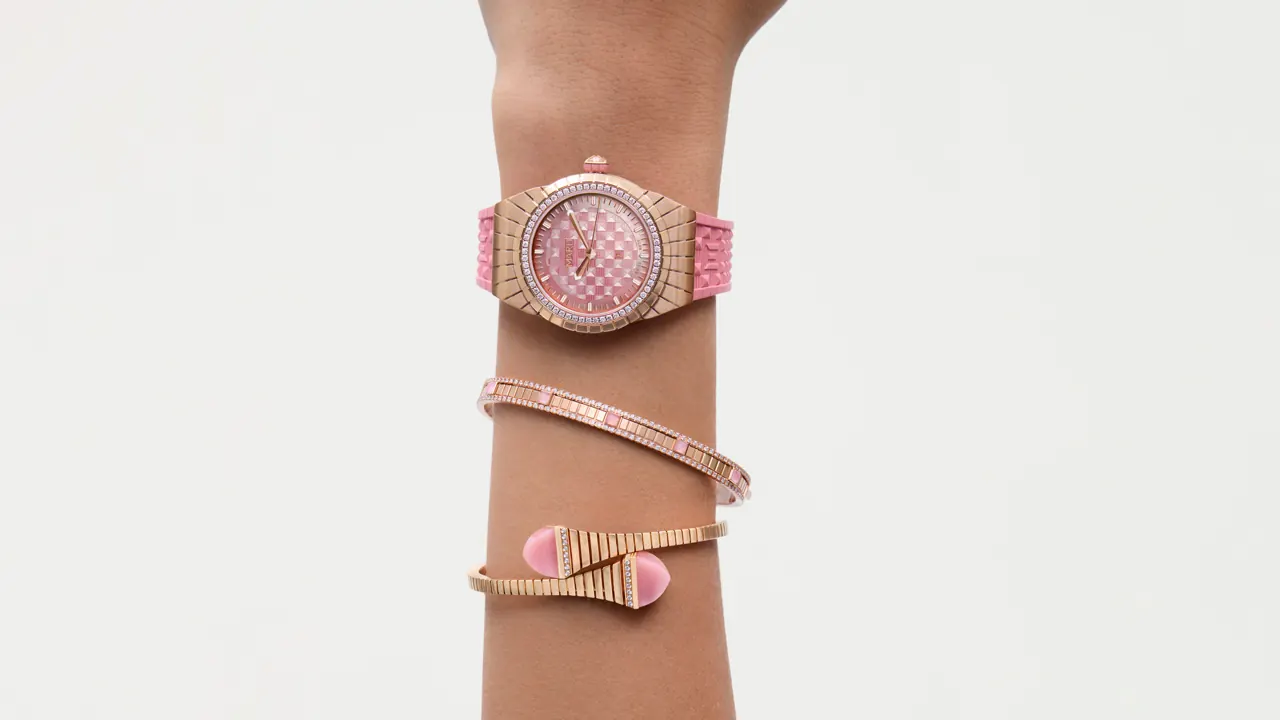
The L35 measures 35 mm and its case is sculpted from rose gold or titanium, with a multi-part sandwich construction in which high-technical resin reduces wrist weight while embedding colour directly into the case architecture rather than onto its surface. The pyramid tapisserie dial is machined from solid natural mother-of-pearl, a material that demanded three years of R&D and bespoke industrial tooling before MARLI could achieve crisp, repeating three-dimensional geometry at watchmaking tolerances. Power comes from a Swiss automatic ETA 2892 A2 at 28,800 vph with a 50-hour power reserve, hand-finished at MARLI’s Le Locle manufacture with circular graining and Côtes de Genève decoration. The pyramid-shaped crown is set with four EF VS diamonds, and sword-shaped faceted hands were chosen specifically for their legibility against the depth of the coloured dial. A rubber strap embossed throughout with the pyramid motif, available in white and black, carries the design language from bezel to buckle without interruption. Every component other than the movement itself is produced at PreciTech SA, Le Locle, across four buildings and 6,000 m².
Form as a Point of Departure
Where the L23 and L30 draw their character from jewellery, with scalloped bezels, diamond pavé, and the grammar of the bracelet, the L35 draws its character from form. The 35 mm case is sculpted from the solid, its bezel a sequence of angled planes designed to capture and redirect light rather than simply hold stones. The result is a timepiece whose presence on the wrist registers as architecture before it registers as jewellery.
That architectural ambition is supported by an engineering decision that is easy to overlook: the multi-part sandwich construction integrating a high-technical resin between case layers. The resin allows colour to be embedded directly into the structure of the case, not applied to its surface, and reduces overall weight so that a timepiece of this visual scale wears with unexpected ease.
The Pyramid Tapisserie Dial
The L35 shares with the rest of the collection the element that defines it: a three-dimensional pyramid tapisserie dial machined from solid natural mother-of-pearl. Mother-of-pearl sits at 3 to 4 on the Mohs hardness scale, soft, organic, and deeply resistant to the kind of repeating precision-tooling that dial-making demands. Achieving pyramids with sharp, consistent edges and uniform depth across an entire dial surface required three years of research and development and a complete suite of bespoke industrial tooling. The details of the process remain closely guarded.
For the coloured versions of the L35, mother-of-pearl is deposited onto a brass plate previously lacquered in the matching shade; the anthracite version employs black mother-of-pearl directly. The pyramid motif then continues across the embossed rubber strap, so that the watch reads as a single coherent object from bezel to buckle. Houses such as Van Cleef & Arpels and Piaget have long understood this principle, that the most persuasive jewellery watches resolve every surface into a single visual intention, and the L35 belongs squarely in that conversation.

The Movement and Its Finishing
ETA 2892 A2, Finished in Le Locle
The L35 is powered by the ETA 2892 A2, running at 28,800 vibrations per hour with a 50-hour power reserve and 21 jewels. The calibre is a known quantity in Swiss watchmaking: reliable, slim, and well-suited to a case of this proportion. What distinguishes its application here is finishing, with circular graining and Côtes de Genève decoration applied by hand at PreciTech SA, the manufacture MARLI operates in Le Locle.
Le Locle’s place in Swiss horological history is not incidental. The town’s streets were widened to maximise sunlight for watchmakers assembling minute components at their benches; its buildings were designed around large windows for the same purpose. This urban fabric earned Le Locle UNESCO World Heritage status, and it is the environment in which every MARLI component, from bridges and plates to cases, clasps, crowns, oscillating weights, and bracelet elements, is produced and finished. The sole exception is the movement itself.
Sword Hands and the Question of Legibility
The L35 departs from the dauphine hands of the L23 and L30 in favour of sword-shaped hands, faceted, dynamic, and designed for legibility against the depth and colour of the pyramid tapisserie surface. It is a considered choice: a coloured, three-dimensional dial creates visual competition that rounded hands would lose. The sword profile cuts through it cleanly.

MARLI’s Foundation and What It Guarantees
Behind the L35 stands a structure that few jewellery brands entering watchmaking can claim. The Artinian Group, founded and led by Arto Artinian and Saro Artinian, brings nearly three decades of vertically integrated experience: a diamond trading office in Antwerp with full control over stone quality and provenance, an atelier of 800 artisans in Bangkok, and the Le Locle manufacture acquired in 2019. Every diamond in the collection, including the four set into the pyramid crown, is selected to EF VS standards, grades E and F on the GIA colour scale and Very Slightly Included on clarity. A comparable commitment to stone quality is what separates Harry Winston from the broader field of jewellery watchmaking, and it is the standard MARLI has applied from the outset.
Maral Artinian founded MARLI in New York in 2014 with a design language rooted in architectural precision and the pyramid motif. The L35 is its most complete expression in watchmaking, with colour, form, finishing, and gem-setting resolved into a single object. For Middle East collectors who wear jewellery as daily architecture rather than occasional ceremony, the proposition is direct.
Stay ahead of the latest releases. Subscribe to our newsletter for editor-curated coverage of luxury timepieces across the Middle East.
Frequently Asked Questions
What makes the MARLI L35 Pink dial so difficult to manufacture?
The pyramid tapisserie dial is machined from solid natural mother-of-pearl, which ranks only 3 to 4 on the Mohs hardness scale and resists precision tooling. Achieving sharp, consistent pyramid edges and uniform depth across the entire dial required three years of research and development plus bespoke industrial tooling.
How does the sandwich construction reduce the weight of the L35 Pink?
The 35 mm case uses multi-part sandwich construction with high-technical resin integrated between the rose gold or titanium layers. This resin embeds colour directly into the case structure rather than applying it to the surface, allowing the watch to wear with unexpected ease despite its visual scale.
What movement powers the MARLI L35 Pink and where is it finished?
The L35 Pink is powered by the ETA 2892 A2 automatic movement with 28,800 vph and a 50-hour power reserve. The movement is hand-finished at MARLI’s Le Locle manufacture with circular graining and Côtes de Genève decoration.