Key Highlights
- First IWC watch engineered from the ground up for human spaceflight, not adapted from an existing design
- Patent-pending rotating bezel system replaces the crown entirely, enabling gloved operation in EVA conditions
- IWC-manufactured calibre 32722 with 120-hour power reserve and integrated GMT module
- Case in white zirconium oxide ceramic; bezel and case back in IWC’s proprietary Ceratanium
- Officially certified for spaceflight by Vast, the company building Haven-1, the world’s first commercial space station
A Blank Sheet of Paper
IWC Schaffhausen has 90 years of experience producing tool watches for aviation. Previous IWC timepieces that travelled to space during the Inspiration4 and Polaris Dawn missions were, by the brand’s own admission, modified terrestrial aviation watches. The Pilot’s Venturer Vertical Drive (Ref. IW328601), unveiled at Watches and Wonders Geneva in April 2026, breaks from that precedent entirely. IWC’s advanced engineering division XPL began with no inherited constraints, defining from first principles what a watch designed specifically for astronauts must deliver.
CEO Chris Grainger-Herr describes the approach as starting with “a blank sheet of paper.” Every detail—functionality, legibility, material selection, and operability—was optimised for the conditions of spaceflight rather than retrofitted to meet them. The result is a watch that qualifies not just as a pilot’s instrument but as the first purpose-built IWC space instrument.
Engineered to Work Without a Crown
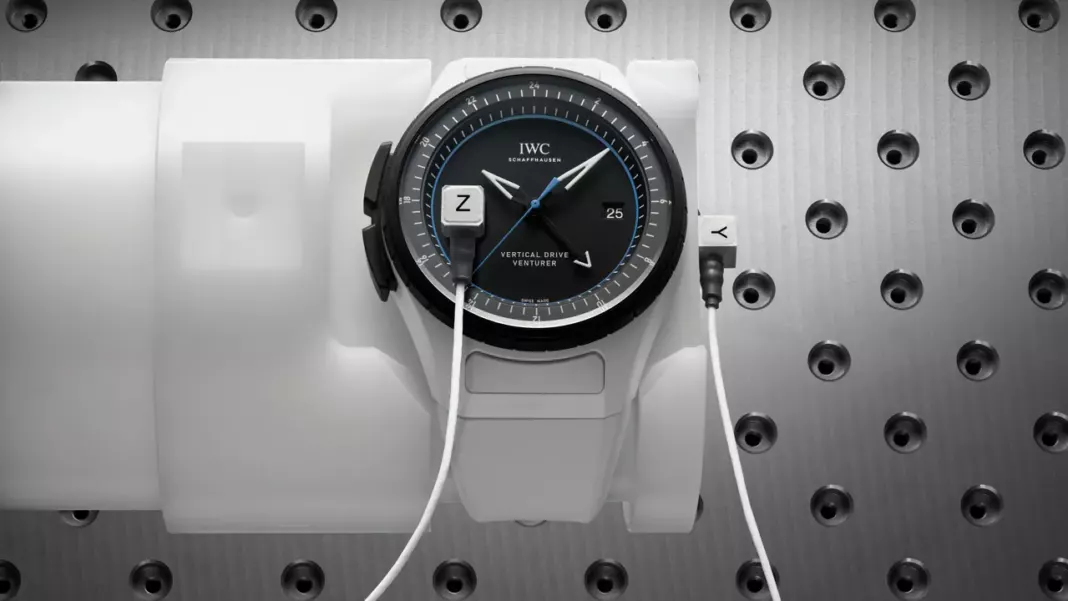
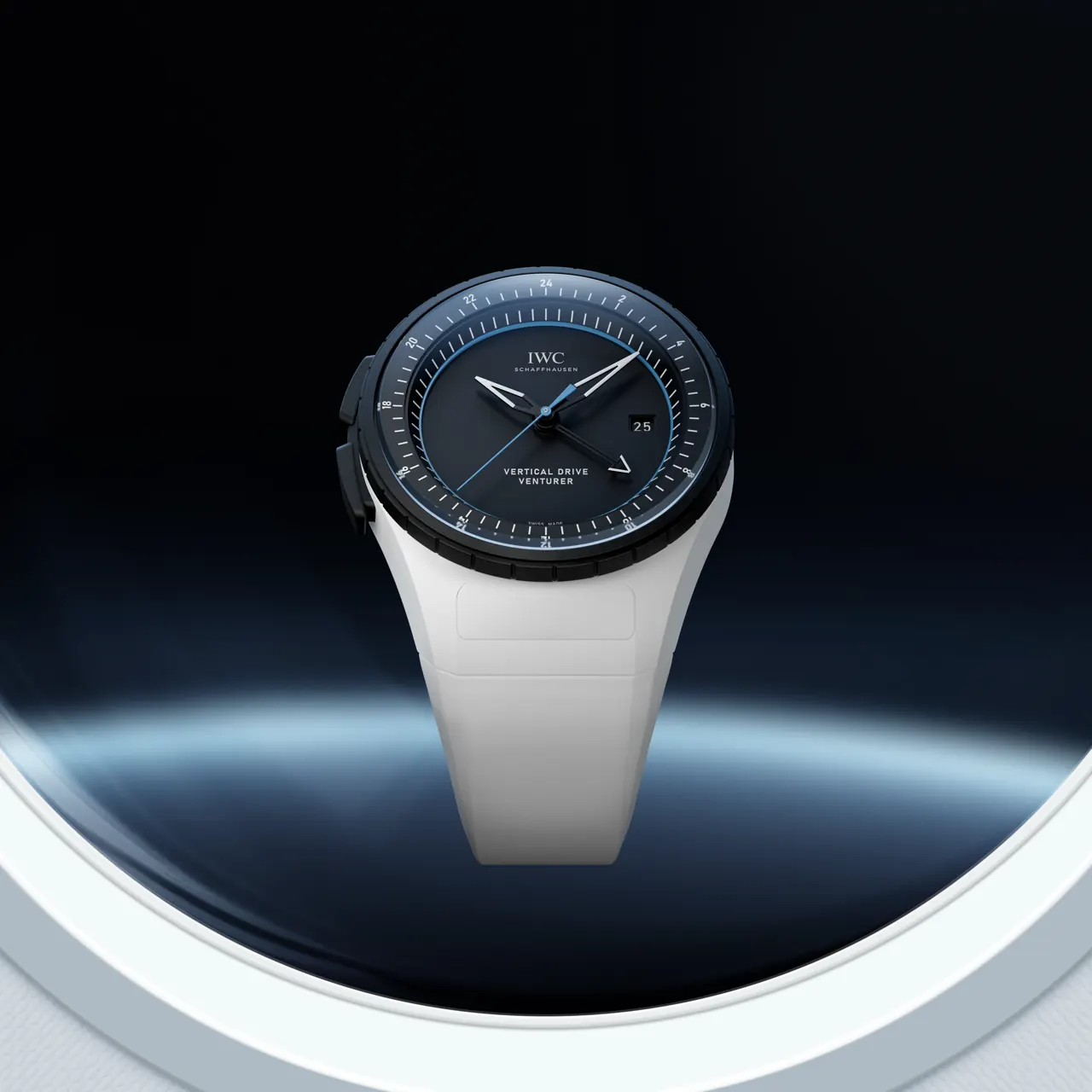
The most consequential design decision is the complete elimination of the crown. During Extravehicular Activity, astronauts wear pressurised gloves that make fine-motor operations impossible. IWC’s solution is a patent-pending rotating bezel system connected to the winding stem via a “Vertical Drive” clutch mechanism. A rocker switch on the case flank allows the wearer to toggle between winding the movement, setting the mission reference time, and adjusting the home-time hour hand. The bezel can also be rotated anti-clockwise to wind the watch manually; a meaningful redundancy in a zero-gravity environment where an automatic rotor may not generate sufficient motion.

The Dial and the 24-Hour Imperative
A spacecraft completes an orbital cycle approximately every 90 minutes, producing up to 16 sunrises and sunsets in a single Earth day. Without a reliable solar reference, astronauts adhere to GMT or UTC; hence the 24-hour display on the outer dial scale, running from 00:00 to 24:00 and indicated by a dedicated arrow-tipped hand that glows blue in darkness. Blue was chosen deliberately. It references the colour of Earth’s horizon as seen from orbit. Central hour and minute hands carry green Super-LumiNova on their edges; a blue seconds hand points to an inner ring in matching hue. The matte black dial is anti-reflective and stripped to essentials, avoiding any surface glare in the harsh light conditions of space.
The hour hand can be moved independently in one-hour increments, displaying a second time zone alongside the mission reference time. Back on Earth, this becomes a straightforward GMT complication for frequent flyers. The Portugieser Chronograph Ceratanium demonstrated IWC’s commitment to advanced materials; the Venturer pushes that material philosophy further still in service of pure utility.
Materials Built for Extreme Environments
Ascending on a rocket exposes hardware to acceleration forces of up to 4g, followed by vacuum, radiation, and temperature swings ranging from +100 °C in direct sunlight to −150 °C in shadow. The case is white zirconium oxide ceramic, whose Vickers hardness is second only to diamond. The rotating bezel and case back are Ceratanium; IWC’s proprietary alloy combines the structural lightness of titanium with hardness and scratch resistance approaching ceramic. The strap is white FKM fluorinated rubber, selected for its thermal insulation and UV resistance. The Ingenieur Tourbillon 41 showcases IWC’s engineering ambition in a different register. Here, every material choice is dictated by mission-critical performance rather than aesthetics alone.

Certified by Vast for Haven-1
At its Long Beach, California headquarters, Vast subjected the watch to comprehensive type testing: vibration and pressure-change assessments, material compatibility checks with the Haven-1 environment, and directional-force tests reaching 10g. These exceeded the forces astronauts experience during ascent. After each test cycle, engineers verified full mechanical integrity and timekeeping accuracy. The Pilot’s Venturer Vertical Drive satisfied every criterion required for Haven-1 crew usage and earned official spaceflight certification. Haven-1, scheduled to launch in 2027, is anticipated to be the world’s first commercial space station, with Haven-2 proposed as a permanently crewed successor.
Why It Matters
The Pilot’s Venturer Vertical Drive represents a precise convergence of horological craft and aerospace engineering; a mechanical watch that has earned its place on the wrist of a working astronaut, not by reputation alone but through certification. For Middle East collectors and enthusiasts who follow both luxury watchmaking and the accelerating new space economy, Ref. IW328601 is a clear signal that IWC’s engineering ambitions now extend beyond the atmosphere. Visit the official IWC Schaffhausen website for full specifications and availability details.
Discover the watches shaping the Middle East market. Join our mailing list for ongoing reviews, releases, and collector insights.
Frequently Asked Questions
What movement powers the IWC Pilot's Venturer Vertical Drive?
The watch is driven by the IWC-manufactured calibre 32722, an automatic movement beating at 28,800 vph with a 120-hour power reserve and an integrated GMT module.
What is the case size of the IWC Pilot's Venturer Vertical Drive?
The Pilot's Venturer Vertical Drive measures 44.3 mm in diameter and 16.7 mm in height, with a ceramic case and Ceratanium bezel and case back.
Why does the IWC Pilot's Venturer Vertical Drive have no crown?
All functions are controlled via a patent-pending rotating bezel system and a side-mounted rocker switch, designed so astronauts can operate the watch while wearing space-suit gloves.
What is Vast's role in the Pilot's Venturer Vertical Drive?
Vast, the company developing the Haven-1 commercial space station, conducted rigorous type testing at its Long Beach headquarters; including vibration tests up to 10g; and issued official spaceflight certification for the watch.
What materials are used in the Pilot's Venturer Vertical Drive?
The case is crafted from white zirconium oxide ceramic, while the rotating bezel and case back use IWC's proprietary Ceratanium, which combines titanium's lightness with ceramic-level hardness. The strap is white FKM fluorinated rubber.