
Key Highlights
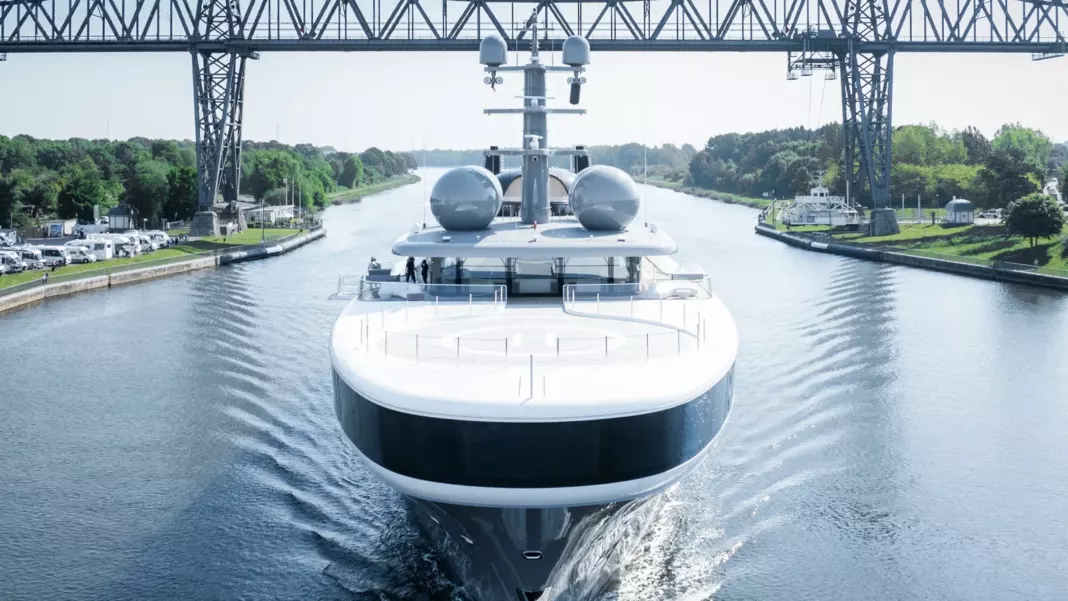
- 114.2 metres (375 ft) in length, 18.7m beam, approximately 6,300 gross tonnes, six decks
- Entire exterior and interior designed by Australian industrial designer Marc Newson
- Built under the working title Project COSMOS at Lürssen’s Rendsburg shipyard; delivered 23 May 2026
- Skydome: 56m² private study formed from seven hot-bent glass panes, each 62mm thick and weighing 1,050kg
- Methanol fuel-cell system converting methanol into hydrogen for onboard electricity — a Lürssen first
- Hull reinforced to Ice Class 1D, enabling operation from tropical waters to polar seas
- Lürssen’s fourth delivery of 2026, arriving during the shipyard’s 150th anniversary year
Signature Features
Few facts about Nausicaä carry more weight than this one: not a single detail changed from the digital concept presented six years ago. Across a project of 114.2 metres, six decks and roughly 6,300 gross tonnes, that fidelity borders on the unprecedented. Marc Newson acknowledged as much at delivery, stating that every detail at every scale had been realised at the most coherent level. For Lürssen, whose 150-year history includes vessels such as Rising Sun and Kismet, it represents one of the most exacting engineering programmes the Rendsburg shipyard has undertaken.
The hull is steel with a displacement form, the superstructure aluminium. Classification is by Lloyd’s Register. Propulsion is diesel-electric, based on MTU 16V4000 engines, with the addition of a methanol fuel-cell installation that converts methanol into hydrogen to generate onboard electricity. Lürssen has described this as a first for the shipyard and a signal of where large-yacht engineering is moving. The hull is reinforced to Ice Class 1D, giving Nausicaä a cruising range that spans tropics to polar regions without compromise.
Design & Silhouette
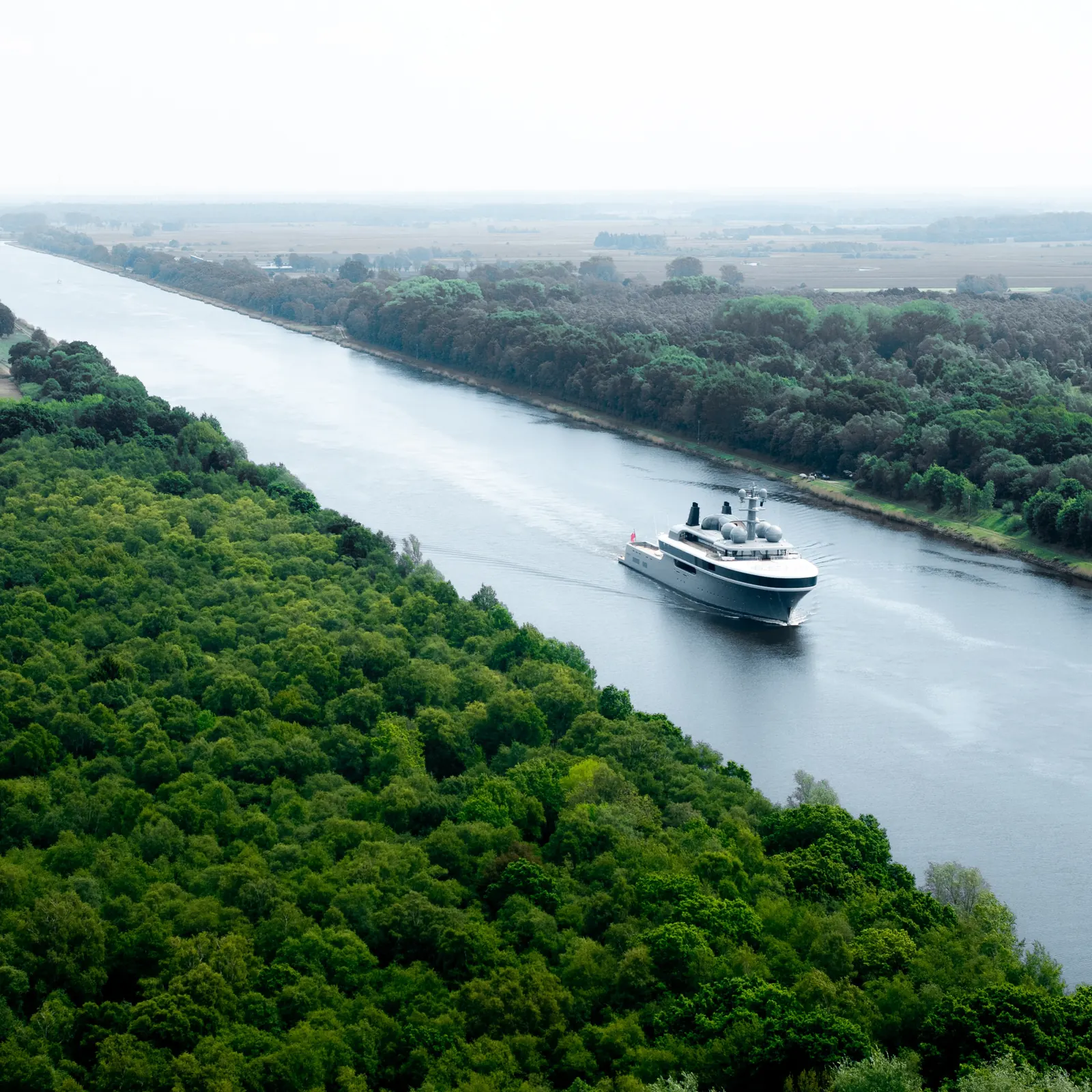
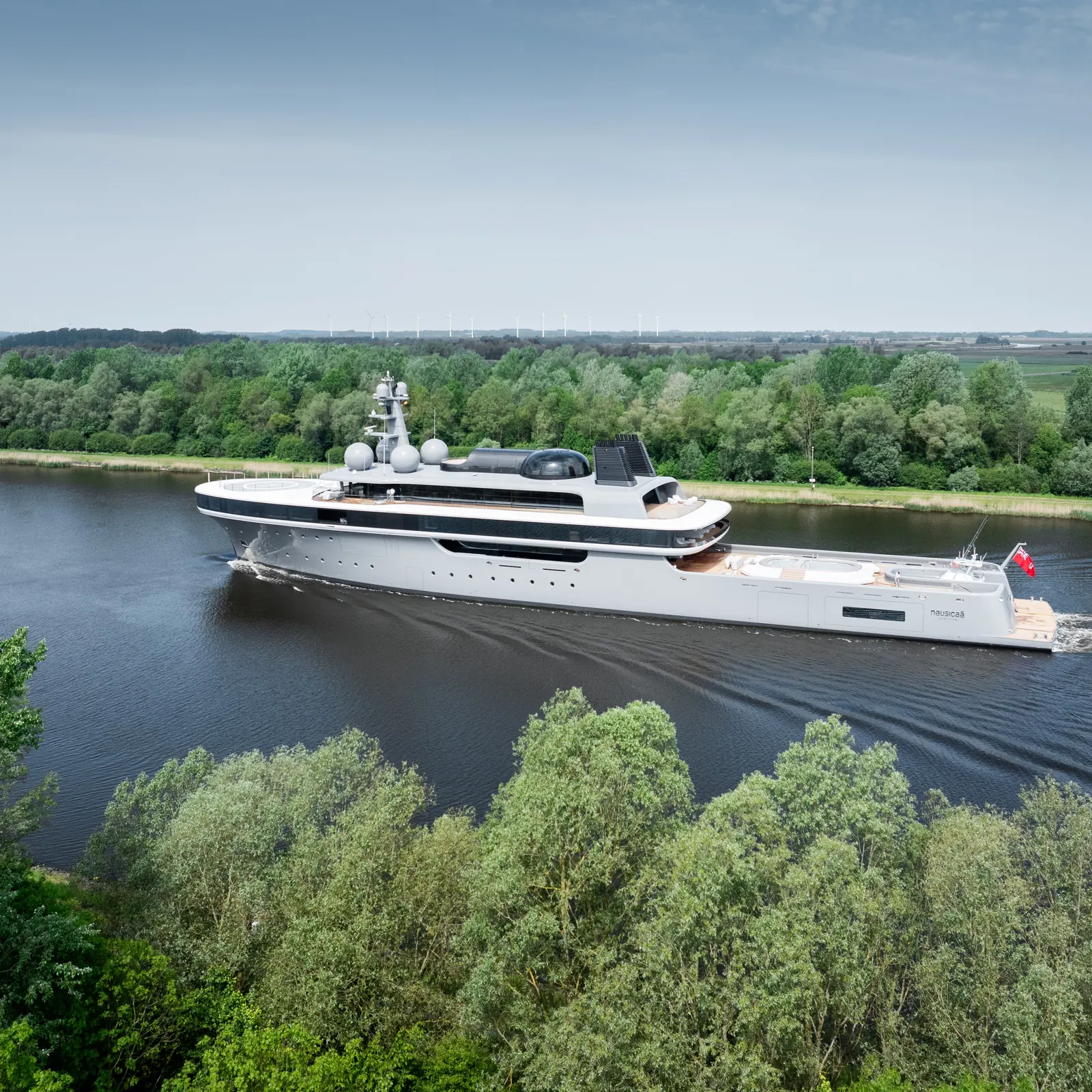
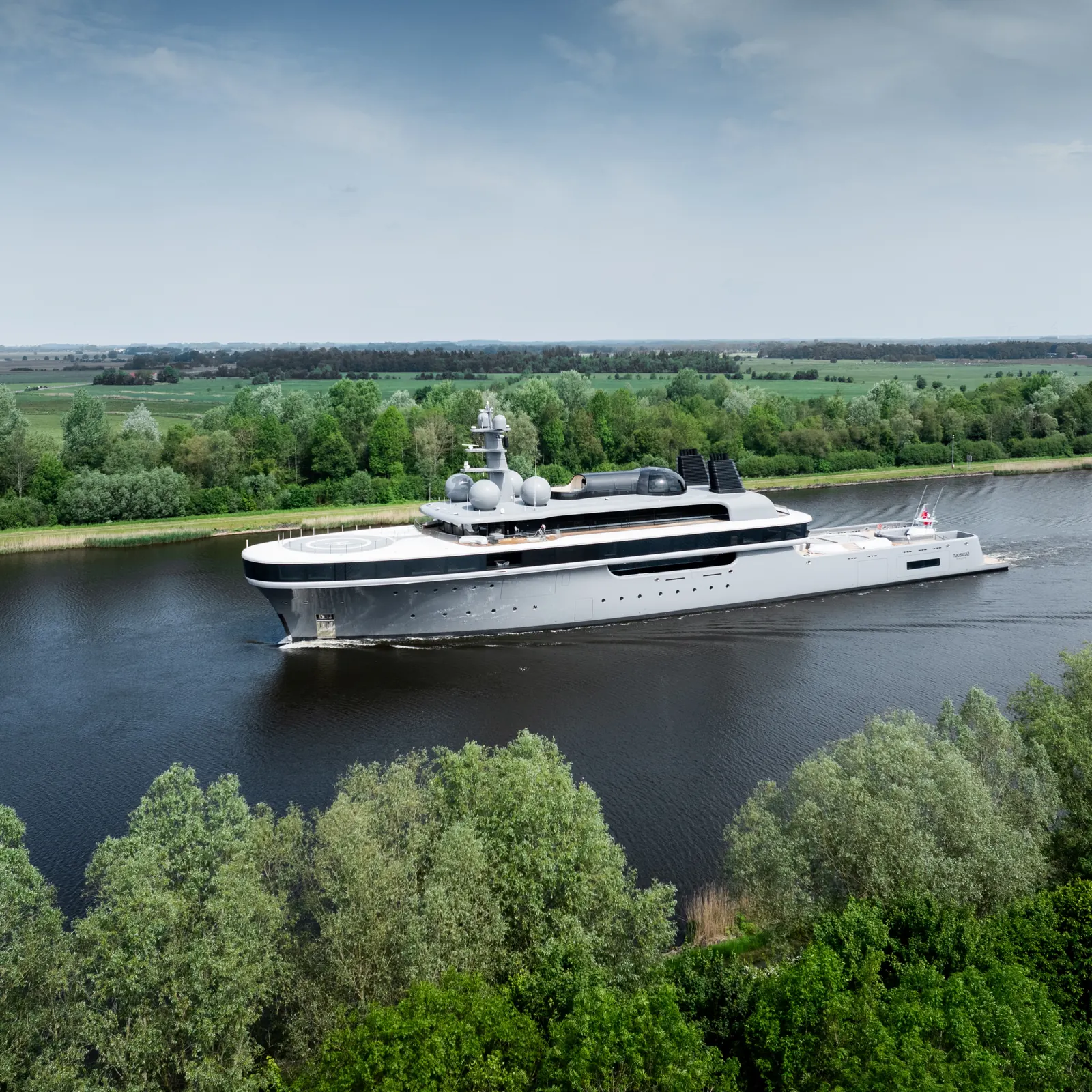
Newson’s visual language rejects the stacked-deck geometries that define much of the contemporary superyacht market. Nausicaä’s profile is built on curvatures, rounded edges and louvred detailing. Large cylindrical steel forms appear at the aft deck framing, exterior entrances, doors and exhaust mast, each mirrored with precision across both sides of the hull — a steel fabrication exercise that extended well past conventional yacht-construction methods.
A continuous glass band wraps the entire upper level, with bulwarks, doors and technical spaces all finished in gloss black to create the impression of an uninterrupted ribbon. Forward, beneath a fully certified helipad, this band terminates in a 19-metre-wide glass-encased observation lounge in the bow, its glazing reportedly 10–12 cm thick. Guests stand directly behind the glass with nothing between them and the horizon.
The Skydome and Interior
The visual centrepiece of Nausicaä’s upper profile is the Skydome, a 56-square-metre private owner’s study formed from seven vast curved panes of glass, each measuring roughly 3m × 2.8m, 62mm thick and weighing 1,050kg. Each pane was hot-bent using gravity alone to achieve its precise curvature. The Skydome opens onto a private sky terrace and is fitted with bespoke internal bronze shutters that close the space entirely when required.
Below, Newson abandoned the conventional main-deck saloon in favour of a two-level atrium and split-level gallery. The main deck functions as a dedicated art gallery, configured around a monumental central sculpture to display rotating works from the owner’s collection. A circular balcony on the upper level overlooks the gallery and accommodates a custom sushi bar, a dedicated table tennis arena, and settees integrated into the bulkheads. Every interior detail, down to tactile finishes and furnishings, was custom-designed by Newson personally.
The Aft Deck and Lürssen’s 150th Year
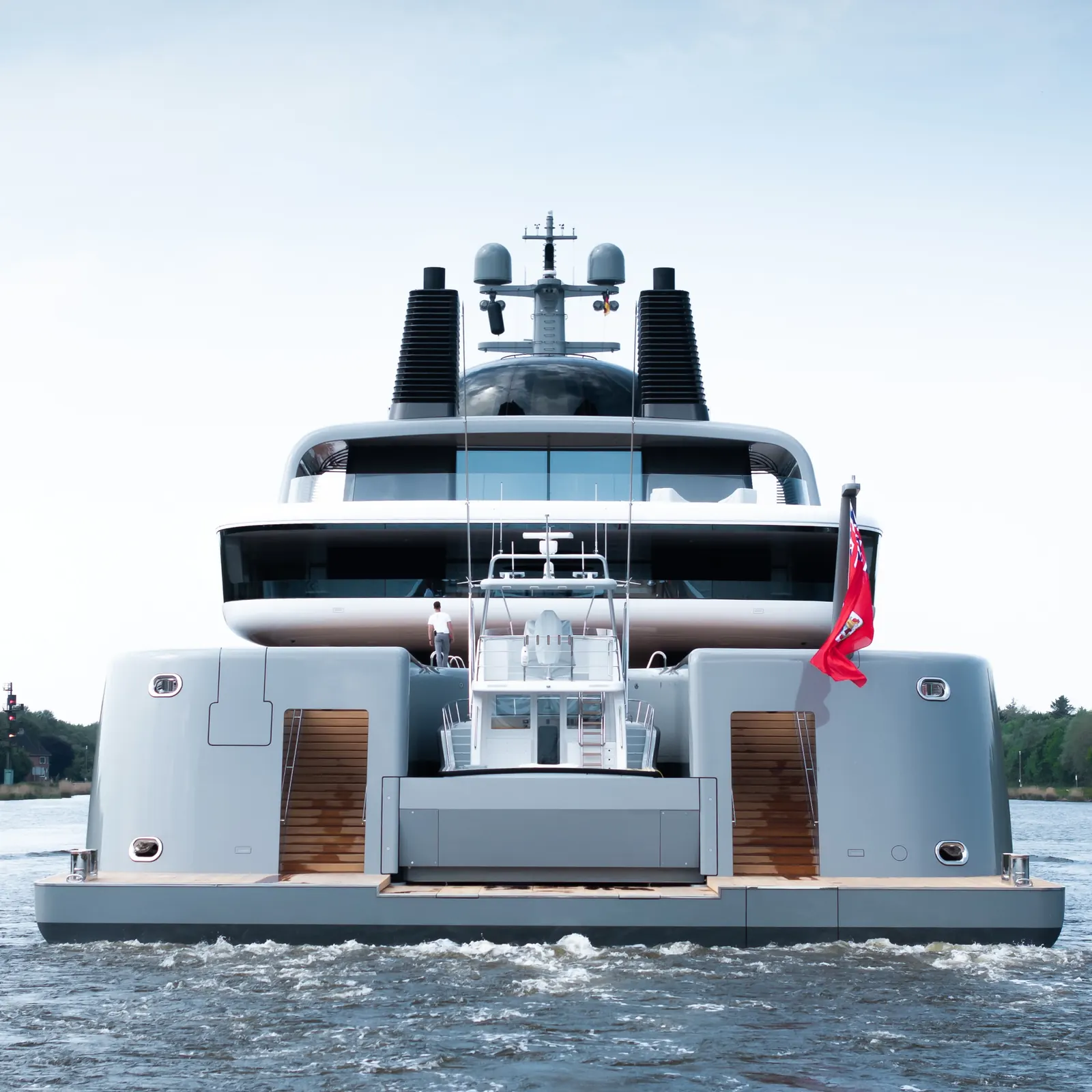
The 18-metre-wide open aft deck spans the yacht’s full beam and is anchored by a pool deep enough for diving and a Jacuzzi flanked by seating. Behind it sits a large dry dock for Nausicaä’s 12.5-metre sportfish tender, served by a bespoke 16-tonne sledge system that extends over the swim platform to launch and retrieve the boat. When the tender is deployed, the tracks retract completely, converting the well into a teak-lined al fresco guest area — with a flat hydraulic beam available to close the space off entirely.
Nausicaä is Lürssen’s fourth delivery of 2026, following the 134-metre Deep Blue, the 117-metre Boardwalk and the 78-metre Odisea. Her arrival during the shipyard’s 150th anniversary year prompted Peter Lürssen to draw a direct line from Friedrich Lürssen’s construction of the world’s first motorboat in 1886 to the vessel now departing Rendsburg. The name itself carries its own knowing charge: Nausicaä translates literally from Ancient Greek as “burner of ships” — an audacious title for the most quietly radical yacht to leave Lürssen in years.
Stay ahead of the latest releases. Subscribe to our newsletter for editor-curated coverage of luxury timepieces across the GCC.
Frequently Asked Questions
What are the key dimensions of the superyacht Nausicaä?
Nausicaä measures 114.2 metres (375 feet) in length overall, with an 18.7-metre beam and approximately 6,300 gross tonnes. She has six decks, a steel displacement hull reinforced to Ice Class 1D, and an aluminium superstructure.
Who designed the Nausicaä superyacht, inside and out?
Australian industrial designer Marc Newson was responsible for every aspect of Nausicaä's design, covering both the exterior styling and all interior spaces and furnishings. Naval architecture was handled by Lürssen.
What propulsion system does Nausicaä use?
Nausicaä is powered by a diesel-electric system based on MTU 16V4000 engines, and also carries a pioneering methanol fuel-cell installation that converts methanol into hydrogen to generate onboard electricity — a first for Lürssen.
When was Nausicaä delivered and where was she built?
Nausicaä was delivered on 23 May 2026, having been launched in August 2025 at Lürssen's Rendsburg shipyard. Her keel was laid on 7 March 2022, with design work beginning six years before delivery.
What is the Skydome on Nausicaä?
The Skydome is a 56-square-metre private owner's study formed from seven curved glass panes, each measuring roughly 3m × 2.8m, 62mm thick and weighing 1,050kg. Each pane was hot-bent using gravity alone to achieve its precise curvature, and the space opens onto a private sky terrace.
Nausicaä joins an exceptional generation of record-setting yachts: revisit Oceanco’s Aquijo, the world’s largest ketch, and browse more landmark launches across our yachts and jets coverage.