
Key Highlights
- More than 125 unique pieces and 85,000 hours of artisan work define this first chapter of Le Chœur des Pierres
- The Panthère Kentia necklace centres on a 50.13-carat cabochon-cut Ceylon sapphire, framed by a three-dimensional panther sculpture
- Eight exceptional rings anchor the collection, each built around a singular gemstone, from a 20.24-carat Colombian emerald to Argyle pink diamonds
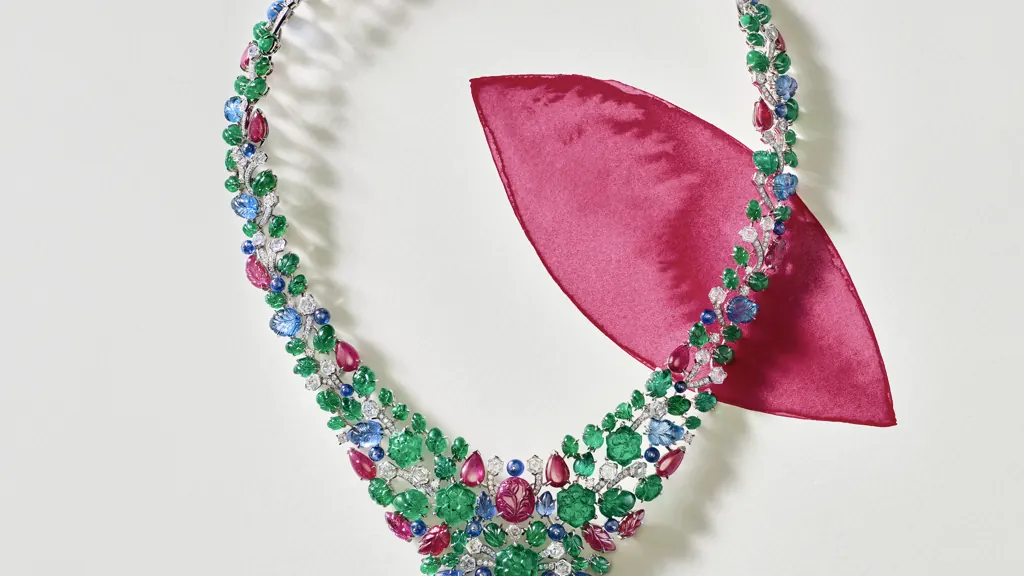
- The Tutti Kanya necklace renews Cartier’s Tutti Frutti style with a 30.33-carat engraved Zambian emerald and carved gemstone florals
- Every piece originates from the stone: its colour, cut, and character drive design, not the reverse
A Collection Named for Harmony
The title Le Chœur des Pierres carries deliberate ambiguity in French: chœur, meaning chorus, and its homophone cœur, meaning heart. Both words, according to Pierre Rainero, Director of Image, Style and Heritage, describe how Cartier selects and elevates gemstones, drawing on each stone’s essence to reveal its singular character. This philosophical clarity shapes the entire collection, which spans necklaces, rings, earrings, brooches, and hair jewels across more than 125 unique pieces. The first chapter required over 85,000 hours of work from stone experts, jewellers, lapidaries, gem-setters, and polishers working in unison. From the first stroke of the pencil, the designer maintains a continuous dialogue with every artisan, a reciprocal understanding that allows each piece to reach its full potential. The result is a body of work in which the stone is never subordinate to the setting; it commands it.
The Necklaces: Architecture in Motion
The Panthère Kentia necklace is the most emblematic expression of this principle. A 50.13-carat cabochon-cut Ceylon sapphire anchors the composition, its organic form set against the necklace’s geometric lines. Wave-like three-dimensional motifs with botanical accents extend toward the outer edge, each ending in a small sapphire cabochon. The panther herself, rendered as a three-dimensional sculpture with emerald eyes and custom-cut onyx markings, balances the tension between curve and graphic line. The necklace is fully articulated, a technical demand driven by wearability rather than spectacle alone.
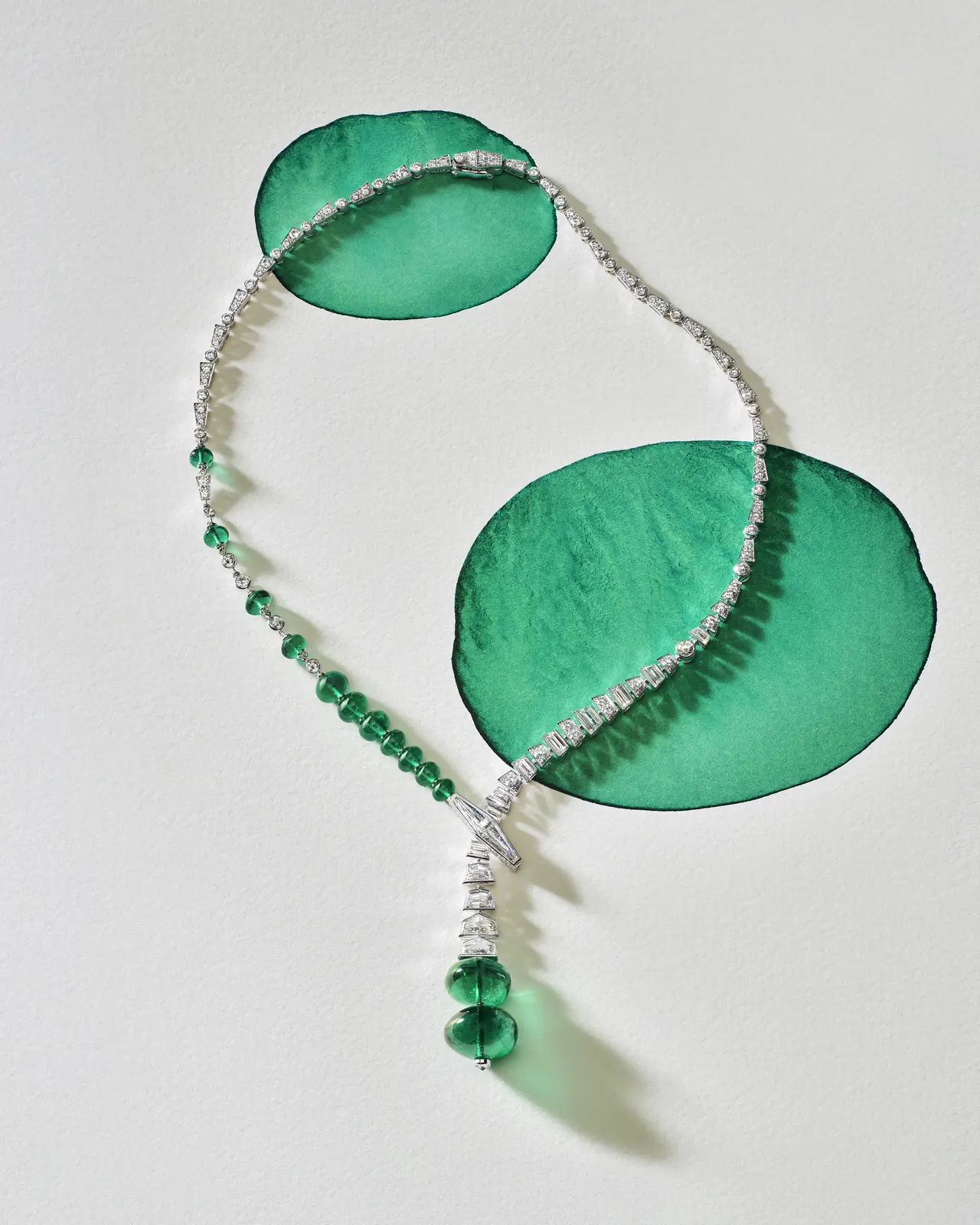
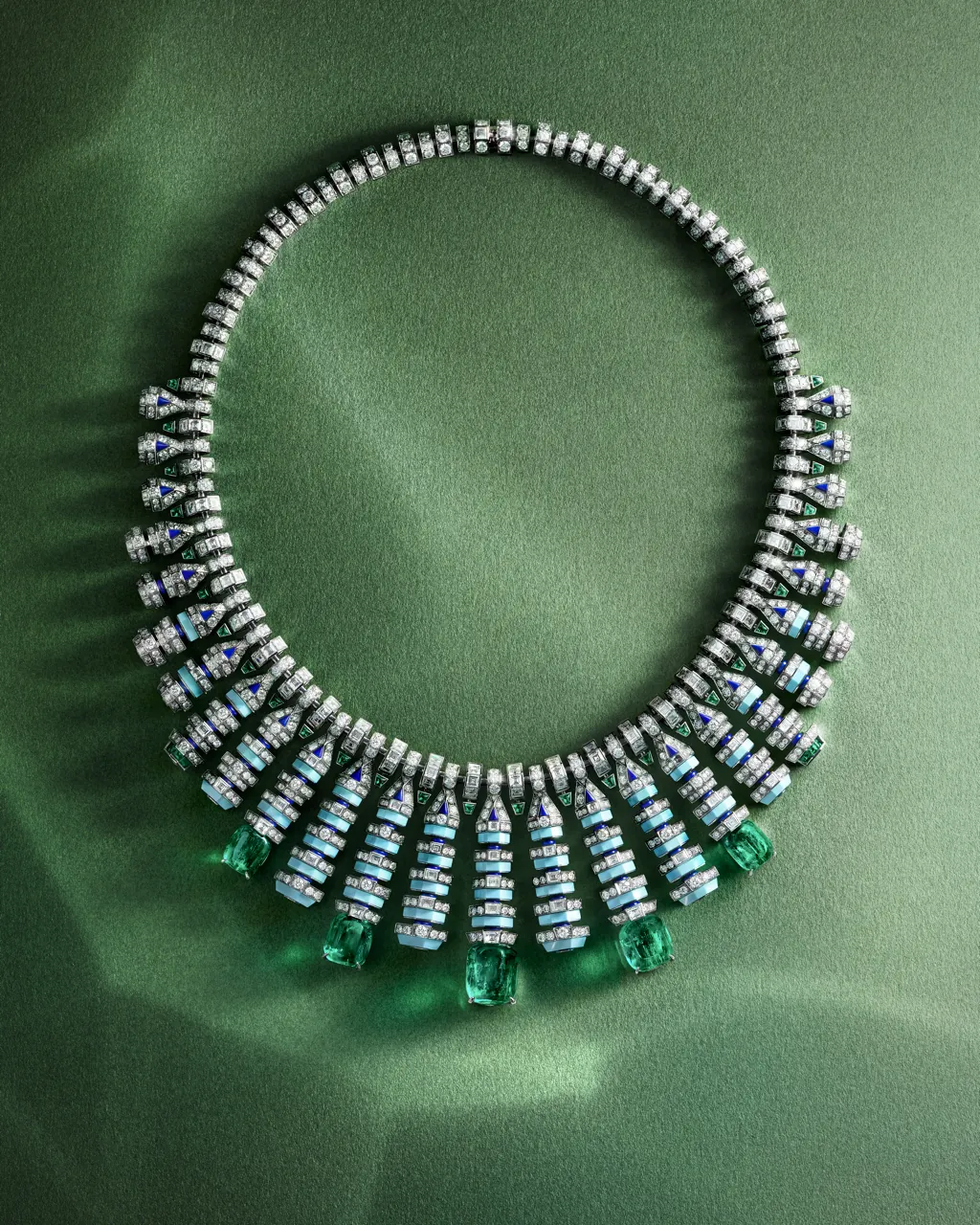
The Olorra necklace draws its structure from five Colombian emeralds totalling 40.67 carats, their intensity determining a radial architecture of custom-cut turquoise, lapis lazuli, and diamonds. Solenara, by contrast, achieves fluidity through restraint: two asymmetrically placed emeralds in dialogue with diamonds, their organic roundness offset by geometric precision. Tellura narrates geological time, with 30 diamonds of unique shapes suspended from motifs conceived in collaboration with master jewellers, creating an impression of continuous movement. The Tutti Kanya necklace, whose 30.33-carat Zambian engraved emerald anchors an efflorescence of ruby, sapphire, and emerald carvings, renews the Tutti Frutti vocabulary that Cartier has carried since the mid-1920s. Made using the stringing technique, the main motif converts to a brooch; the underside of the necklace reveals a precious metal tree visible only to the wearer.
Eight Rings, Eight Singular Stones
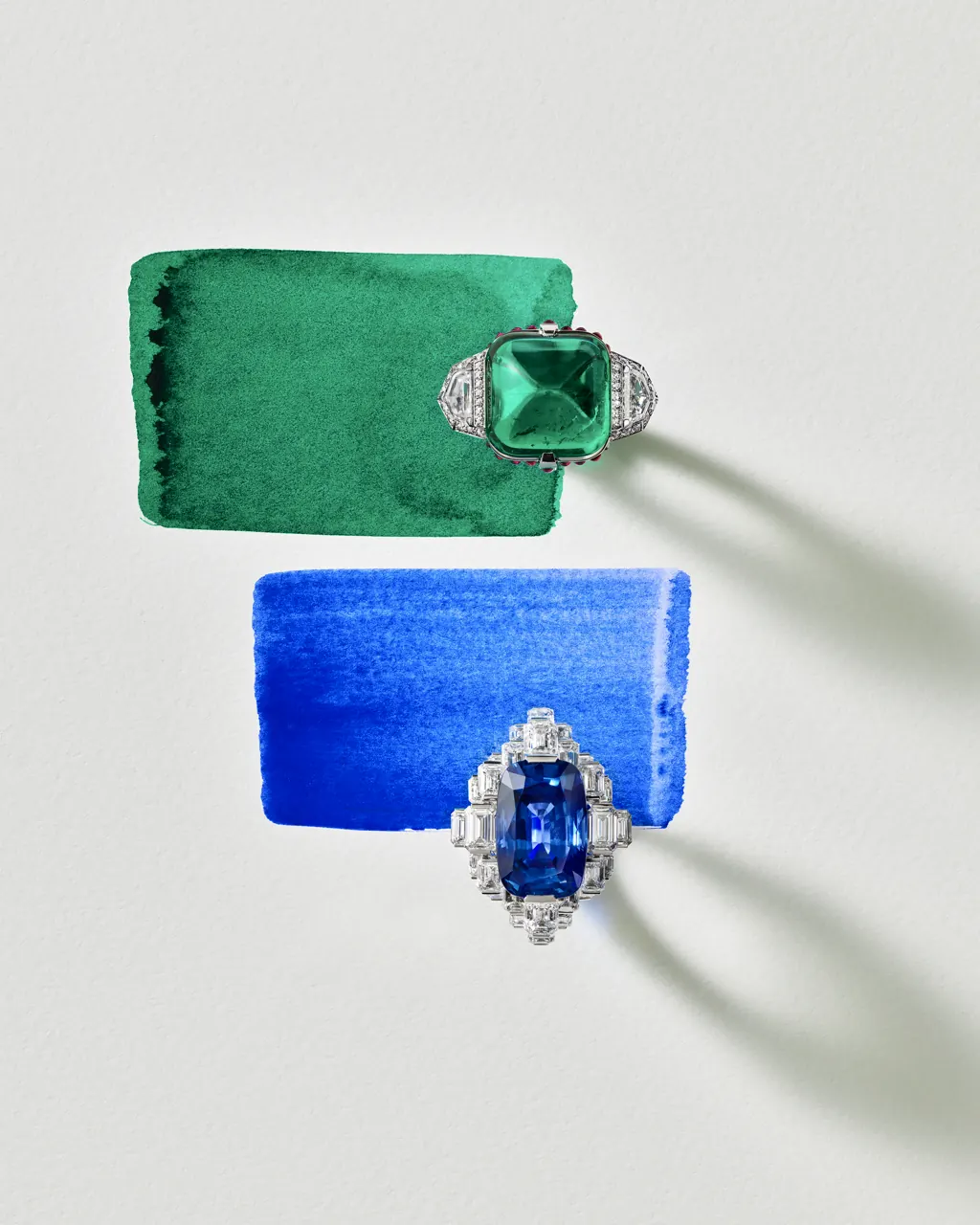
The ring section of Le Chœur des Pierres comprises eight pieces, each conceived for a single exceptional stone. Tetraya frames a 20.24-carat sugarloaf-cut Colombian emerald with modified shield-cut diamonds and a border of 18 calibre-cut rubies, the green-and-red pairing that has belonged to Cartier’s repertoire for over a century. Stratelia celebrates a 23.35-carat Madagascan cushion-cut sapphire through a faceted architecture of emerald-cut diamonds arranged across multiple levels, the sapphire’s exposed pavilion creating an impression of weightlessness. Tesselia builds a platinum composition around a 5.24-carat Mozambican ruby, its setting unfolding like a corolla with openwork cushion-cut diamond petals. Keona is designed entirely around an 11.60-carat diamond of exceptional colour rarity, the structure custom-made to fit the stone’s elongated oval shape.
Specula offers something unexpected: a modular Toi & Moi in which two triangular diamonds totalling 6.44 carats can be worn in two distinct orientations, the larger ring composed of two smaller ones. Amberis centres a certified 7.09-carat cognac-coloured diamond, among the rarest coloured diamonds in existence, on a shank entirely set with brown diamond cabochons and white diamond lines. The Auralis ring honours six pear-shaped pink diamonds from the now-closed Argyle mine in Australia, totalling 1.42 carats. Kinkō interprets the classic Toi & Moi for two alexandrite-type gems, one green-blue at 1.11 carats and one green at 0.42 carats, a tribute to the peacock motif that Louis Cartier claimed as a stylistic signature. For collectors in the Middle East drawn to Van Cleef & Arpels or Harry Winston as reference points in haute joaillerie, these eight pieces demonstrate how Cartier’s gemstone-led methodology produces results that are architecturally distinct from any competitor.
Why It Matters
In a market as discerning as the Middle East, where collectors seek jewellery that carries both narrative depth and technical rarity, Le Chœur des Pierres arrives as a considered statement. Each of its 125-plus pieces is unique; no stone is repeated, no composition replicated. For a full exploration of Cartier’s parallel necklace vocabulary, the Haryana necklace offers an illuminating companion reference. Explore the full collection at Cartier‘s official channel for availability in the region.
Stay ahead of the latest releases. Subscribe to our newsletter for editor-curated coverage of luxury timepieces across the Middle East.
Frequently Asked Questions
What is Le Chœur des Pierres and how many pieces does it include?
Le Chœur des Pierres is Cartier’s high jewellery collection comprising more than 125 unique pieces across necklaces, rings, earrings, brooches, and hair jewels. The first chapter required over 85,000 hours of artisan work from stone experts, jewellers, lapidaries, gem-setters, and polishers.
What is the Panthère Kentia necklace and what stone does it feature?
The Panthère Kentia necklace is anchored by a 50.13-carat cabochon-cut Ceylon sapphire, framed by a three-dimensional panther sculpture with emerald eyes and custom-cut onyx markings. Wave-like three-dimensional motifs with botanical accents extend toward the outer edge, each ending in a small sapphire cabochon.
What is the Tutti Kanya necklace and which Cartier heritage does it reference?
The Tutti Kanya necklace features a 30.33-carat engraved Zambian emerald surrounded by ruby, sapphire, and emerald carvings, renewing the Tutti Frutti vocabulary that Cartier has carried since the mid-1920s. The main motif converts to a brooch, and the underside reveals a precious metal tree visible only to the wearer.