Editorial Take
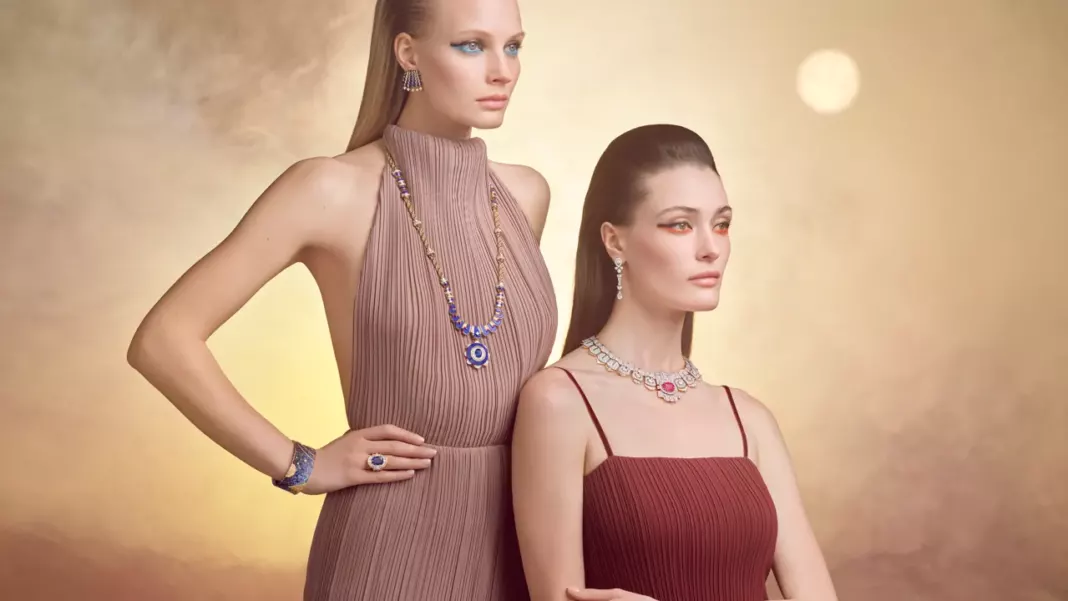
- Approximately 180 high jewellery pieces spanning clips, necklaces, bracelets, rings, earrings and a table clock.
- The Traditional Mystery Set technique, patented by Van Cleef & Arpels in 1933, appears throughout the collection.
- Centre stones include a 10.02-carat cushion-cut Fancy Vivid Yellow diamond and a 14.05-carat pear-shaped DFL Type 2A diamond.
- Each piece bears a cartouche in hieroglyphics reproducing the Van Cleef & Arpels monogram.
- The collection draws directly on Egyptian-motif archive pieces from 1923 and 1924, held in the Maison’s patrimonial Collection.
- The Paysage secret bracelet conceals a hieroglyphic message reading “horizon of eternity”.
A Closer Look
Fascinating Egypt is not a theme casually applied to precious metal. It is the culmination of a relationship that began the moment Howard Carter broke through the sealed doorway of Tutankhamun’s tomb in November 1922. Within months, Van Cleef & Arpels had incorporated Egyptian motifs into cuff bracelets, brooches and long necklaces. The patrimonial Collection retains some ten pieces from 1923 and 1924 alone. The 2026 collection, comprising around 180 works, is the most expansive return to that territory the Maison has ever mounted.
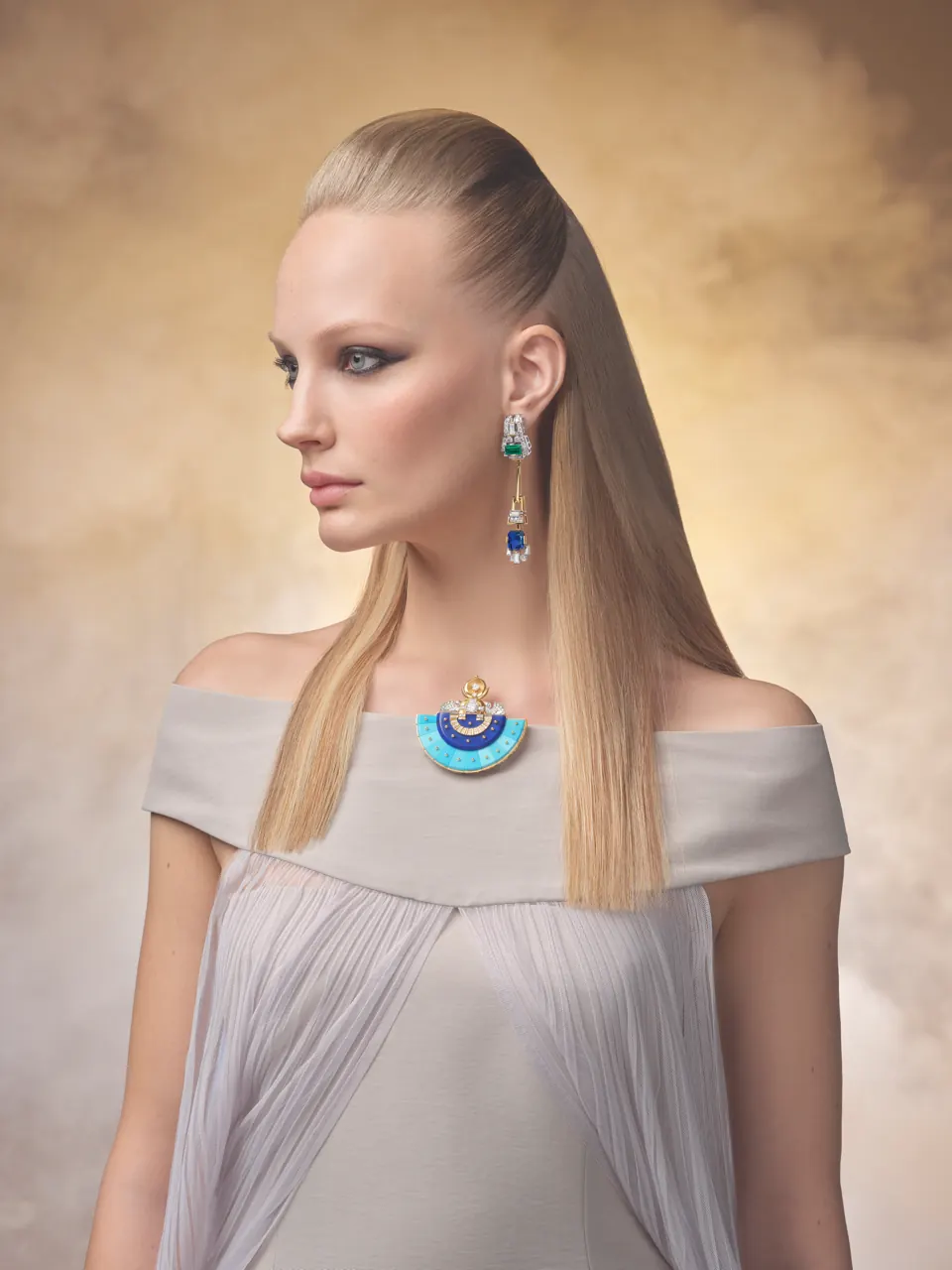
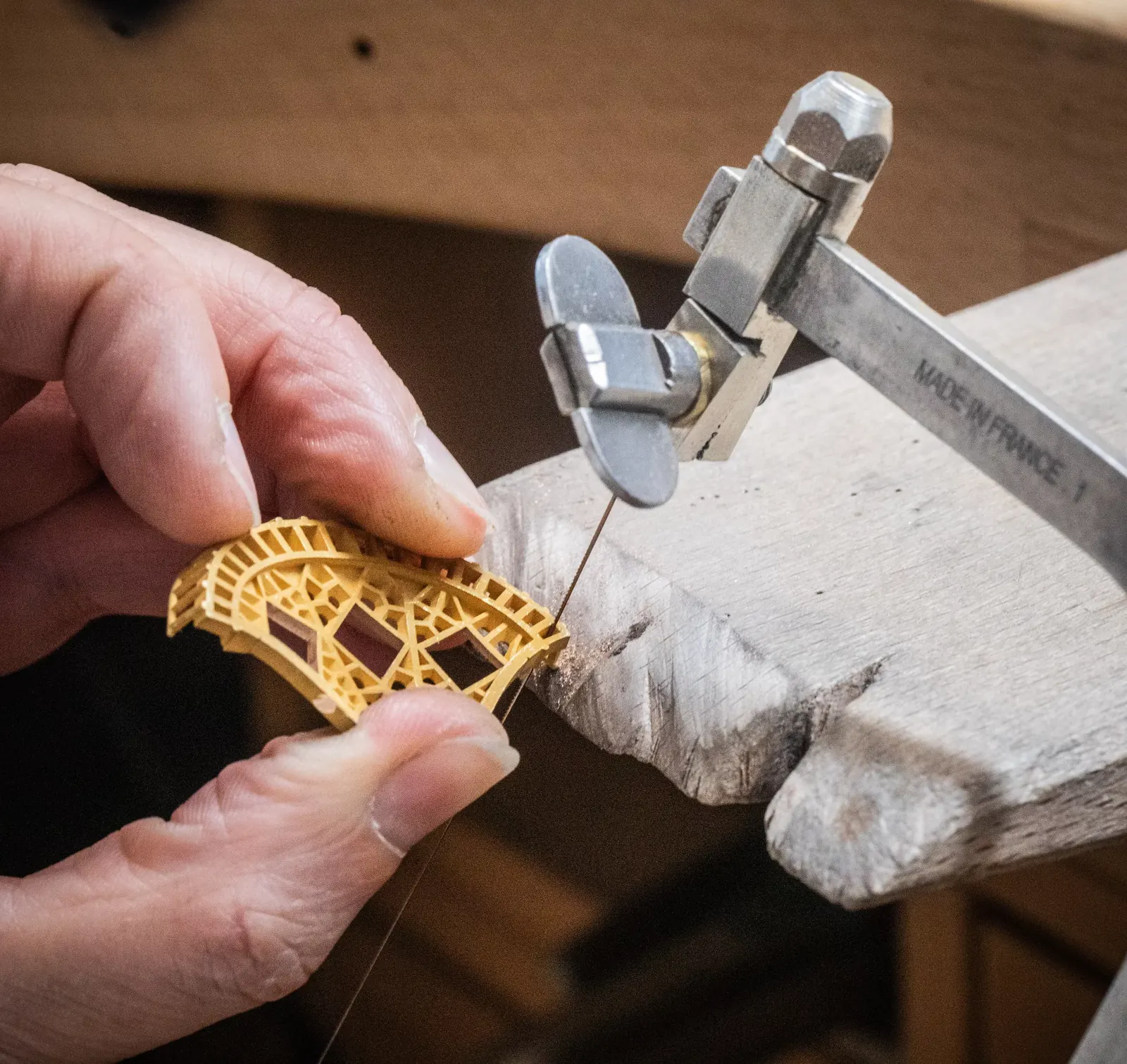
The collection’s scope runs from sculptural mythological clips to a Nuit étoilée table clock whose lapis lazuli panels were individually cut, pierced and set with gold stars. Every discipline in the Maison’s craft vocabulary is engaged: engraving, hammering, gadrooning, snow-setting, sugarloaf cutting and, above all, the Traditional Mystery Set. That technique, patented in 1933, remains the clearest signature across the collection.
The Mystery Set at the Heart of the Work
The Traditional Mystery Set conceals the gold armature entirely beneath the stone surface. On the Fleur de lotus Mystérieuse clip, three lotus flowers rendered in profile combine baguette-cut rubies in Mystery Set with round and baguette-cut diamonds, while mirror-polished metal at the base of the corollas introduces deliberate textural contrast. The Déesse ailée Mystérieuse necklace, which transforms into a ring, uses Mystery Set rubies alongside snow-set diamonds and polished rose gold rays to model the spread wings of an Egyptian deity in three dimensions. Its principal stone, a pear-shaped DFL Type 2A diamond weighing 14.05 carats, is raised on a bezel so that it sits above the surrounding composition.
The Bastet Mystérieuse clip applies the technique to buff-topped emeralds covering the bust and headdress of the cat-headed goddess, where it is complemented by coral, lapis lazuli, turquoise, sapphires and rubies. The Bénou Mystérieux clip pairs Mystery Set emeralds with a 2.63-carat pear-shaped DIF diamond on one wing of the Bennu bird, while a 4.08-carat oval spessartite garnet and an intense red spinel animate the body. These are not decorative flourishes; they are demonstrations of the technique operating at its highest degree of complexity.
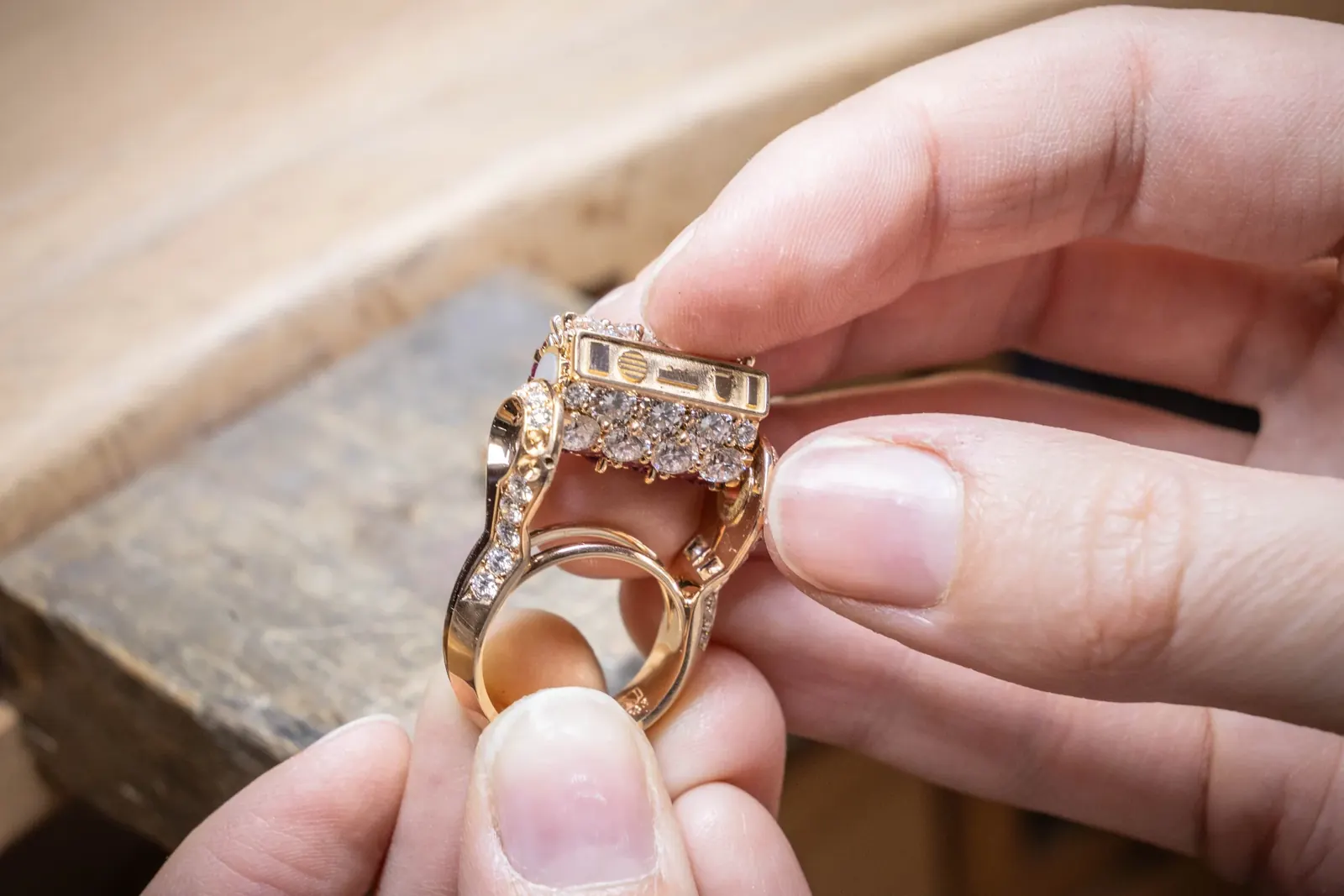
Gem Selection and Craft Execution
The gem palette is built on contrast rather than uniformity. Thirty-seven pear-shaped Zambian emeralds totalling 41.58 carats cascade across the Rivage égyptien necklace, their characteristic crystallisation chosen to suggest the luminosity of water, papyrus and birds in relief. The Narration précieuse necklace anchors a 6.73-carat Sri Lankan sapphire, a 5.66-carat Colombian emerald and a 2.16-carat Mozambican ruby within a fully articulated yellow gold mosaic of gadroons. The Origine de l’eau, Origine florale and Origine du soleil rings present an 8.71-carat Sri Lankan sapphire, an 8.02-carat Colombian emerald and a 5.04-carat Mozambican ruby respectively, each in a cushion cut that maximises colour saturation.
In craft terms, several stones were recut in-house to fit specific settings. The Paysage bracelets, whose articulated structures recall the Egyptian-style cuff bracelets of the 1920s, required rubies, emeralds, sapphires, spinels, garnets, onyx and diamonds to be individually selected for shade and then recut to form continuous pictorial frescos. Readers familiar with earlier Van Cleef & Arpels transformable jewellery, such as the Lady Rencontre Celeste and the Ludo Secret, will recognise a consistent ambition to make every technical constraint a visible part of the aesthetic.
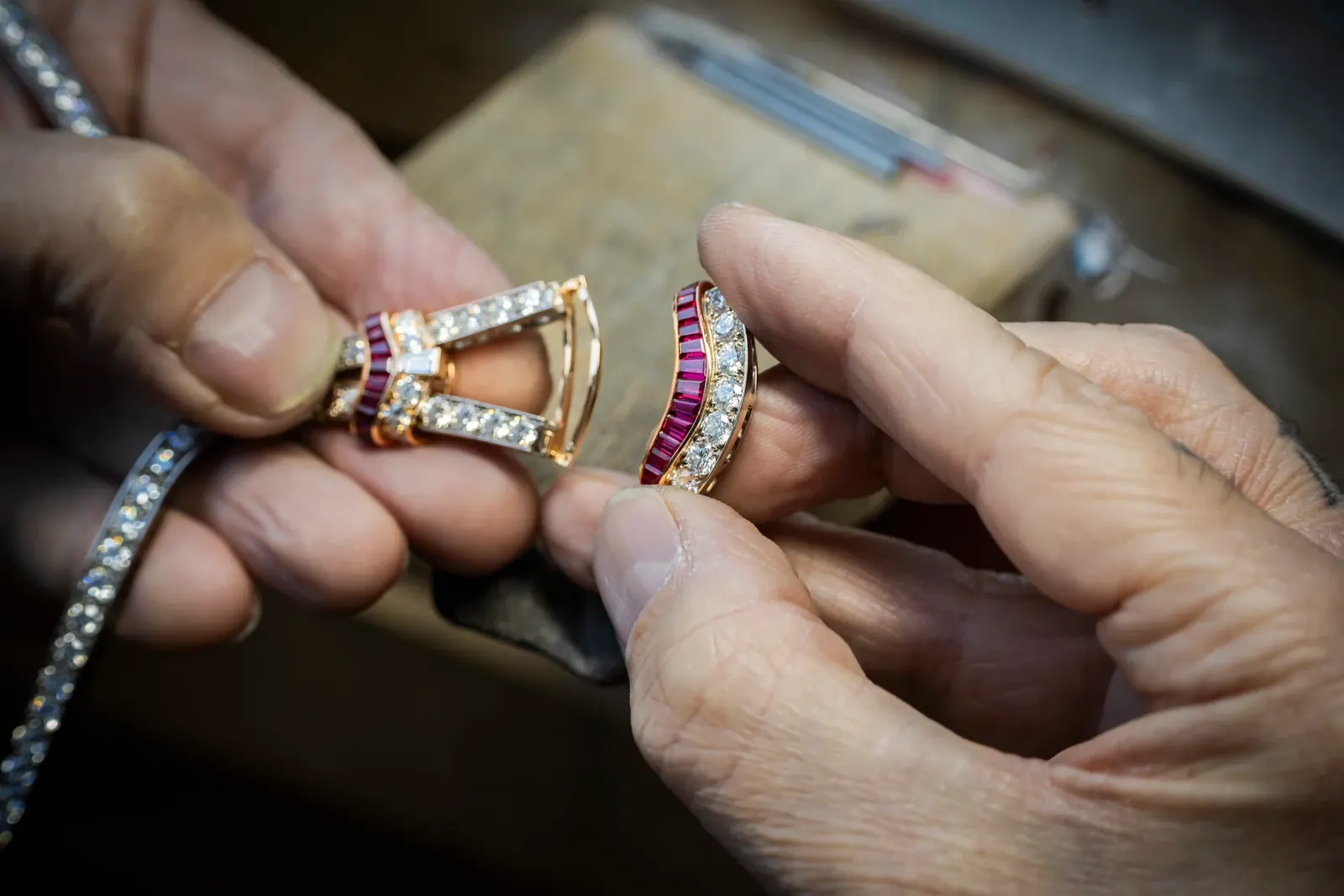
A Century of Engagement Made Visible
The Maison’s ties with Egypt extend beyond artistic inspiration. In 1939, Van Cleef & Arpels created a diadem, necklace and earring set for the wedding of Princess Fawzia of Egypt, alongside a diamond necklace for Queen Nazli. A 1929 Collaret necklace that passed through the collection of Princess Faiza directly informs the Princesse du Nil necklace created for Fascinating Egypt, which echoes its emerald teardrops and baguette-cut diamond pendeloques with contemporary geometry. The cartouche in hieroglyphics that hallmarks every piece in the 2026 collection is the final codification of that lineage.
As a statement of what haute joaillerie demands in terms of time, material intelligence and accumulated institutional knowledge, Fascinating Egypt is precise in its argument. The Van Cleef & Arpels official press resource provides full technical specifications for each creation.
Stay ahead of the latest releases. Subscribe to our newsletter for editor-curated coverage of luxury timepieces across the Middle East.
Frequently Asked Questions
How many pieces does the Van Cleef & Arpels Fascinating Egypt collection comprise?
The Fascinating Egypt High Jewellery collection comprises approximately 180 pieces, spanning abstract and figurative creations including clips, necklaces, bracelets, rings, earrings and a table clock.
What is the Mystery Set technique used in the Fascinating Egypt collection?
The Mystery Set is a technique patented by Van Cleef & Arpels in 1933. It allows precious stones to be set in such a way that the gold setting disappears entirely beneath the gems, giving the surface a velvety, uninterrupted appearance.
What is the centrepiece stone of the Beauté légendaire necklace?
The Beauté légendaire necklace is centred on a cushion-cut Fancy Vivid Yellow diamond weighing 10.02 carats, held in a six-pronged bezel above a fully flexible diamond-set breastplate.
What connection does Van Cleef & Arpels have with Egyptian royalty?
In 1939, Van Cleef & Arpels created a jewellery set for the wedding of Princess Fawzia of Egypt and a separate diamond necklace for Queen Nazli of Egypt. The Maison also held a double Peony clip once owned by Princess Faiza, which has since entered its patrimonial Collection.
Where is Van Cleef & Arpels based, and when was the Maison founded?
Van Cleef & Arpels is a Paris-based haute joaillerie house founded in 1906, at a moment when renewed European interest in Egyptian heritage was already shaping the decorative arts.