
Key Highlights
- Final edition of 25 pieces: the UR-10 SpaceMeter Blue closes URWERK’s “10” collection permanently
- Three subdials measuring Earth’s rotation, solar orbit, and their combined trajectory — not the time of day
- Calibre UR-10.01 with patented Dual Flow Turbine, two counter-rotating propellers, 43-hour power reserve
- Sandblasted titanium case, 45.40 mm × 44 mm × 7.13 mm, ADL-treated blue dial
- Priced at CHF 70,000 excl. tax; upon leaving production it enters URWERK‘s permanent “The Legends” archive

An Instrument of Cosmic Awareness
URWERK has always positioned its creations outside the conventions of civil timekeeping. The UR-10 SpaceMeter, in each of its iterations, has been the purest expression of that ambition — an object that measures not minutes but kilometres, not hours but orbital distances. With the Blue Final Edition, the Geneva and Zurich-based independent manufacture closes the collection at precisely the right moment: when the idea has reached its fullest density. Twenty-five pieces. No continuation.
The round dial is deliberately disarming. At first glance it reads as almost classical — a shape that offers momentary reassurance to the uninitiated before the function draws the eye toward three subdials whose logic belongs to astrophysics as much as horology. This tension between familiar form and radical content has always been the UR-10’s subversive currency, and the blue dial of this final edition intensifies it. The colour places the watch in its natural setting: the cosmos itself.
Reading Space, Not Time
The three counters on the dial face perform distinct and rigorously specific functions. At 2 o’clock, the EARTH counter measures every 10 km the planet travels in its daily axial rotation, graduated in 500 m increments. At 4 o’clock, the SUN counter records every 1,000 km of Earth’s solar orbit in 20 km steps. At 9 o’clock, the ORBIT counter brings both trajectories together on two synchronised concentric scales, expressing 1,000 km of rotation and 64,000 km of solar revolution simultaneously. Hours and minutes remain on the main dial, but they are almost peripheral to the experience.
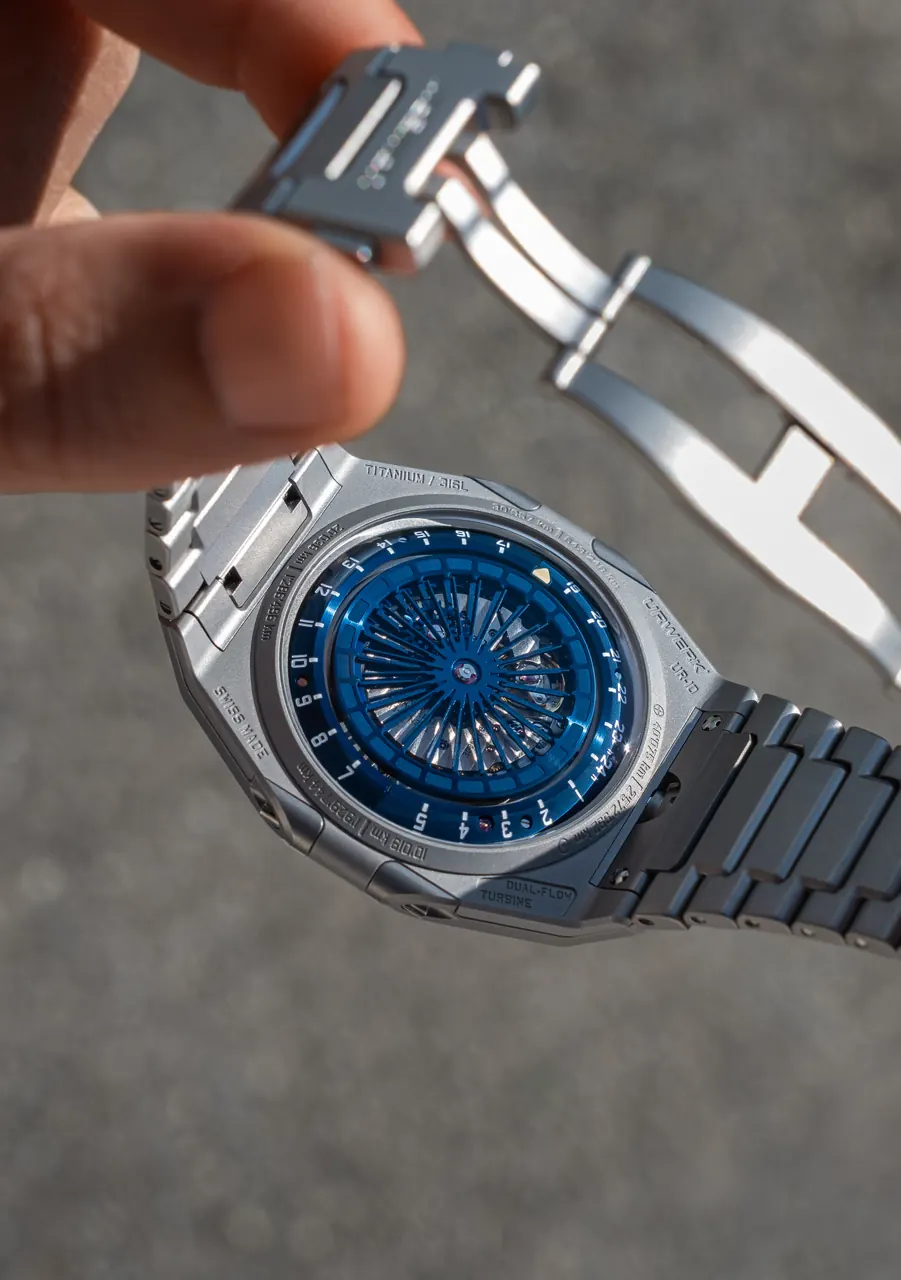
The caseback deepens this reading. A peripheral hand traces the hours on a 24-hour scale representing one complete axial rotation. Engraved pictograms mark “Rotation” — read clockwise — and “Revolution” — interpreted counter-clockwise. Three physical realities are thus encoded across both faces: the Earth spinning on its axis, the Earth circling the Sun, and the human convention of civil time. URWERK co-founder and artistic director Martin Frei frames it precisely: “Time is not something we observe. It is something we inhabit.”
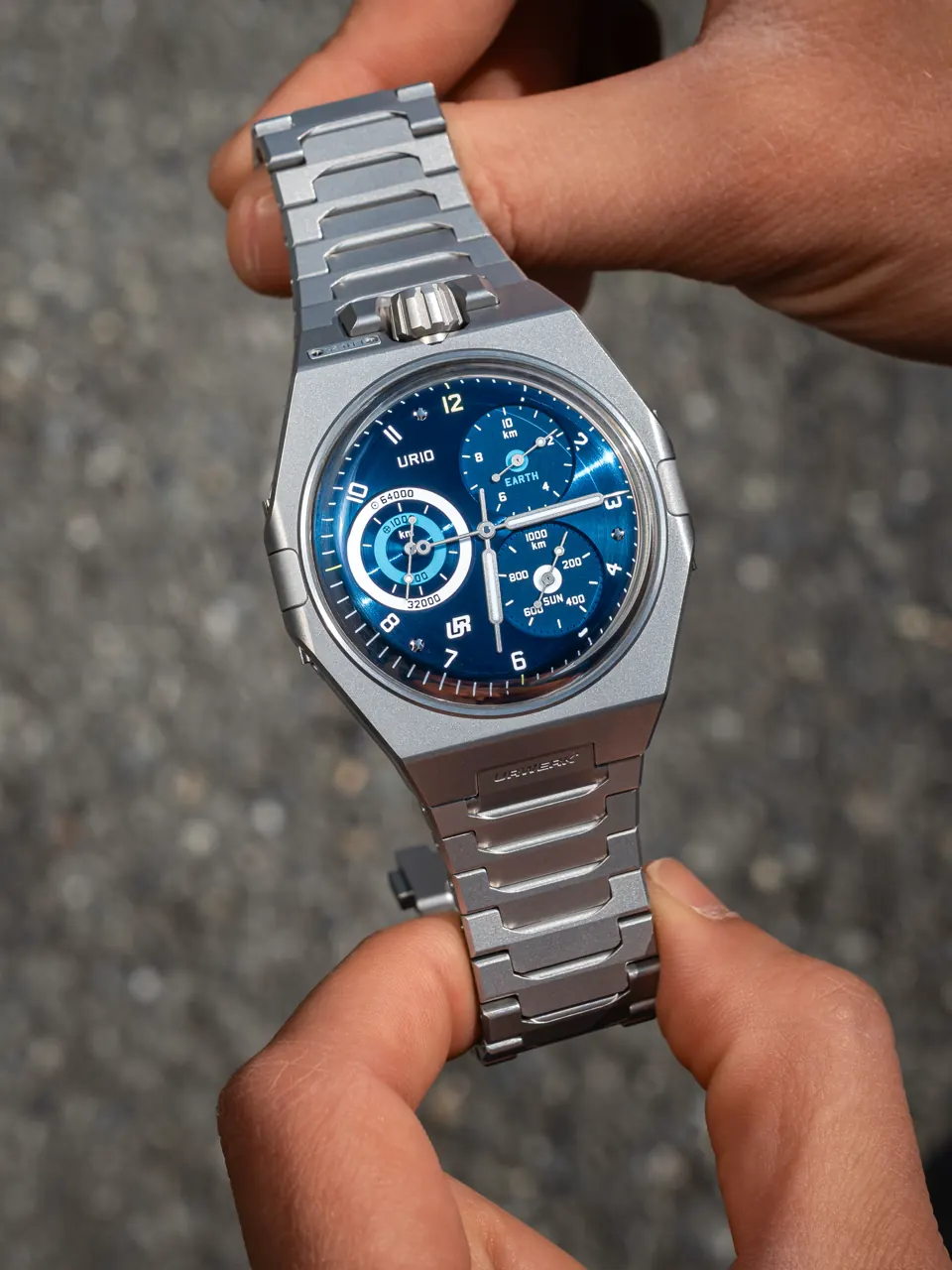
Calibre UR-10.01 and the Dual Flow Turbine
The movement is Calibre UR-10.01, self-winding, running at 4 Hz (28,800 vph) with 44 jewels and a 43-hour power reserve. Its most distinctive mechanical feature is the Dual Flow Turbine — a patented evolution of URWERK’s one-way winding system. Two propellers, stacked and contra-rotating, address a specific engineering problem: when a standard self-winding rotor spins against its winding direction, the high rotational speed places strain on the mechanism. The double turbine generates airflow between the two blade sets, decelerating them and protecting the system. The result is both technically sound and visually arresting — a hypnotic mechanical spectacle visible through the exhibition crystal. Case dimensions are 45.40 mm wide, 44 mm long, and a remarkably contained 7.13 mm thick, executed in sandblasted titanium with a sandblasted steel caseback and glare-proofed box sapphire crystals.
A Heritage Passed from Father to Son
The intellectual lineage of the UR-10 is traceable to a specific object: an antique clock by Gustave Sandoz featuring three astronomical dials, discovered and restored by Gérard Baumgartner — father of URWERK co-founder Felix Baumgartner. That clock, passed from one generation to the next, became the conceptual seed from which the UR-10’s three-counter architecture grew. URWERK’s founding philosophy — that mechanics serve an idea rather than decorate a dial — is nowhere more legible than here. The blue final edition honours that lineage directly, the colour a considered editorial choice that returns the piece to its conceptual home. (For further context on the broader landscape of independent watchmaking releases this season, see coverage from Watches and Wonders.)
Why It Matters
For collectors in the GCC who engage with contemporary independent watchmaking at its most conceptually rigorous, the UR-10 SpaceMeter Blue Final Edition is a singular acquisition: 25 pieces closing a collection that, per URWERK’s own practice, passes directly into “The Legends” archive and will never return to production. At CHF 70,000, it occupies a considered position within the independent market — and for a buyer who wishes to hold, not merely own, an object of lasting horological consequence, the finality here is the point. See the official URWERK website for further details.

Discover the watches shaping the GCC market. Join our mailing list for ongoing reviews, releases, and collector insights.
Frequently Asked Questions
What do the three subdials on the UR-10 SpaceMeter Blue measure?
The EARTH counter at 2 o’clock measures the planet’s daily axial rotation in 500 m increments, the SUN counter at 4 o’clock records Earth’s solar orbit in 20 km steps, and the ORBIT counter at 9 o’clock combines both trajectories on synchronised concentric scales.
How many pieces of the UR-10 SpaceMeter Blue will be produced?
This final edition is limited to exactly 25 pieces, after which URWERK closes the UR-10 collection permanently and archives the watch in its “The Legends” collection.
What is the Dual Flow Turbine and why does the UR-10 use it?
The Dual Flow Turbine is a patented two-propeller self-winding system with contra-rotating blades that generate airflow to decelerate the rotors and protect the mechanism from strain, while creating a visually distinctive mechanical display through the exhibition crystal.