Key Highlights
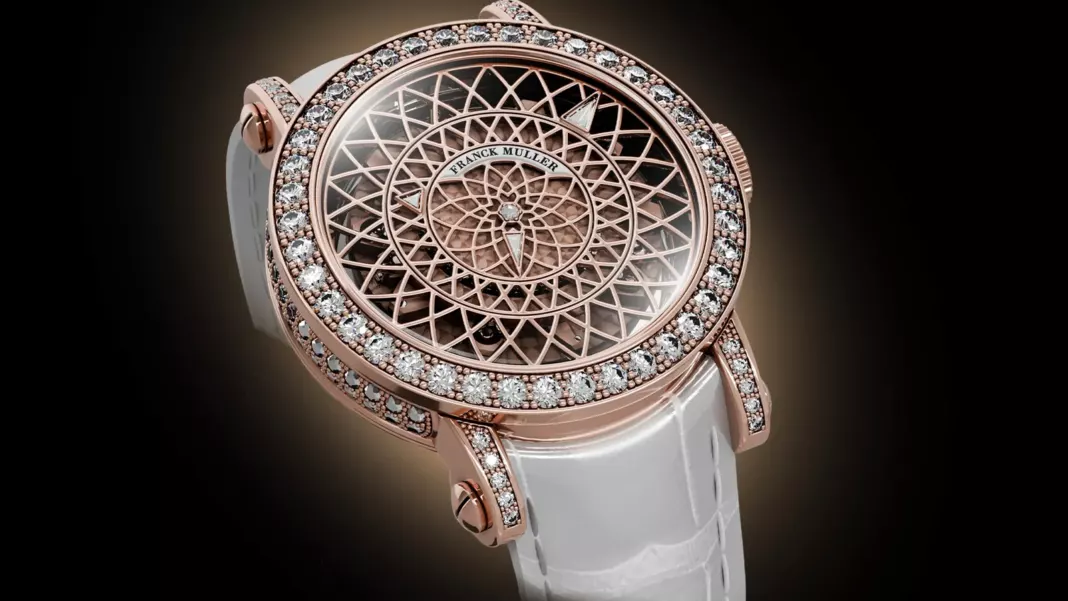
- Three independent rotating discs display hours, minutes, and seconds — no conventional hands
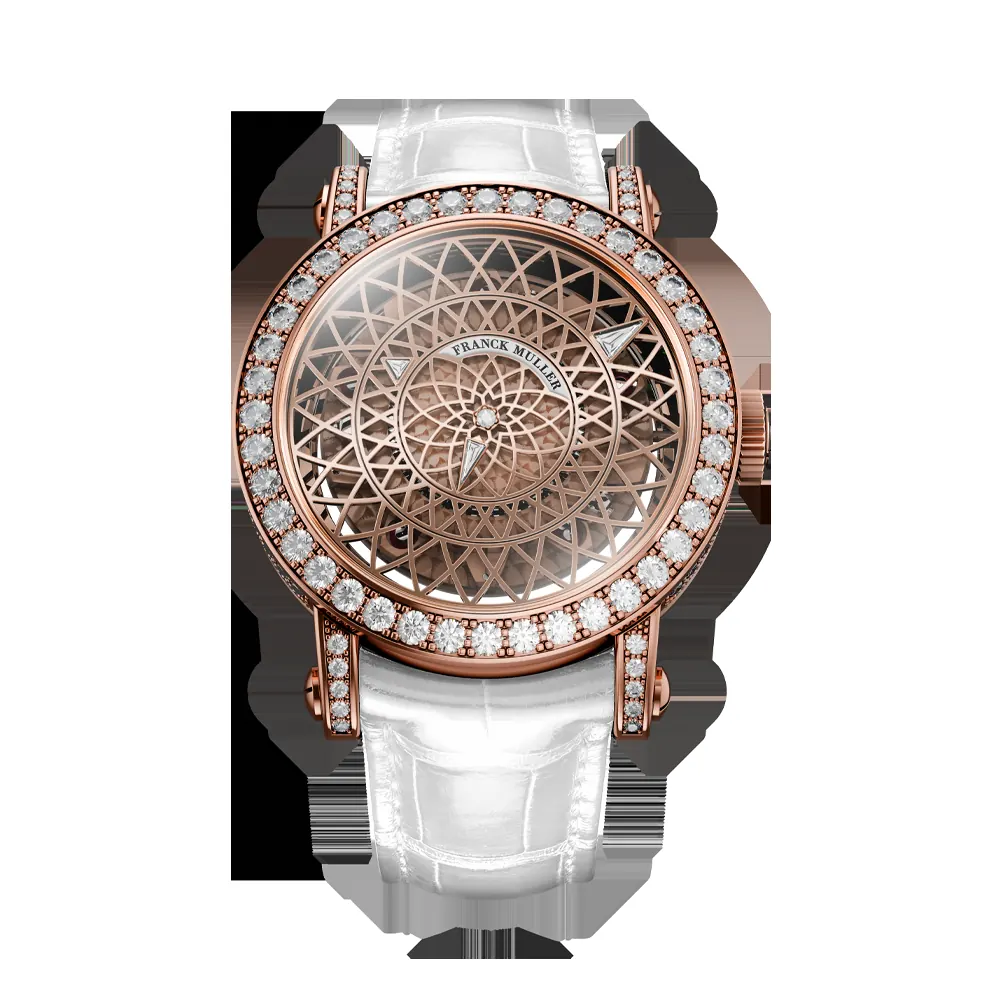
- 36 mm round case in 18K rose gold, entirely set by hand with 3.63 carats of brilliant-cut diamonds
- Skeletonised rose gold central plate with bridges measuring just 0.3 mm in width
- 217 components; automatic movement engineered to drive three discs with independent precision
- Open-heart architecture exposes every gear, lever, and bridge as a visible mechanical composition
- Designed, assembled, and finished at Watchland manufacture in Genthod, Geneva
Editorial Take
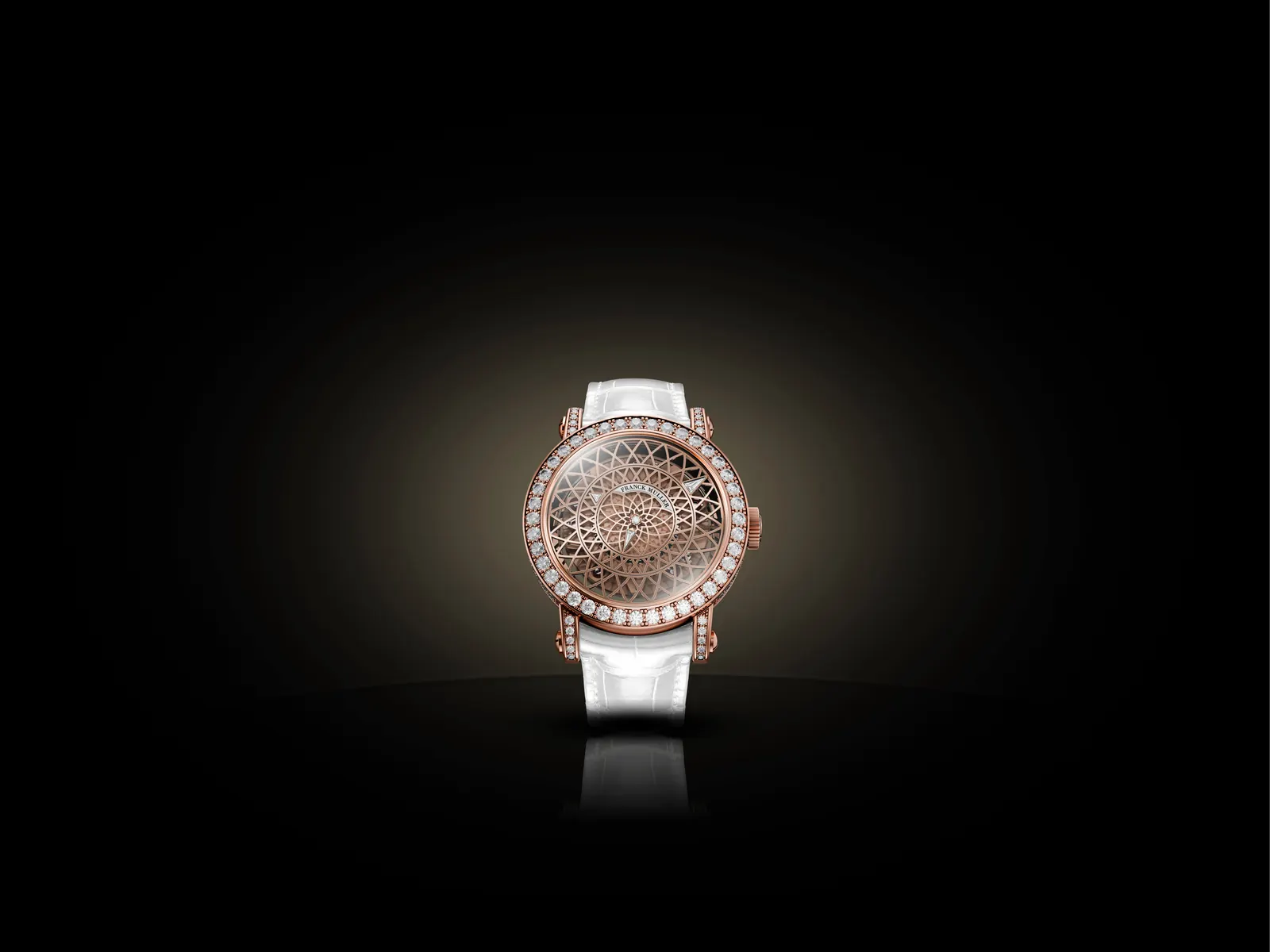
Reference 7036 TM SQT D 1R marks the point at which Franck Muller’s Mystery concept reaches its logical and most technically demanding conclusion. Where the original Mystery replaced the hour hand with a single rotating disc, and the Double Mystery added a minute disc, the Round Triple Mystery Skeleton introduces a dedicated seconds disc. That step sounds incremental; it demands a complete rethinking of the movement’s energy budget and structural logic.
FRANCK MULLER introduced a new case shape with the Imperium Block, revealed in an official film.
The result reads less as a watch and more as a controlled optical phenomenon on the wrist. For collectors in the Middle East who value haute horlogerie that arrests attention without resorting to size or shock, this piece occupies rare ground.
Case, Setting & Finishing
The 36 mm round case, machined from a solid block of 18K rose gold, carries 3.63 carats of brilliant-cut diamonds set entirely by hand. The stone-setting alone represents years of accumulated craft; each diamond must be positioned to maintain even light return across a curved surface while leaving structural integrity intact. The round form is deliberate: its unbroken perimeter draws the eye inward to the dial’s activity rather than competing with it.
Warm rose gold was chosen for its visual temperature as much as its material value. Against a diamond-set case, a cooler metal risks visual fragmentation; the rose gold unifies the composition, giving the piece a coherence that photographs fail to fully convey at scale.
Dial & Stone Artistry
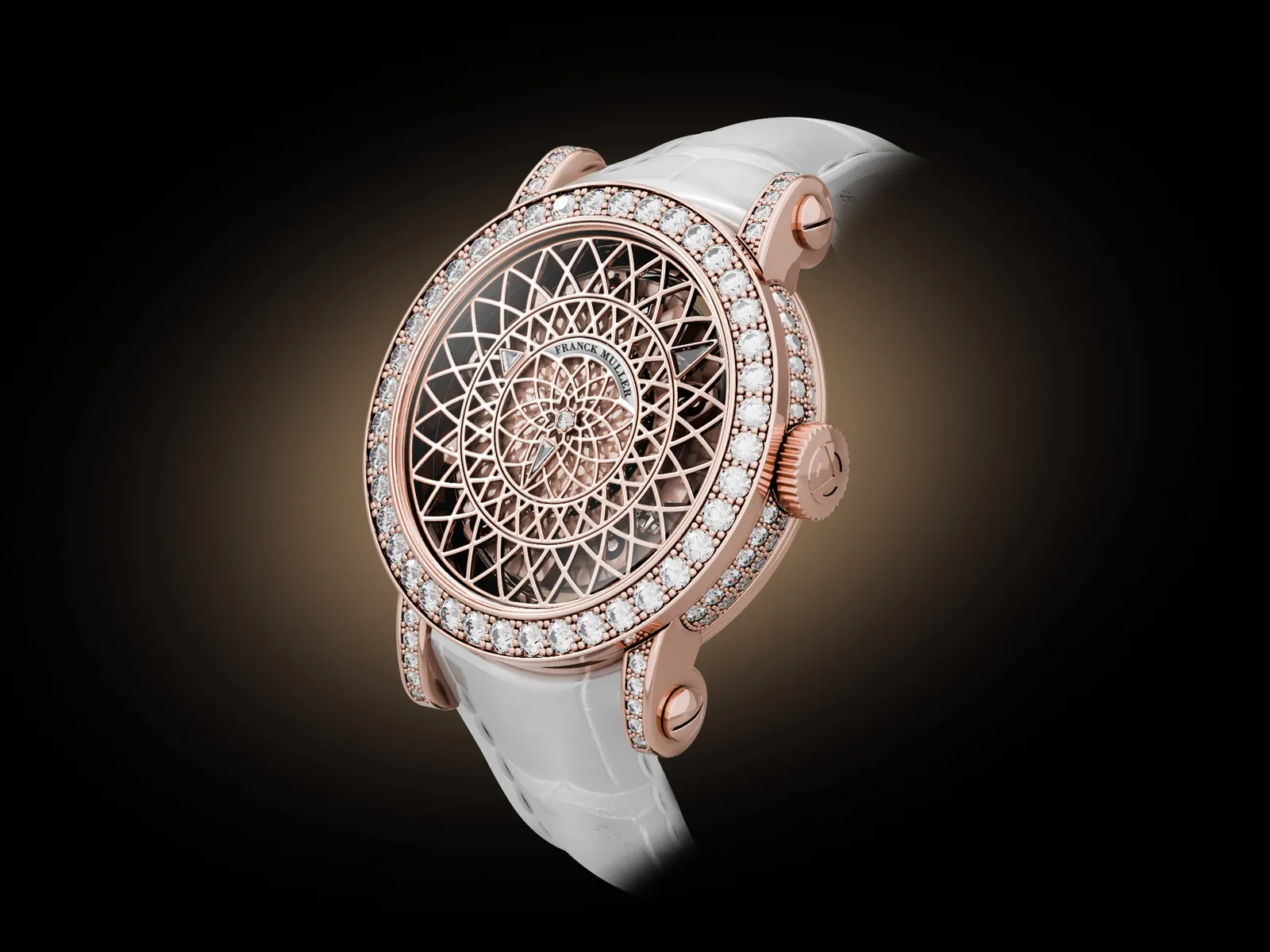
The dial’s diamonds are arranged in a spiral composition, a layout that is functional as much as decorative. The spiral naturally guides the eye toward the three triangular rotating indicators, giving each glance a reading sequence rather than a visual puzzle. The effect is what Franck Muller describes as a celestial choreography: hours, minutes, and seconds each tracing their own continuous arc across the gem-set field.
Without conventional hands, the dial surface floats. The absence of a central pinion, chapters, or applied indices strips the face down to pure kinematics: rotating geometry against a ground of light-scattering stones. This is among the firmest expressions of the maison’s long-standing conviction that time can be shown rather than merely indicated. The Master Jumper Skeleton explored adjacent territory through jumping hours; this piece operates on an entirely different optical register.
Movement & Material Engineering
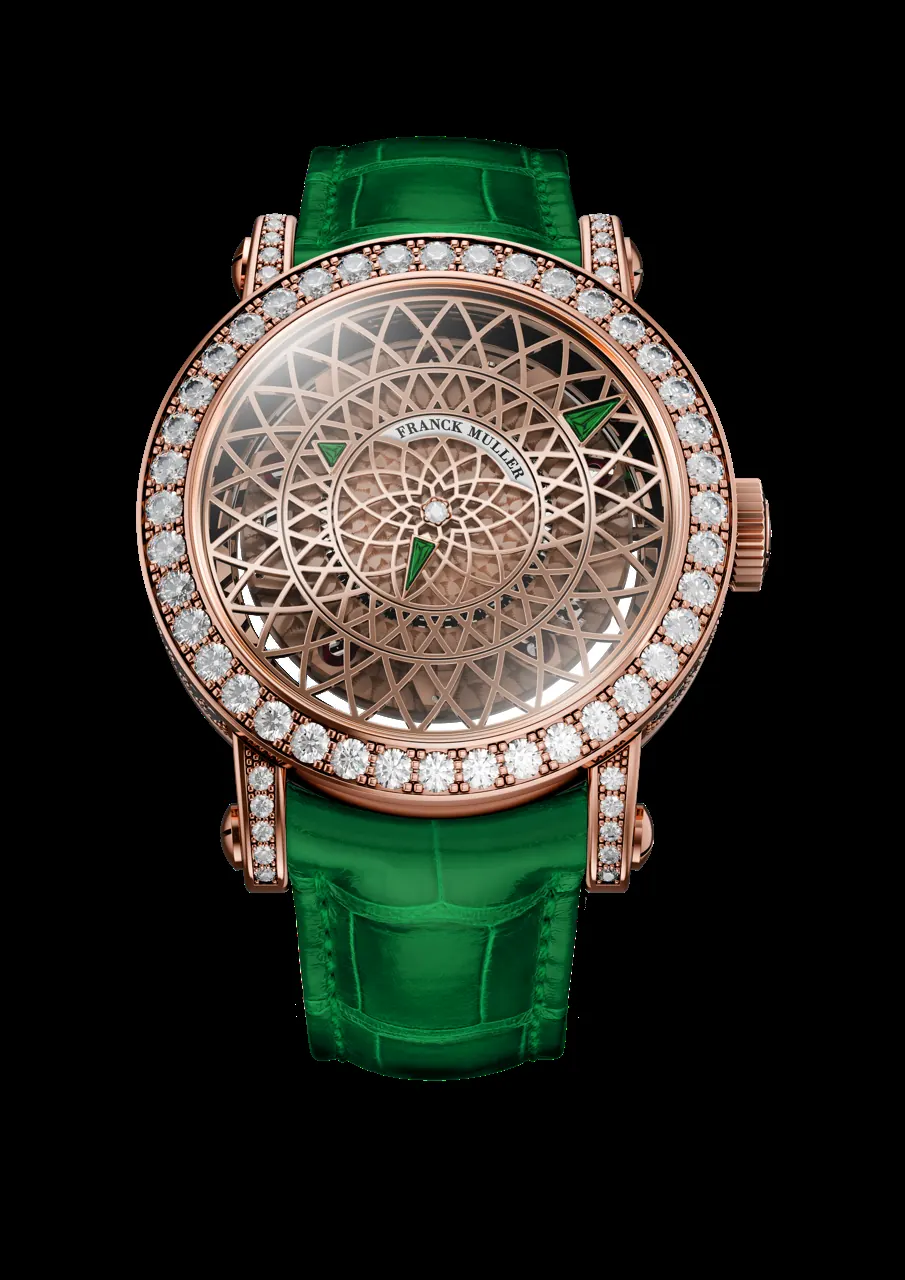
Driving three independent discs from a single automatic movement is not a scaling exercise; it is a structural problem. The seconds disc rotates once per minute, a cadence fast enough to generate meaningful inertial load within a compact 36 mm case. Franck Muller’s engineers resolved this by developing a skeletonised central plate in rose gold: the same material as the case, but hollowed to reduce mass at the most stress-sensitive point in the gear train. Each bridge within that plate measures 0.3 mm in width. At that scale, machining tolerances are measured in microns, and any deviation compromises both aesthetics and mechanical reliability.
The 217-component movement is fully open-worked, every surface visible and finished. Every gear, lever, and barrel is decorated to a standard that recognises the architecture as an exhibition object. The Vanguard Revolution 3 Skeleton demonstrates how consistently Watchland applies this open-heart philosophy across its collections; the Round Triple Mystery Skeleton applies it under the greatest spatial constraint. The entire assembly, including movement, case, and gem-setting, is executed at the Watchland manufacture in Genthod, where Franck Muller has developed world premieres including the first tri-axial tourbillon and the world’s most complex wristwatch ever made.
For the collector who has moved through the Cintree Curvex Gatsby and the broader Franck Muller estate, the Round Triple Mystery Skeleton represents the manufacture at its most uncompromising. Discover the watches shaping the Middle East market. Join our mailing list for ongoing reviews, releases, and collector insights.
Learn more about the Round Triple Mystery Skeleton directly at Franck Muller’s official website.
Frequently Asked Questions
What is the Triple Mystery complication in the Franck Muller Round Triple Mystery Skeleton?
The Triple Mystery uses three independent rotating discs to display hours, minutes, and seconds, replacing conventional hands entirely. Each triangular indicator moves continuously across a diamond-set spiral dial, creating what Franck Muller describes as a hypnotic choreography of time.
What case material and dimensions does the Round Triple Mystery Skeleton use?
The watch is housed in an 18K rose gold round case measuring 36 mm in diameter. The case is entirely set by hand with 3.63 carats of brilliant-cut diamonds and comprises 217 components in total.
How was the skeletonised central plate engineered for the seconds disc?
Engineers at Franck Muller's Watchland manufacture developed a skeletonised central plate in rose gold to achieve the rigidity and minimal weight required by the rapidly rotating seconds disc. Each bridge within the plate measures just 0.3 mm in width, representing a significant precision-manufacturing achievement.
How does the Round Triple Mystery Skeleton differ from earlier Mystery models?
The original Mystery replaced hands with a single rotating disc, while the Double Mystery introduced two discs for hours and minutes. The Triple Mystery adds a dedicated third disc for the seconds, the most technically demanding step in the evolution, requiring an entirely new lightweight open-worked architecture to maintain energy efficiency.
Where is the Franck Muller Round Triple Mystery Skeleton manufactured?
Every component is designed, crafted, and assembled at the Watchland manufacture in Genthod, Geneva, by Franck Muller's engineers and master watchmakers.