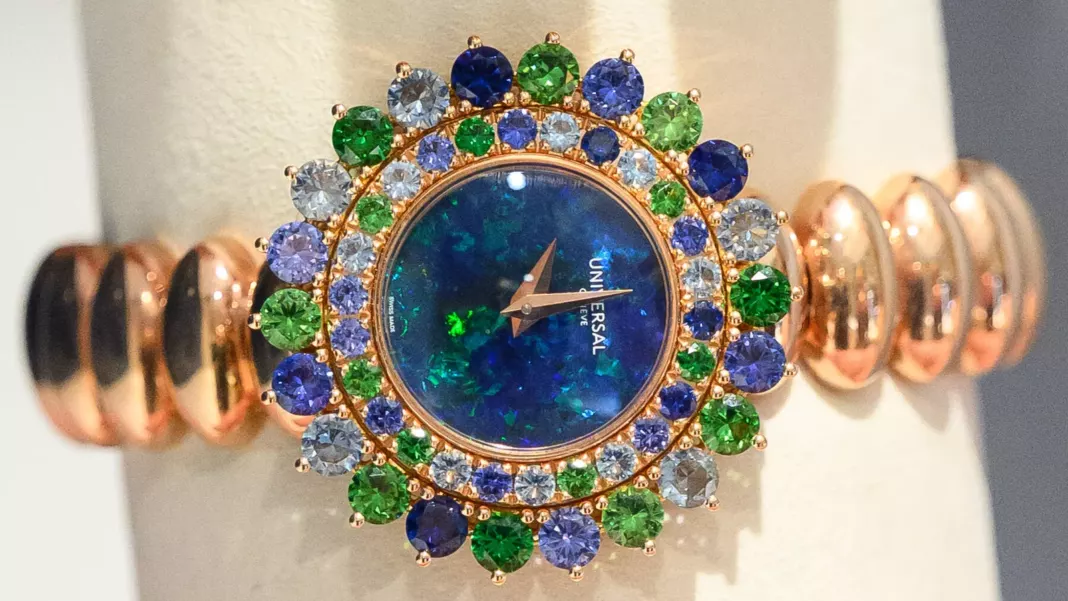

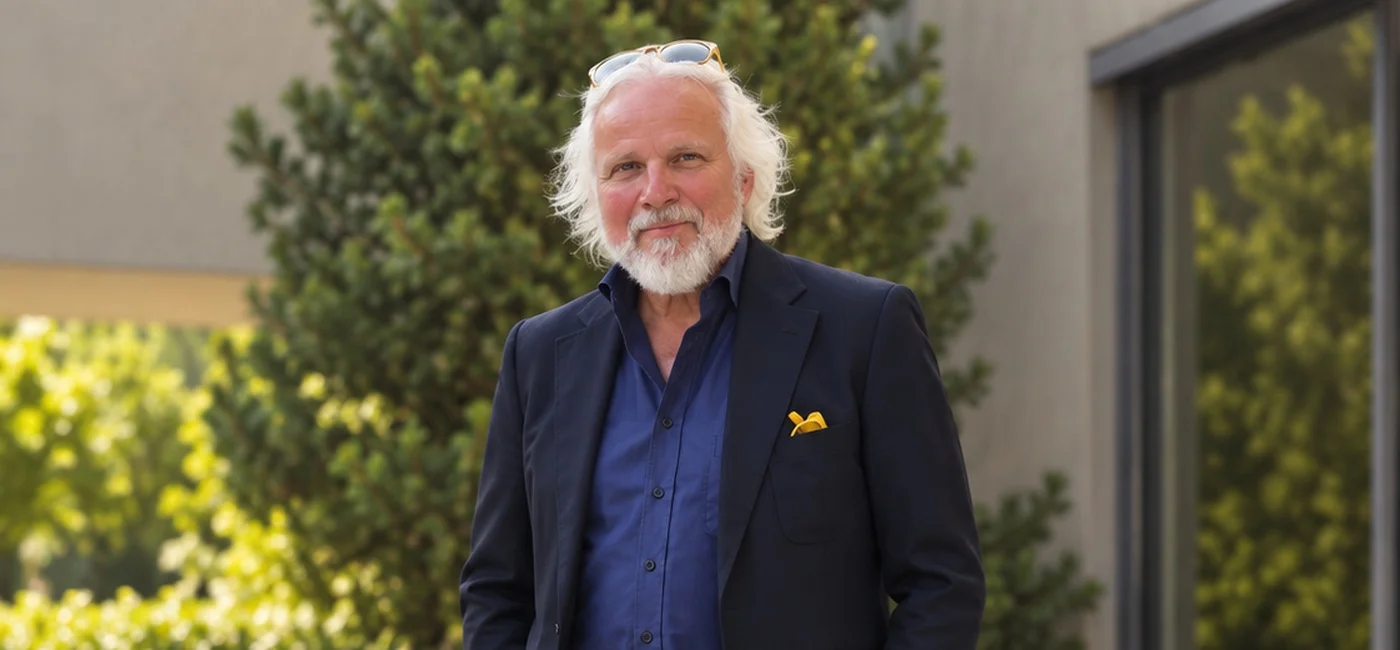
Our Editor-at-Large Isabelle Junod met Lucien Vouillamoz, co-founder of HYT and the inventor of its fluidic technology, at Milano Watch Week.
What the interview reveals: an idea born in 1998, in the preparations for Expo.02, of making a liquid tell the hour; over a decade of research and development that drew on aerospace bellows, microfluidics and a coating developed in San Diego; a first watch, the H1, that won the Innovation prize at the Grand Prix d’Horlogerie de Genève in 2012; trades that did not exist before, practised by operators who train for months; an S1 Titanium that brings the invention to everyday wear; a Conical Tourbillon of 533 components that places fluid alongside the most demanding complications; and a Bespoke Atelier that invites the collector into the conception of the piece.
HYT at a Glance
- The idea dates from 1998 and the preparations for Expo.02; HYT was founded in 2012 at Neuchâtel.
- Conceived by HYT co-founder Lucien Vouillamoz, the fluidic technology is developed and
manufactured by Preciflex SA and protected by seven patents: two immiscible fluids travel through
a glass capillary, and their meeting point indicates the hour. - The H1 received the Innovation Watch Prize at the Grand Prix d’Horlogerie de Genève in 2012.
- The capillary measures 0.8 mm in internal diameter; the module is filled without a single air
bubble, and training the operators and technicians takes several months. - The S1 Titanium carries the 501-CM calibre: 352 components, 4 Hz, 72-hour power reserve.
- The Conical Tourbillon Midnight Blue, a limited edition of eight pieces launched in July 2026,
carries the 701-TC calibre and its 533 components, with a conical tourbillon completing one
revolution every thirty seconds. - The philosophy, in the Maison’s own words: challenge everything.
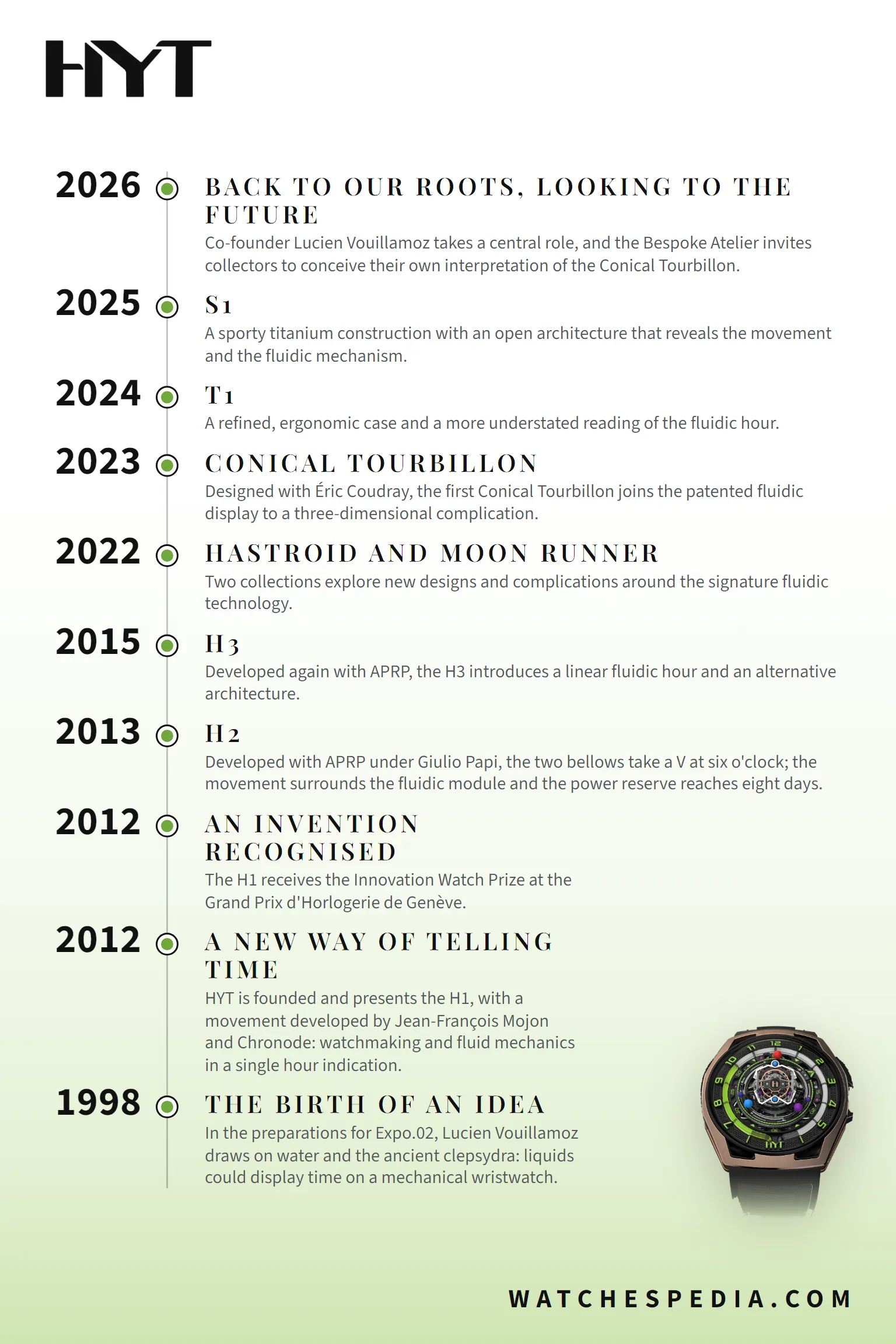
HYT, 1998-2026: Ten Milestones
Time Before the Watch
HYT draws on the clepsydra, the ancient water clock. What fascinates you in it?
What appeals to me is its fundamental simplicity. Long before mechanical watchmaking existed, people had already understood that time could be made perceptible through a physical phenomenon. Water flows, and that flow provides a measure of time. What interested me was always the underlying principle rather than a miniature water clock on the wrist: making fluid the messenger of time. There is something both ancient and, paradoxically, very contemporary about that idea. HYT takes this original intuition and gives it an entirely new expression through mechanics and microfluidics.
Is the subject of HYT the watch, or time itself?
Time itself. The watch is the medium through which we explore the idea. With fluid, the passage of time becomes physically perceptible: the coloured liquid advances, making the time elapsed visible, before returning to its starting point in a retrograde motion. This cyclical dimension matters to me. We no longer simply read the time; we observe it passing. In an HYT timepiece, the mechanics provide the rhythm and the precision, while the fluid gives time a physical presence.
“An invention may begin with one individual, but it only becomes a reality through the contributions of many others.”
From a Swiss Idea to an International Adventure
The idea appeared in 1998, around Expo.02. At what point did you realise it could become an invention?
At first it was an engineer’s question: is it possible? The idea sounds simple when you explain it, but making two liquids circulate through a capillary with the precision an horological indication requires is extraordinarily complex. We had to master pressure, temperature, gravity, the chemical stability of the fluids, water resistance and the interface with a mechanical movement. That is when the intuition became a research programme. It took over a decade of research and development, and several years more to refine it, during which we also had to invent processes and skills that had never existed in traditional watchmaking.
Your research went far beyond Swiss watchmaking. Why was that necessary?
Because not all the answers existed within our industry. We sought expertise wherever it could be found: technologies derived from the American aerospace industry for the bellows, microfluidic expertise, specific research in San Diego to develop a transparent coating for the inside of a capillary that repels aqueous and oil-based liquids equally well, and chemistry, materials science and mechanical engineering in Switzerland and across Europe. HYT is deeply Swiss in its engineering culture and in its watchmaking expression, but the invention emerged from an exchange of knowledge across disciplines and continents. When a solution does not exist in your own field, sometimes you have to look elsewhere.
An Invention, and a Collective Adventure
Your name is attached to the invention, yet you insist on the collective. Why?
Because an idea alone does not make a watch. The H1 and everything that followed are the result of a collective endeavour. Engineers solved microfluidic challenges that had never been approached this way in watchmaking. Watchmakers learned to bring a mechanical movement and a fluidic module together. Designers gave the technology its form. Entrepreneurs, executives, investors and industrial partners were willing to take the risk. Retailers learned how to explain it and, above all, collectors placed their trust in it. Each person made the next step possible. An invention may begin with one individual, but it only becomes a reality through the contributions of many others.
HYT created new techniques, and new trades. Is that also what innovation means?
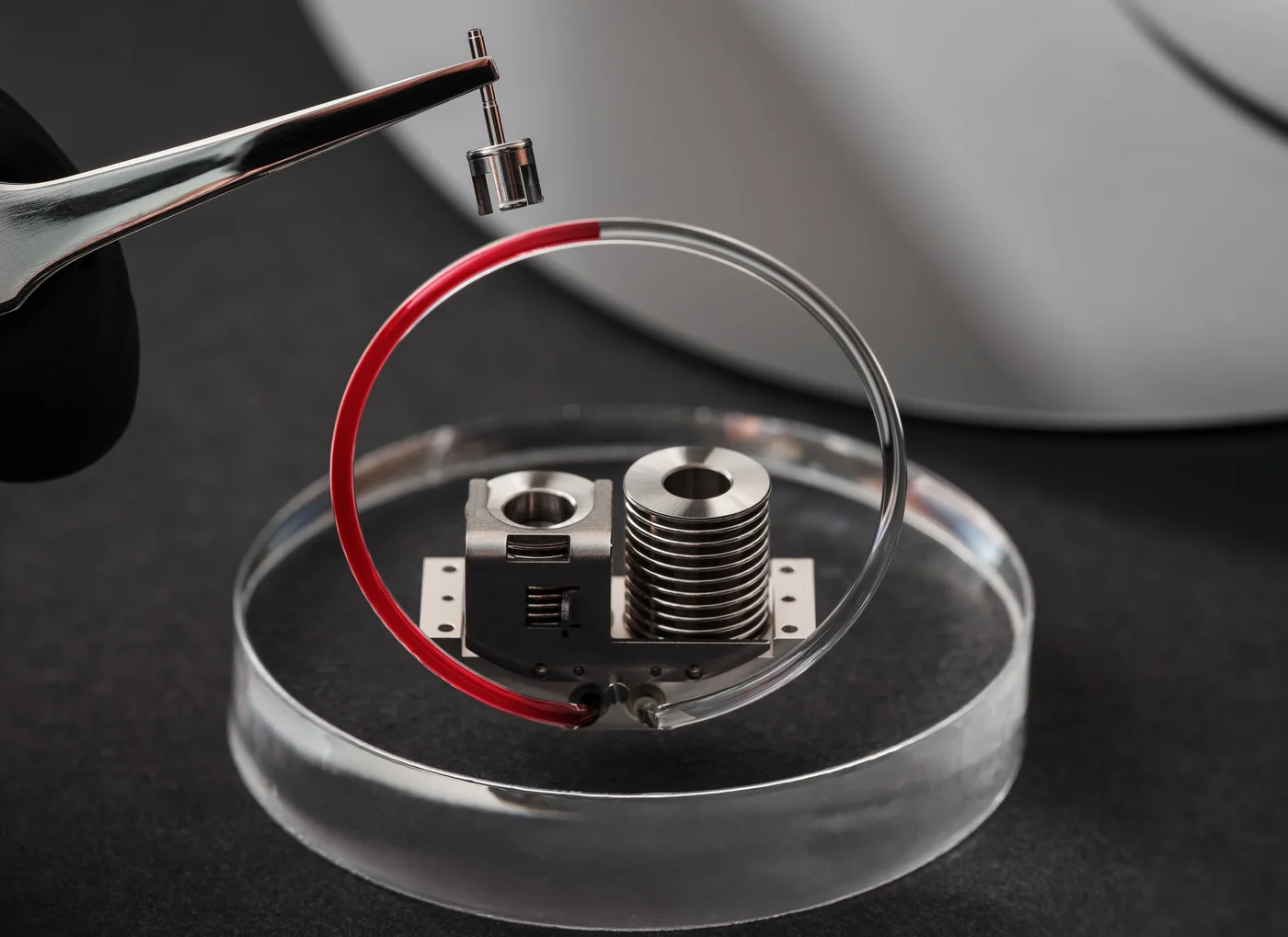
Yes, and I value it because it shows that technology does not replace the hand: it can create entirely new skills. Bending a glass capillary of 0.8 mm internal diameter, applying and inspecting its coating, preparing the fluids and filling the module without a single air bubble all demand highly specialised technique and long training. We estimate several months to train the people behind each watch: the operators, most of them women, and the technicians who produce the fluidic module, as well as the watchmakers who pair that module with the mechanical movement. We had to invent components and machines, and also processes and skills. In a sense, these are new professions within watchmaking.
S1 Titanium: The Invention, Worn Every Day
Images courtesy of HYT
What does the S1 Titanium represent for you?
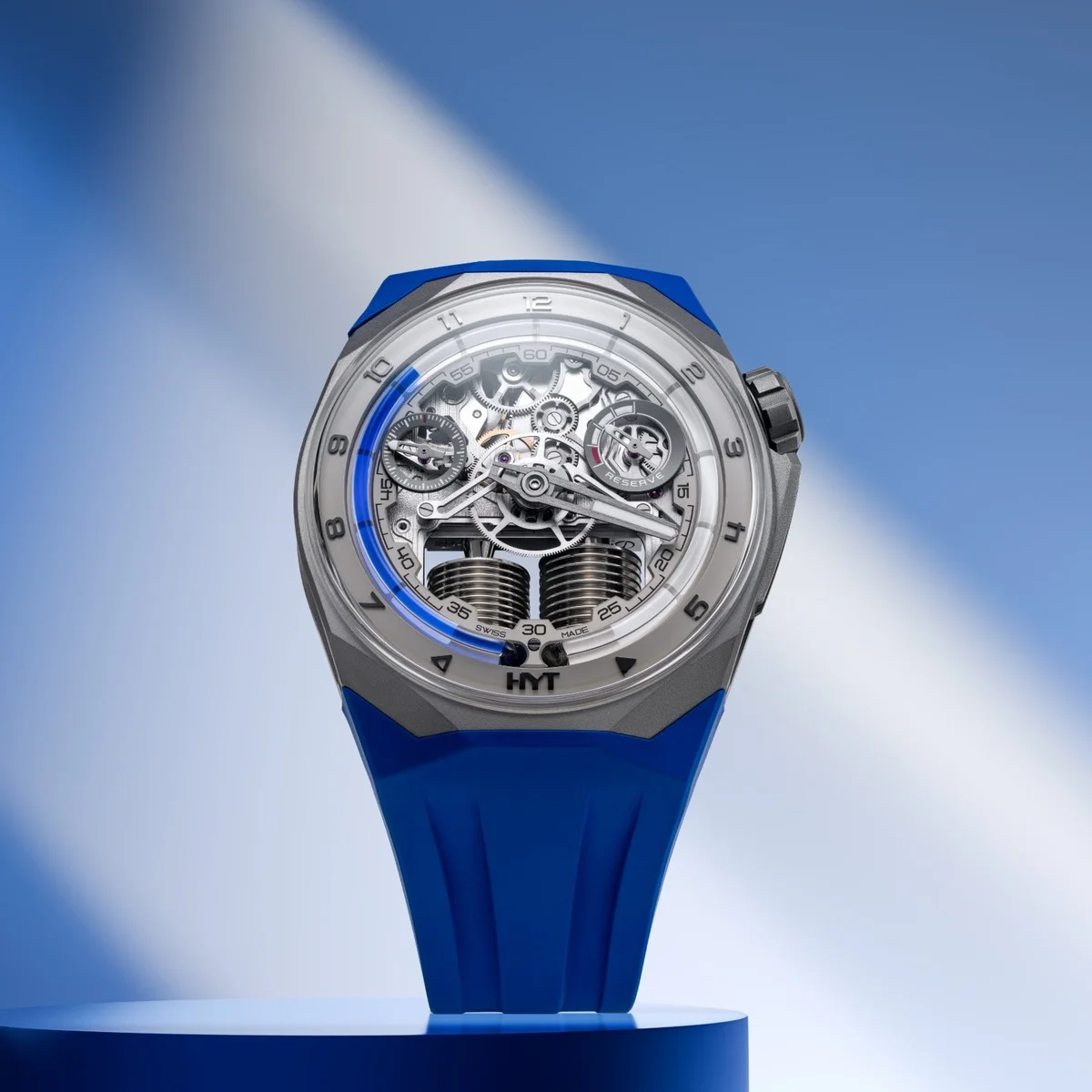
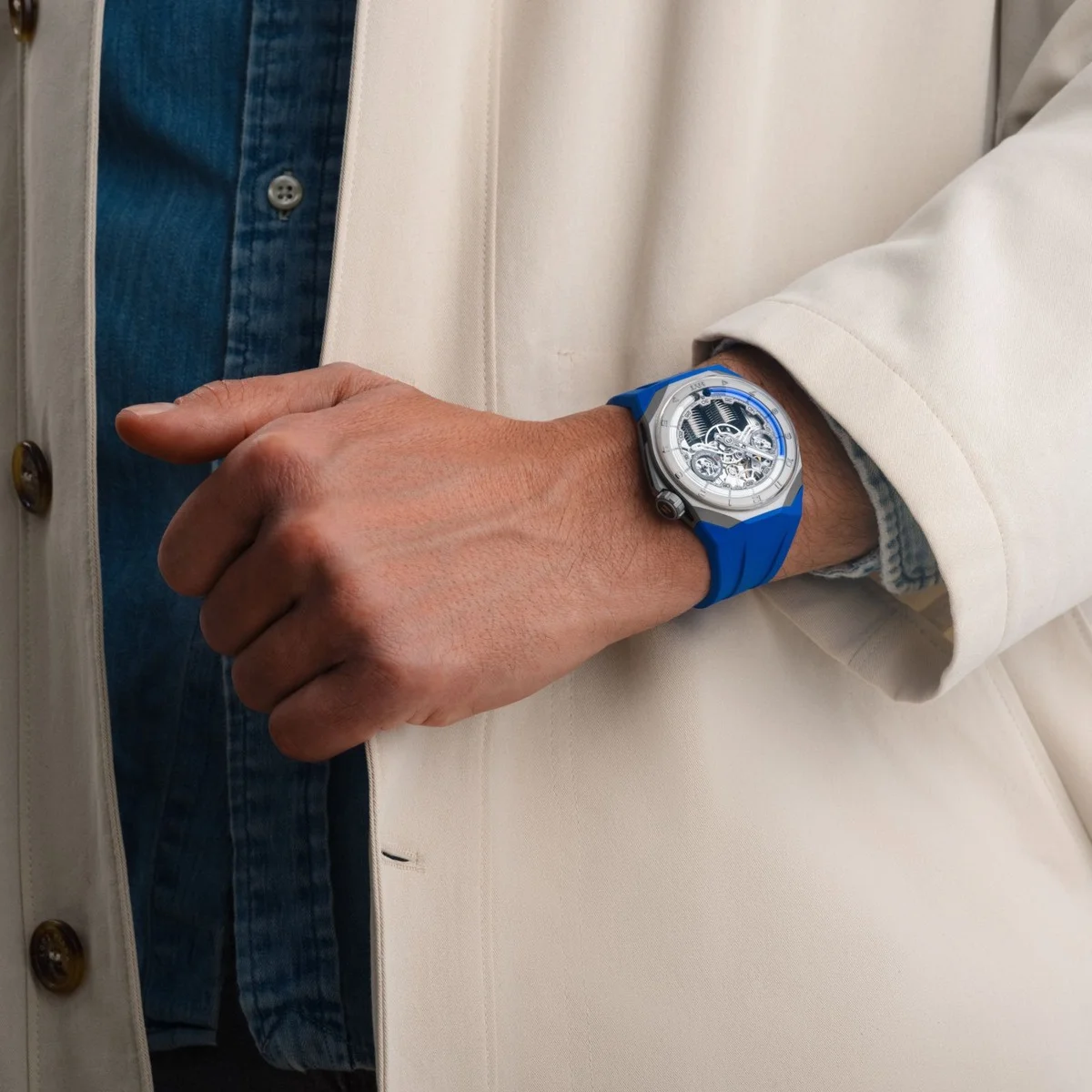
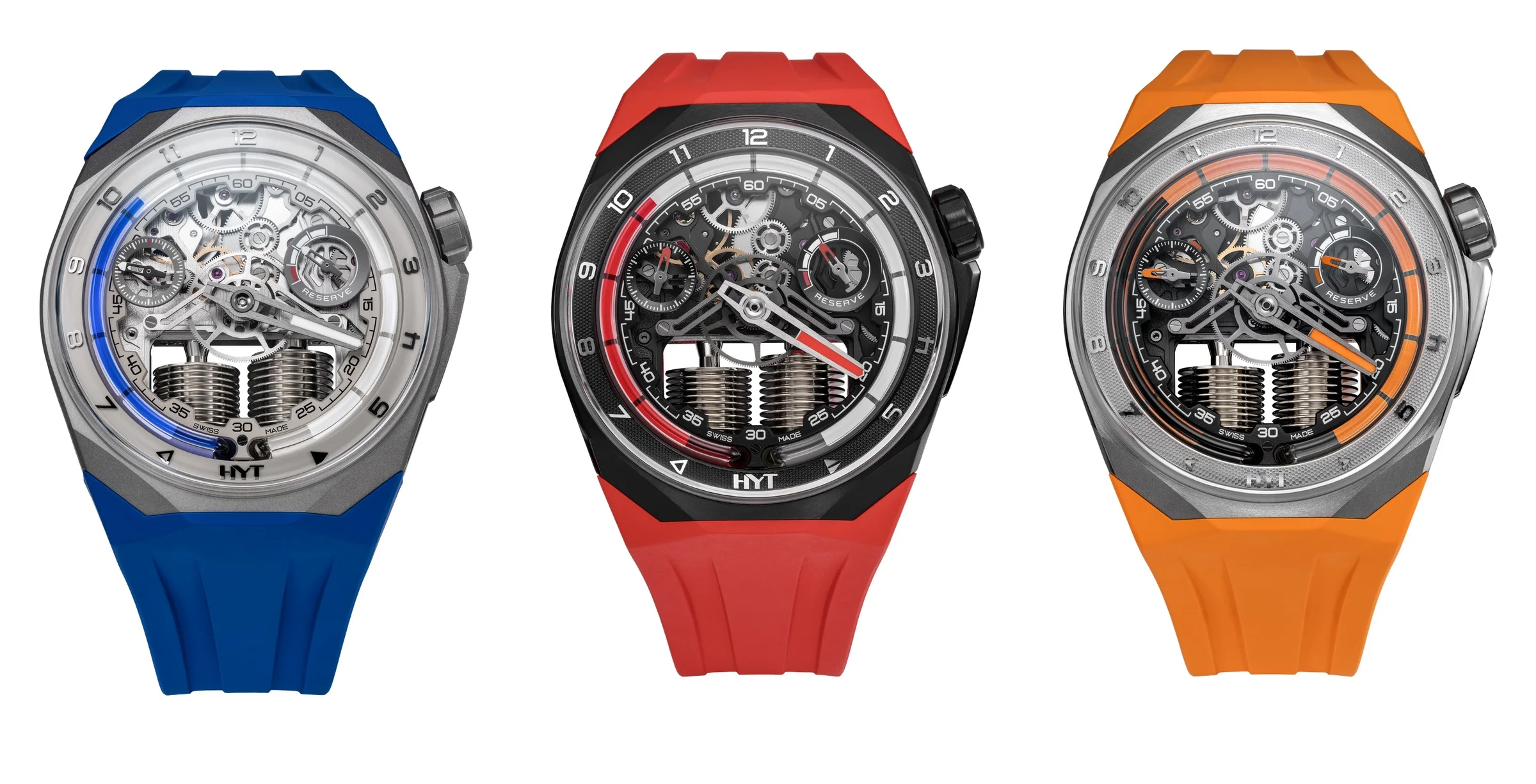
The S1 matters because it shows that our technology is not only to be admired. It can be enjoyed on the wrist, with a sporty character and an open architecture that lets you understand immediately what is happening inside. Titanium brings lightness, while the openworked construction places the 501-CM calibre and the two bellows centre stage. The movement has 352 components, operates at 4 Hz and offers a 72-hour power reserve. What I appreciate most is how clearly the technology can be read: you see the mechanics and the fluid working together.
Colour is prominent in the S1. Is it aesthetic, or is it another way of expressing time?
At HYT, colour is part of the time indication itself, and the fluid carries it. Depending on the interpretation of the S1 Titanium, it brings energy, creates contrast or reinforces a technical aesthetic. We have taken this further with coloured Super-LumiNova applied behind the capillary: it tints the light passing through the transparent fluid and interacts with the hue of the coloured one, giving the two liquids a new relationship by day and by night. Colour serves a watchmaking function above all else.
“Time is ancient. The way we express it can still be entirely new.”
Conical Tourbillon, and the Bespoke Atelier
Images courtesy of HYT
What does the Conical Tourbillon Midnight Blue say about HYT today?
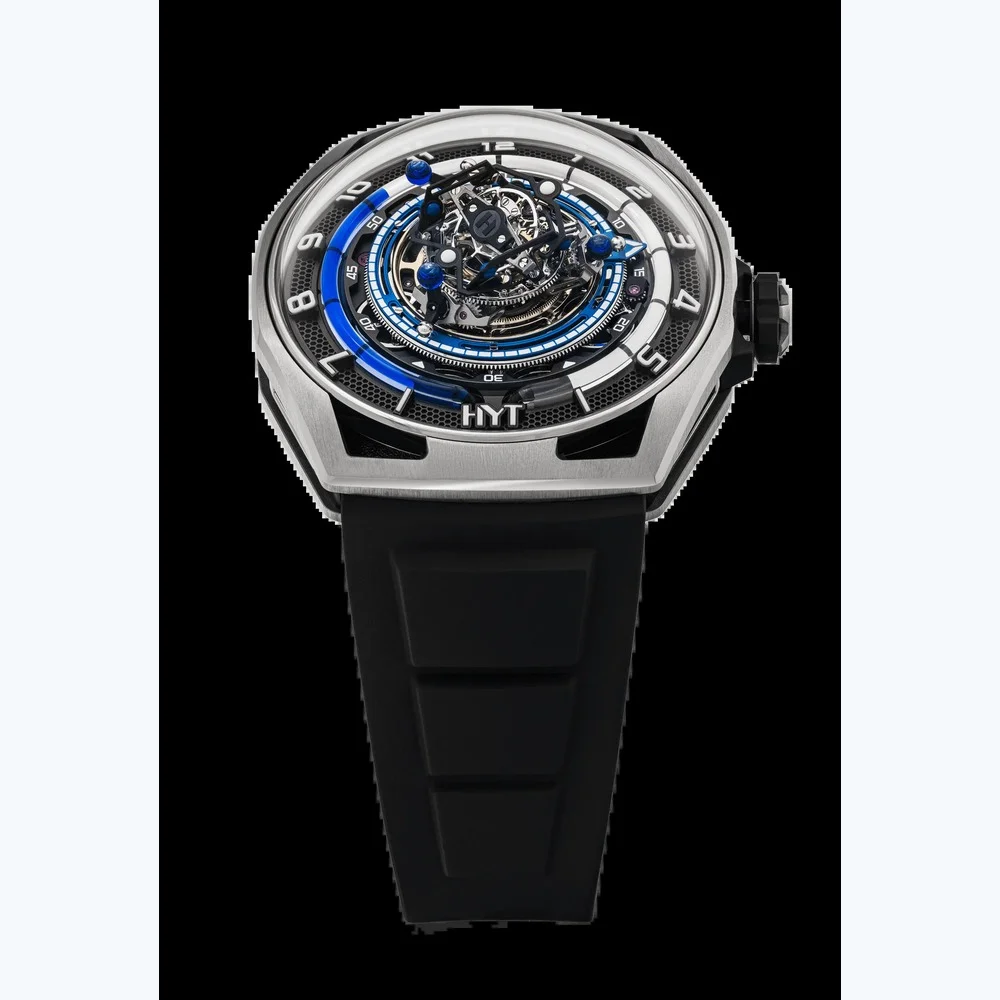
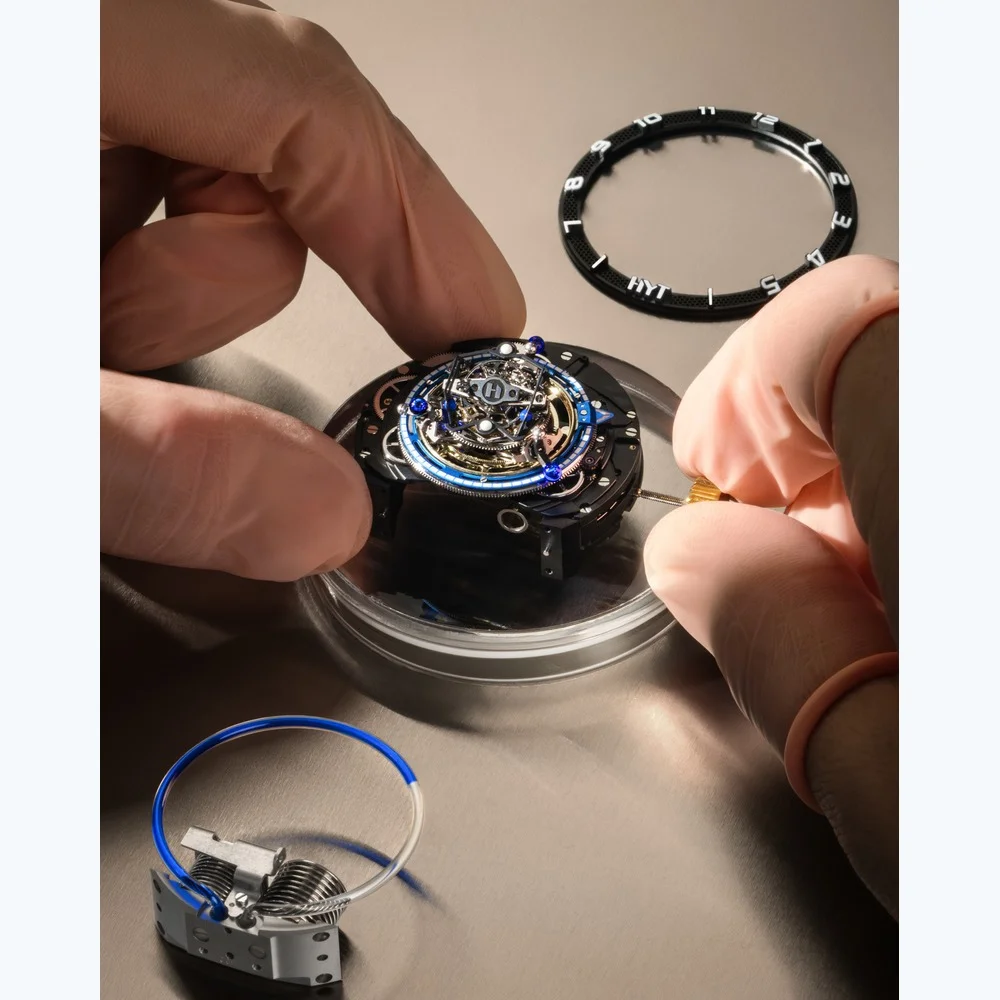
It shows how far our watchmaking language can go when combined with a spectacular complication. The 701-TC calibre has 533 components and places a conical tourbillon at its centre, completing one revolution every thirty seconds. Its balance and hairspring are inclined at thirty degrees, the escape wheel at fifteen and the pallet fork at twenty-three. Around that architecture, three spheres rotate at four, five and six revolutions per minute. And all of it coexists with our retrograde fluidic hour indication. In the Midnight Blue, limited to eight pieces, the blue fluid interacts with 5N gold and black DLC-coated titanium. Fluidic technology has its place within haute horlogerie, alongside its most demanding complications.
Why begin the Bespoke Atelier with that watch?
Because its architecture offers an exceptional canvas. Bespoke should not be a list of options added as an afterthought; it should let collectors take part in conceiving a coherent, personal interpretation of the timepiece. A colour, a material, a stone, a surface treatment or a mechanical detail can become the starting point for a dialogue with our team. The case, the dial, selected visible components of the movement, the rotating spheres and the fluid itself can all contribute. The technology imposes constraints, and within them creativity can travel far. I like the idea that an invention born from one person’s vision can, years later, become the foundation for a collector’s own.
The Next Chapters of Time
As HYT evolves, what must remain?
The very reason the Maison exists. We can evolve in design, complications, materials or the way our timepieces are worn, but we must always remember that HYT was born from the desire to explore a different way of representing time. Fluid is our founding language, and mechanics give it rhythm and precision. That relationship must remain immediately recognisable. If a future creation does not advance our exploration of time, it may be a beautiful piece, but we have to ask ourselves whether it is truly an HYT.
More than twenty-five years after the first idea, are there still new ways to represent time?
I am convinced there are, and that is what makes the subject fascinating. For thousands of years, humanity has used physical phenomena to understand time: flow, movement, light, shadow and matter. Today we have knowledge, technologies and mechanical capabilities that let us revisit these questions from an entirely different perspective. The aim is not to reproduce ancient instruments, but to rediscover the ingenuity of their principles and explore what contemporary watchmaking can do with them. Time is ancient. The way we express it can still be entirely new.
Interview by Isabelle Junod, Editor-at-Large, WATCHESPEDIA.