Key Highlights
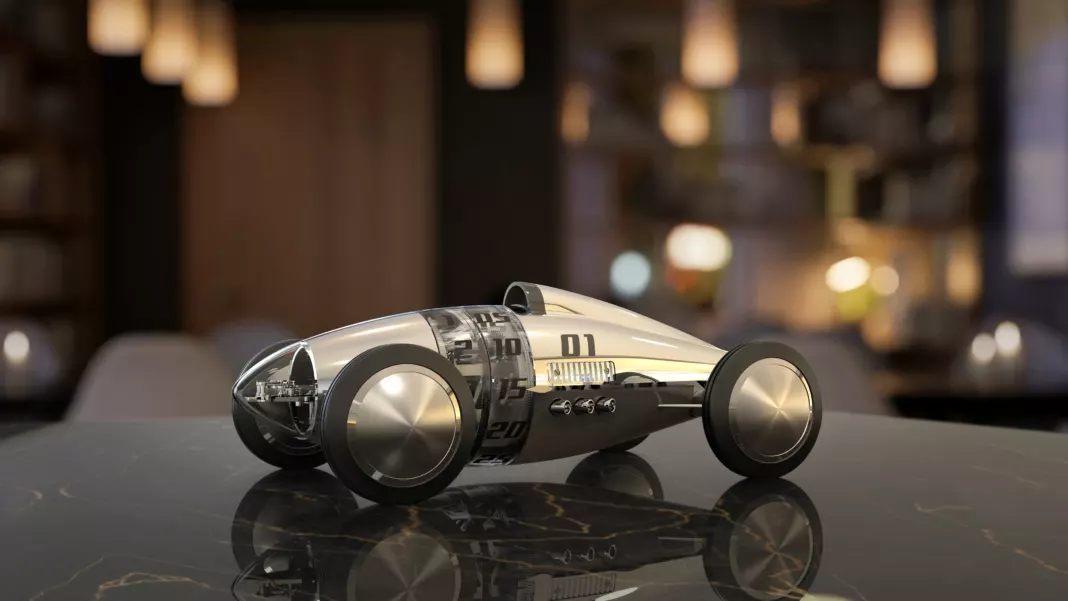
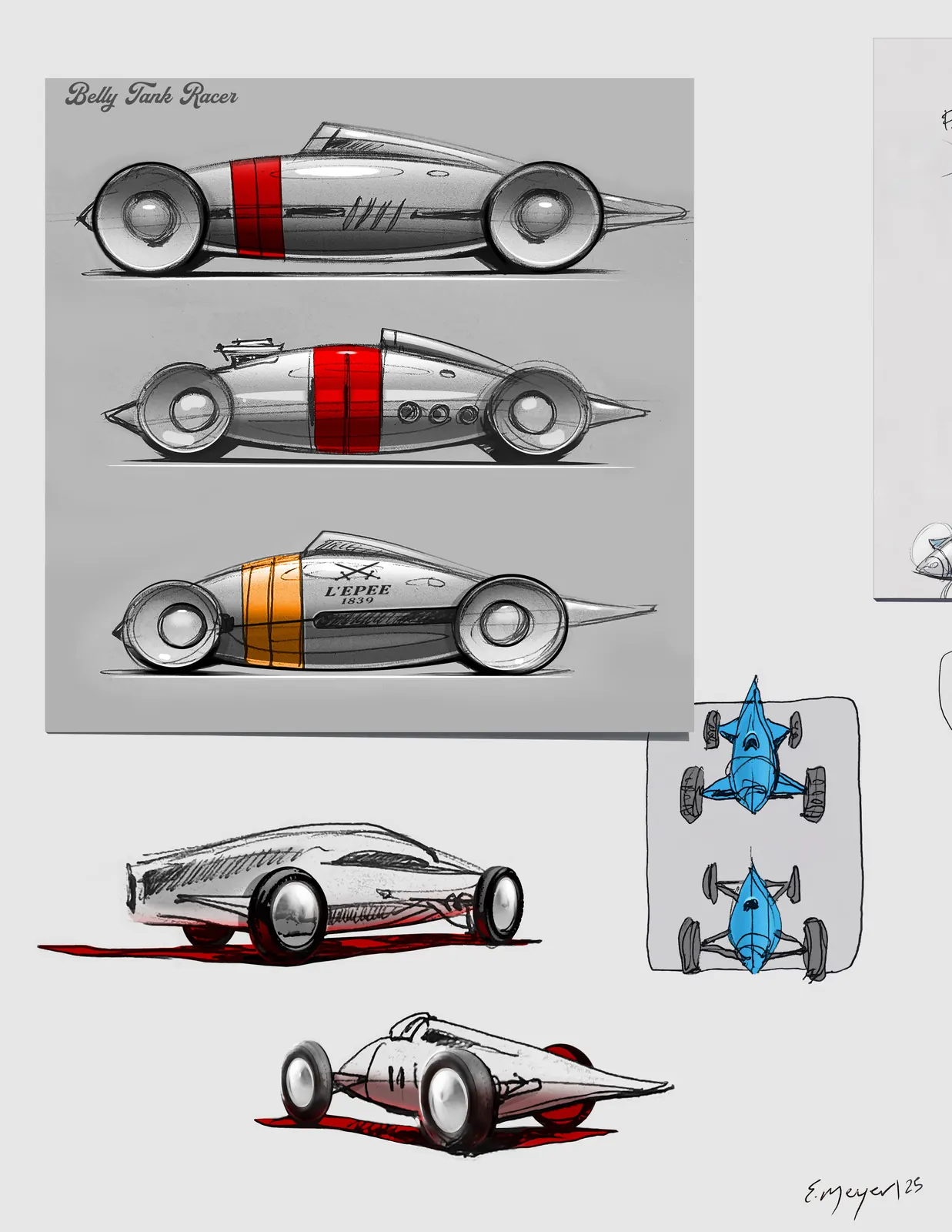
- Designed by Eric Meyer; inspired by WWII aircraft drop tanks repurposed as dry-lake speed racers
- Hours and minutes displayed on two transparent rotating discs integrated into an aerodynamic aluminium body
- In-house L’Epée 1839 movement — 2.5 Hz, 11 jewels, 8-day power reserve, Incabloc shock protection
- Wound by rolling the piece backwards on its rear wheels, mirroring the action of a pullback toy car
- Five colour versions — Blue, Green, Metallic Grey, Red, Black — each strictly limited to 99 pieces
From Drop Tank to Desert Speed Record
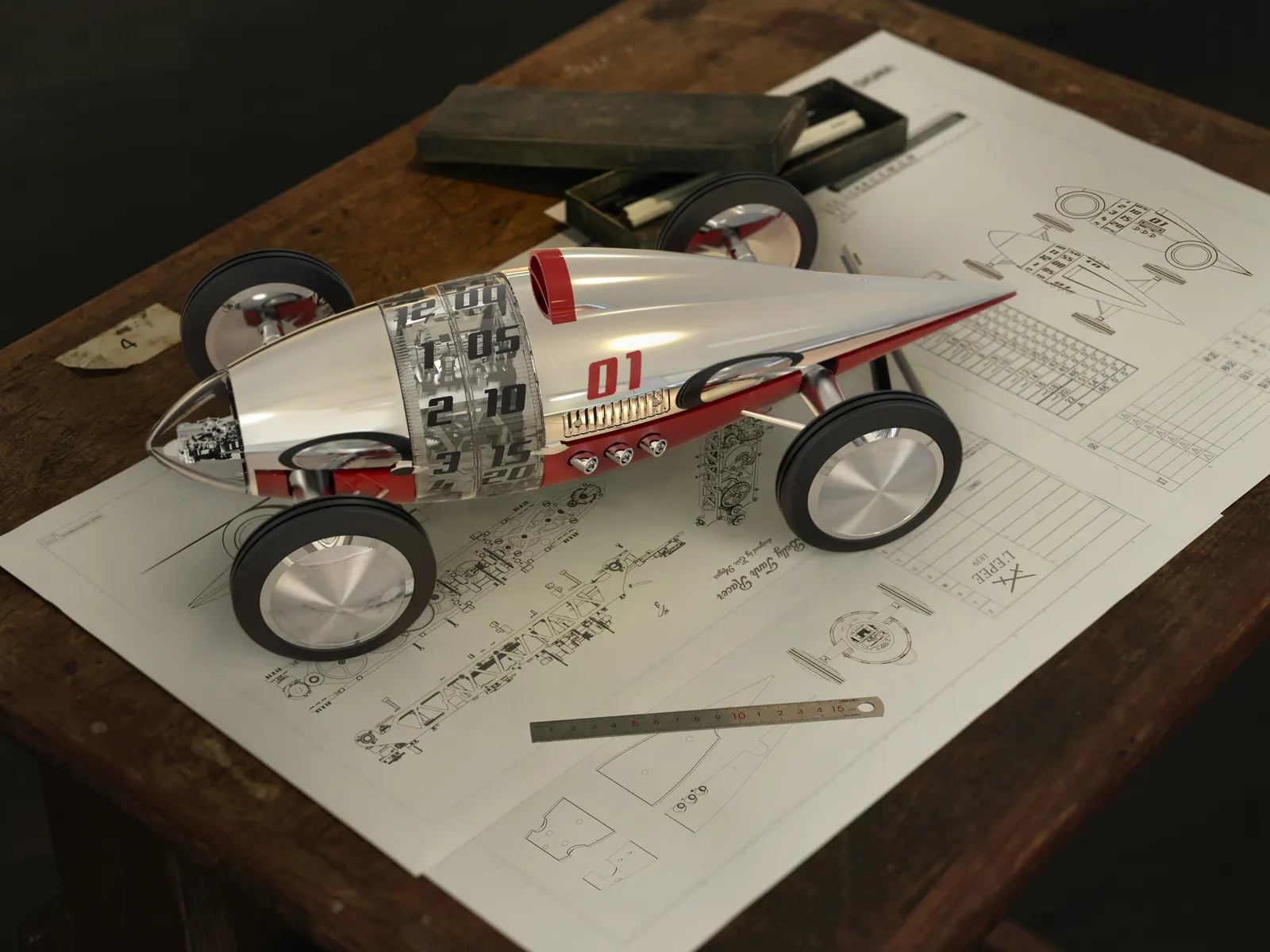
After the Second World War, surplus aluminium belly tanks, the teardrop-shaped external fuel containers carried beneath fighter aircraft, flooded American markets at near-zero cost. Returned pilots looked at those perfectly aerodynamic forms not as scrap but as a chassis waiting to happen. On the dry lake beds of Muroc and El Mirage in Southern California, they split the tanks open, reinforced the shells, and squeezed inside, lying almost flat to merge with the machine’s silhouette. The result was a torpedo-shaped racer that broke 150 mph, then 200 mph; figures that would have been extraordinary for vehicles built with ingenuity rather than industrial budgets.
The philosophy was absolute in its clarity: eliminate the unnecessary, honour the mechanics, let purpose define form. Every element, engine, wheels, steering, streamlined shell, earned its place or was discarded. L’Epée 1839 finds in that ethos a natural mirror of its own manufacture discipline, where each component of a kinetic sculpture serves a mechanical or narrative function. Nothing exists for decoration alone.
The Kinetic Sculpture
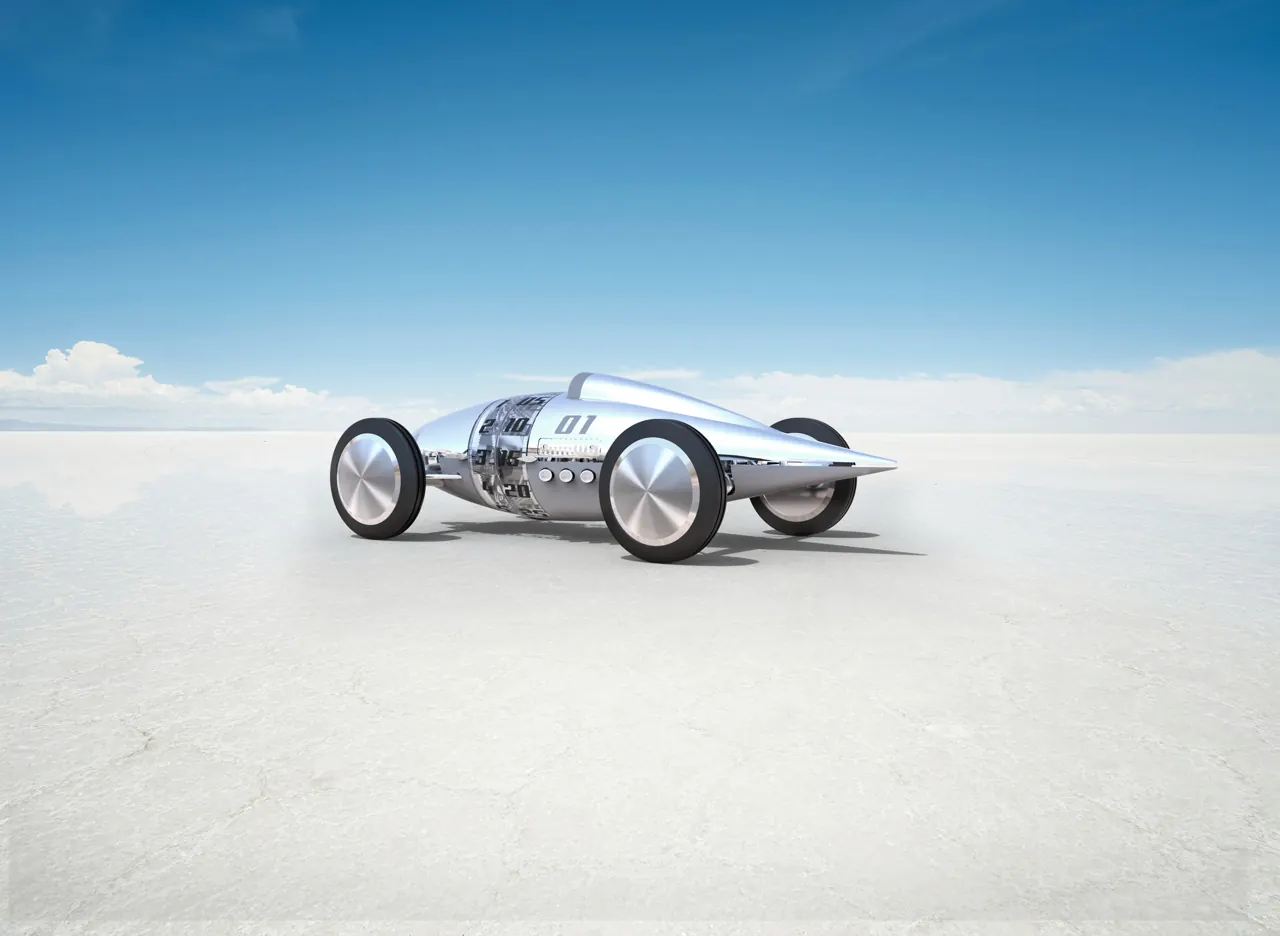
At 420 mm long, 212 mm wide, and 123 mm tall, the Belly Tank Racer occupies a desk the way a period racing car occupies a garage. The upper and lower body are crafted in aluminium, while steel rims carry soft rubber tyres that lend tactile authenticity. Palladium-plated brass, polished stainless steel, and acrylic glass cylinders and dome compose the movement’s visible architecture, finished in a combination of polished, satin, and sandblasted surfaces.
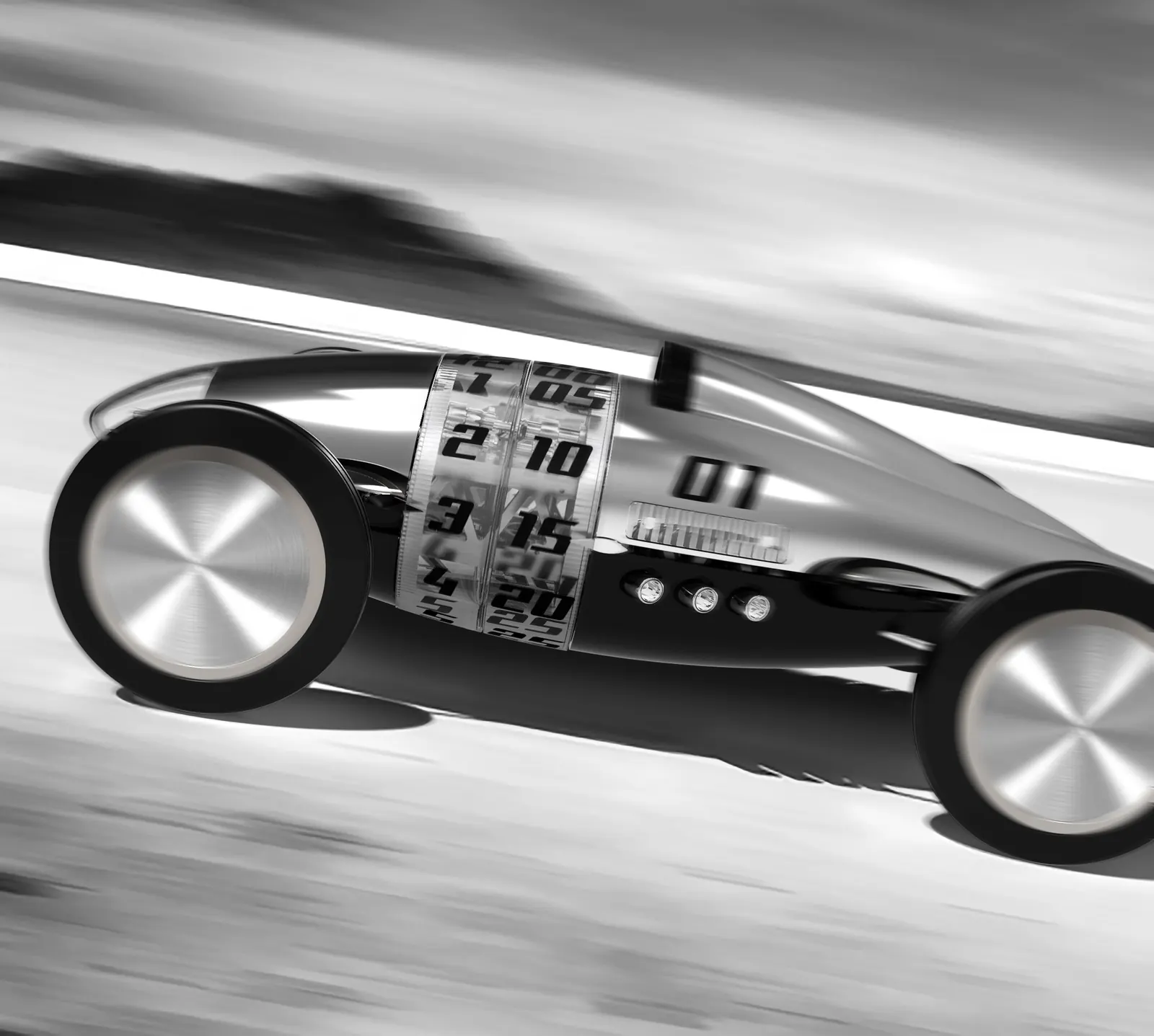
Time is read on two transparent rotating discs that wrap around a central cylinder like racing livery painted directly onto the machine. Hours and minutes glide across the visible movement beneath; every gear and oscillation part of the spectacle rather than hidden behind a dial. At the nose, where airflow would first strike the original racer, L’Epée 1839 positions the escapement. Placed there with evident symbolism, it beats visibly at 2.5 Hz, communicating velocity through the regularity of its swing. On the flanks, a sculpted V6 engine sits beside the driver’s position exactly as it would in the narrow cockpit of a historical streamliner.
The piece weighs 5.4 kg, substantial enough to convey mechanical seriousness and light enough to recall the aluminium efficiency of the originals. Winding requires no key or crown. Pull the Belly Tank Racer backward across a surface; the rear wheels turn and the movement charges, yielding eight days of autonomy from a single session. To set the time, rotate the transparent minute disc upward with a fingertip. Both interactions are direct and tactile, built entirely around the connection between motion and mechanical consequence.
Eric Meyer and the L’Epée 1839 Tradition
The Belly Tank Racer was conceived by Eric Meyer, whose Switzerland-based studio has produced award-winning designs for Nespresso, Swatch Group, Rolex, MB&F, and L’Epée 1839, among others. Meyer’s background in sculpture and fine arts is legible in the object’s composition: the teardrop silhouette reads as a three-dimensional study in aerodynamic form before it reads as a clock.
That duality, art object and precision instrument, sits precisely within L’Epée 1839’s Creative Art collection, where external designers and the manufacture collaborate to produce pieces that surprise collectors conditioned by conventional horology. The release arrives as part of L’Epée 1839’s broader exhibition presence at events such as Watches and Wonders, where the manufacture consistently draws attention to Swiss fine clockmaking through the Fondation Haute Horlogerie‘s global advocacy for the craft.
Why It Matters
The Belly Tank Racer distils a moment in history, post-war resourcefulness transformed into speed, into an object of genuine mechanical poetry. For Middle East collectors seeking pieces that operate beyond conventional watch and clock categories, it offers rarity (99 per colour), a fully in-house movement, and a narrative grounded in one of the most compelling chapters in automotive and aeronautical history. Five colours, one discipline.
Discover the watches and clocks shaping the Middle East market. Join our mailing list for ongoing reviews, releases, and collector insights.
Frequently Asked Questions
How does the L’Epée 1839 Belly Tank Racer get wound?
The Belly Tank Racer is wound by rolling it backward across a surface, which turns the rear wheels and charges the movement. This pullback-toy-car mechanism requires no key or crown and provides an eight-day power reserve from a single winding session.
What inspired the design of the L’Epée 1839 Belly Tank Racer?
The design was inspired by WWII aircraft drop tanks that were repurposed as dry-lake speed racers in Southern California after the war. Pilots used the surplus aluminium belly tanks to build streamlined racing vehicles on the dry lake beds of Muroc and El Mirage, breaking speed records with machines built on ingenuity rather than industrial budgets.
How many colour options are available for the Belly Tank Racer?
The Belly Tank Racer comes in five colour versions — Blue, Green, Metallic Grey, Red, and Black — with each colour strictly limited to 99 pieces.